


If you’re trying to choose your first or next cryptocurrency exchange, you’ve almost certainly narrowed it down to two names: Binance vs Coinbase.
They’re the giants of the industry, but they serve fundamentally different masters. Choosing wrong could mean paying 5x higher fees, missing out on your favorite coins, or, if you’re in the US, signing up for a platform you can’t even use.
I’ve maintained active accounts on both exchanges for years. I’ve tested their fees with real transactions, compared their coin listings side by side, and experienced their customer support (the good, the bad, and the frustrating). Here’s what I’ve learned:
Binance is the global liquidity leader: lowest fees, 400+ coins, and advanced trading tools.
Coinbase is the regulated US on-ramp: beginner-friendly, publicly traded, and FDIC-insured on USD balances.
One isn’t “better”, they’re built for different users.
In this comprehensive comparison, we’ll examine everything: fees (the gap is massive), security (both strong but different), coin selection (Binance wins by miles), regulatory status (critical for US users), and, most importantly, which exchange is right for your specific situation.
Quick Verdict: Which Exchange Should You Choose?
TL;DR for Skimmers
| If you are… | Choose… | Why |
|---|---|---|
| A US beginner making first purchase | Coinbase | Regulated, FDIC-insured USD, simpler interface |
| A global user wanting lowest fees | Binance | 0.1% fees vs Coinbase’s 0.4-0.6% |
| An altcoin hunter | Binance | 400+ coins vs Coinbase’s ~250 |
| A security-focused trader | Both are strong | Different approaches – Binance has SAFU ($1B), Coinbase has public company oversight |
| A US resident wanting derivatives | Neither fully | Binance.US has no futures; Coinbase has limited derivatives via Deribit acquisition |
| A passive income seeker | Binance | More staking options, competitive yields |
| Someone who values regulatory clarity | Coinbase | Publicly traded, SEC-regulated, 80% of US Bitcoin ETF custody |
The 30-Second Answer
Binance wins on fees and coin selection – period. If you’re outside the US and comfortable with a slightly steeper learning curve, it’s the better choice.
Coinbase wins on regulatory safety and beginner experience. If you’re in the US, just starting, or value compliance above all else, start with Coinbase.
Binance vs Coinbase: At a Glance Comparison
| Feature | Binance | Coinbase |
|---|---|---|
| Spot Trading Fees (Base) | 0.10% / 0.10% | 0.40% / 0.60% (Advanced) |
| Simple Buy Fees | ~1-2% with card | 1.5-3% effective (spread + fee) |
| Futures Fees | 0.02% / 0.04% | Limited (via Deribit acquisition) |
| Supported Coins | 400+ (global), ~180 (Binance.US) | ~250 (US), more globally |
| User Base | 275M+ | 110M+ |
| Protection Fund | SAFU ($1B+ USDC) | FDIC insurance on USD ($250K) + crime insurance |
| Regulatory Status | Multi-jurisdiction, ADGM license 2026 | Publicly traded (NASDAQ: COIN), SEC-regulated |
| Beginner Friendly | Moderate (steep learning curve) | Excellent (gold standard) |
| US Availability | Binance.US only (restricted states) | All 50 states (NY fully licensed) |
| Mobile App | Feature-rich, can overwhelm | Clean, intuitive |
| Unique Strength | Lowest fees, massive liquidity | Regulatory trust, FDIC insurance |
| Best For | Active traders, altcoin investors | Beginners, US residents, long-term holders |
Head-to-Head: Detailed Comparison
Fees: The Biggest Difference
This is where the two exchanges diverge most dramatically. Binance is consistently among the lowest-fee exchanges globally. Coinbase is among the highest – especially if you use the simple interface.
Spot Trading Fees
| Exchange | Standard Maker/Taker | With Token Discount | VIP Lowest |
|---|---|---|---|
| Binance | 0.10% / 0.10% | 0.075% / 0.075% (BNB) | 0.011% |
| Coinbase (Advanced) | 0.40% / 0.60% | No token discount | 0.10% / 0.20% (highest tier) |
Simple Buy Fees (Where Beginners Actually Pay)
Here’s where the gap widens even further:
| Exchange | Bank Transfer | Credit/Debit Card |
|---|---|---|
| Binance | ~1% (including spread) | ~2% average |
| Coinbase | 1.5-3% (spread-based) | ~3.99% |
Real-World Cost Example
Buying $1,000 of Bitcoin:
| Method | Total Cost | You Receive |
|---|---|---|
| Binance (Bank Transfer) | ~$1,001 | ~$999 worth |
| Binance (Credit Card) | ~$1,020 | ~$980 worth |
| Coinbase Advanced (Bank) | ~$1,005-1,010 | ~$990-995 worth |
| Coinbase Simple (Bank) | ~$1,015-1,030 | ~$970-985 worth |
| Coinbase Simple (Card) | ~$1,040 | ~$960 worth |
The difference between Binance bank transfer and Coinbase simple buy on a $1,000 purchase is $15-30. Over time, that adds up significantly.
Withdrawal Fees
| Asset | Binance (approximate) | Coinbase (approximate) |
|---|---|---|
| Bitcoin (BTC) | 0.00003 BTC ($1-2) | 0.0001 BTC ($3-5) |
| Ethereum (ETH) | 0.0002 ETH ($0.50-1) | 0.0005 ETH ($1.50-3) |
| USDT (TRC-20) | 1 USDT | 1 USDT (similar) |
| Bank transfer (USD) | Free (ACH) | Free (ACH) |
The Verdict on Fees
Binance wins decisively. For active traders, the fee difference alone can save thousands annually. Even casual users save $15-30 per $1,000 purchase by choosing Binance over Coinbase’s simple interface.
Coin Selection: 400+ vs 250+
Global Comparison
| Exchange | Global | US Version |
|---|---|---|
| Binance | 400+ coins, 1,500+ pairs | ~180 coins (Binance.US) |
| Coinbase | ~250+ (varies by region) | ~200+ (US) |
What This Means in Practice
| Coin Category | Binance Advantage | Coinbase Advantage |
|---|---|---|
| Blue Chip (BTC, ETH, SOL) | Both have them | Both have them |
| Major Altcoins | Wider selection, faster listings | Curated, slower to add |
| New Projects | Launchpad, Alpha access | Rare – must pass strict review |
| Meme Coins | Many listed quickly | Conservative approach |
| Privacy Coins | Limited | Almost none |
| Regional Tokens | Extensive | US-focused |
New Listings Velocity
Binance regularly adds new cryptocurrencies, over 600 perpetual futures alone. Coinbase adds coins slowly after extensive legal review. This protects users from scams but means missing early opportunities.
The Quality vs Quantity Debate
Coinbase’s conservative approach means every listed coin has passed legal review. Binance’s broader selection includes more speculative projects – opportunity and risk in equal measure.
The Verdict
If you want to trade established coins safely, both work. If you’re an altcoin hunter seeking the next 100x, Binance is essential. If you’re a US resident, Binance.US offers fewer coins than global Binance, narrowing the gap.
Security: SAFU Fund vs FDIC Insurance
Two Different Security Philosophies
Both exchanges are secure, but they protect you in fundamentally different ways.
Binance Security
| Feature | Detail |
|---|---|
| Cold Storage | Majority of funds in offline wallets |
| SAFU Fund | $1 billion+ USDC emergency insurance fund |
| Past Incidents | 2019 hack (7,000 BTC) – SAFU covered all losses |
| Proof of Reserves | Monthly Merkle-tree reports |
| User Security | 2FA, device whitelisting, anti-phishing codes |
Coinbase Security
| Feature | Detail |
|---|---|
| Cold Storage | 98% of funds offline |
| FDIC Insurance | USD balances insured up to $250,000 |
| Crime Insurance | Private insurance for hot wallet breaches |
| Past Incidents | 2025 data breach (user metadata, no funds) |
| Public Company Oversight | SEC filings, quarterly audits |
Protection Fund Comparison
| Scenario | Binance Protection | Coinbase Protection |
|---|---|---|
| Exchange hack (funds stolen) | SAFU covers losses | Insurance policy may cover |
| Bank failure (USD deposits) | Not applicable (crypto only) | FDIC up to $250K |
| Your account hacked | Your responsibility (2FA, whitelist) | Coinbase One offers $1M theft coverage |
| Data breach | No fund risk | No fund risk (2025 incident) |
Track Record
| Metric | Binance | Coinbase |
|---|---|---|
| Years operating | Since 2017 | Since 2012 |
| Major fund losses | None (SAFU covered 2019) | None |
| Data breaches | None reported | 2025 third-party incident |
| Regulatory actions | Multiple settlements | SEC case dismissed 2025 |
The Security Verdict
Both exchanges have strong security. Binance’s SAFU fund is a unique advantage – a dedicated $1B+ pool just for user protection. Coinbase’s FDIC insurance on USD is equally valuable for cash holdings.
Your personal security habits (2FA, whitelisting) matter more than the marginal differences between these two.
Regulatory Status: Global Giant vs US Public Company
The Fundamental Difference
This is where the exchanges diverge most sharply. Binance operates globally with a complex regulatory footprint. Coinbase is a US public company with transparent compliance.
Binance Regulatory Status (2026)
| Jurisdiction | Status |
|---|---|
| United States | Binance.US only (separate entity, regulated) |
| European Union | Preparing MiCA compliance |
| United Kingdom | Restricted services (no derivatives) |
| Middle East | ADGM license (Abu Dhabi) |
| Past Issues | Multiple regulatory settlements, now evolving |
Coinbase Regulatory Status (2026)
| Jurisdiction | Status |
|---|---|
| United States | Publicly traded (NASDAQ: COIN), SEC-regulated |
| New York | Full BitLicense, operates in all 50 states |
| European Union | Licensed in multiple countries |
| Past Issues | SEC lawsuit dismissed March 2025 with prejudice |
| Institutional Trust | Custodian for 80% of US Bitcoin ETFs |
What This Means for You
| Your Situation | Regulatory Implication |
|---|---|
| US resident | Coinbase is simpler (all 50 states). Binance.US available but restricted |
| Non-US resident | Binance offers full platform; Coinbase available but fewer features |
| Institutional investor | Both have institutional services; Coinbase leads in US |
| Privacy-focused | Binance historically less data-sharing; both now report to tax authorities |
The 2026 Evolution
Binance has made massive compliance strides, the ADGM license in January 2026 represents a fundamental restructuring into institutional-grade operations. Coinbase resolved its SEC lawsuit and continues as the most regulated US option.
The Verdict
For US residents, Coinbase offers cleaner regulatory standing. For global users, Binance’s compliance improvements make it increasingly acceptable, but its history means some still prefer Coinbase’s public company transparency.
User Experience: Advanced vs Beginner-Friendly
Two Different Design Philosophies
Binance builds for traders. Coinbase builds for everyone. This distinction permeates every interaction.
Binance Experience
| Aspect | Experience |
|---|---|
| First-time user | Overwhelming – dozens of options, multiple interfaces |
| Simple buy | Available but buried; default is trading view |
| Advanced features | Excellent – full charting, order types, bots |
| Learning curve | Steep – requires time to learn |
| Demo account | Yes – simulated trading available |
Coinbase Experience
| Aspect | Experience |
|---|---|
| First-time user | Guided step-by-step, clear explanations |
| Simple buy | Front and center – 3 clicks to purchase |
| Advanced features | Available (Advanced Trade) but separate |
| Learning curve | Minimal – intuitive for beginners |
| Demo account | No – but educational resources (Coinbase Earn) |
The “Hidden” Advanced Mode
Coinbase Advanced Trade exists – with real order books, charts, and lower fees, but many beginners never find it. Binance’s advanced features are front and center, which helps traders but intimidates newcomers.
The Verdict
Coinbase wins for beginners. It’s the gold standard of simplicity. Binance wins for active traders who need professional tools.
If you’re new, start with Coinbase. If you’re experienced, Binance’s interface will feel familiar and powerful.
Mobile Apps: Both Excellent, Different Philosophies
| Feature | Binance App | Coinbase App |
|---|---|---|
| Ease of use | Moderate (many features) | Excellent |
| Simple buy | Available | Front and center |
| Advanced trading | Full features | Limited (desktop recommended) |
| Biometric login | Yes | Yes |
| Ratings | 4.5+ stars | 4.5+ stars |
| Learning curve | Steeper | Gentle |
Both apps are highly rated, but they serve different purposes. Coinbase’s app is cleaner and more intuitive for checking balances and making simple purchases. Binance’s app is more powerful but can overwhelm new users.
Staking and Earning: Competitive vs Conservative
Passive Income Options
| Feature | Binance | Coinbase |
|---|---|---|
| Staking availability | 20+ assets | 10+ assets |
| ETH staking | Yes | Yes (~1.89% APY) |
| SOL staking | Yes | Yes (~5.10% APY) |
| Flexible savings | Yes (variable rates) | No |
| Locked savings | Yes (higher rates) | No |
| Dual investment | Yes (structured products) | No |
| Learn and Earn | No | Yes (small crypto rewards) |
Sample Yields (2026)
| Asset | Binance (approximate) | Coinbase (approximate) |
|---|---|---|
| Ethereum (ETH) | 3-5% | 1.89% |
| Solana (SOL) | 5-7% | 5.10% |
| USDT/USDC | 4-10% (varies) | 4-6% (Auto-Earn) |
| Cardano (ADA) | 3-5% | Not available |
The Verdict
Binance offers more staking options and often higher yields. Coinbase’s offerings are more limited but come with the reassurance of a regulated platform.
For passive income seekers, Binance is the better choice, but yields carry risk, and neither guarantees returns.
Customer Support: The Weak Spot for Both
Honest Assessment
Neither exchange has great customer support. This is the dirty secret of the crypto industry, when things go wrong, getting help is notoriously difficult.
| Aspect | Binance | Coinbase |
|---|---|---|
| Support channels | Chat, email, social media | Chat, email, social media |
| Phone support | No | Coinbase One only |
| Response time | Hours to days (peak) | Hours to days (peak) |
| AI triage | Yes | Yes (frustrating for complex issues) |
| Premium support | VIP tiers | Coinbase One ($29.99/month) |
What Users Report
Common complaints on both platforms include:
- Getting stuck in AI chatbot loops
- Long wait times during market volatility
- Vague “account under review” messages
- Difficulty reaching humans for complex issues
The Verdict
Don’t choose based on support, both are underwhelming. If you need reliable support, consider paying for premium tiers (Coinbase One) or maintaining lower balances so support issues matter less.
Binance vs Coinbase by User Type
Decision Matrix
If you’re a US beginner making your first purchase:
Choose Coinbase. The regulatory clarity, FDIC-insured USD, and simple interface are worth the higher fees. You’ll learn safely, and you can always move to Binance later if you outgrow it.
If you’re a US resident comfortable with trading:
This is tricky. Binance.US offers lower fees and more coins than Coinbase, but fewer than global Binance. Compare the specific coins you want. If they’re on Binance.US, it may be worth the switch. If not, Coinbase’s simplicity still wins.
If you’re a global user (outside US):
Choose Binance. Lower fees, more coins, and full platform access make it the superior choice for non-US residents. The learning curve is worth the savings.
If you’re an active trader:
Choose Binance. The fee difference alone (0.1% vs 0.4-0.6%) will save you thousands over time. Advanced charting tools and order types are essential for active trading.
If you’re a long-term holder (HODLer):
Either works, but consider: Binance’s lower fees matter less if you trade rarely. Coinbase’s regulatory safety might appeal more for long-term holdings. Both are secure, move to hardware wallet either way.
If you’re an altcoin hunter:
Choose Binance. 400+ coins vs 250+ means access to emerging projects months or years before they hit Coinbase.
If you value regulatory peace of mind:
Choose Coinbase. Public company transparency, SEC oversight, and FDIC insurance on USD provide institutional-grade comfort.
If you want to stake and earn yield:
Choose Binance. More options, higher yields, and flexible products. Just understand the risks – yield isn’t guaranteed.
If you need to buy with credit card regularly:
Both work, but fees are high on both. Binance’s 2% average is slightly better than Coinbase’s 3.99%. Better yet, use bank transfers on either.
Quick Decision Table
| Priority | Winner | Why |
|---|---|---|
| Lowest fees | Binance | 0.1% vs 0.4-0.6% |
| Beginner ease | Coinbase | Gold standard simplicity |
| Most coins | Binance | 400+ vs 250+ |
| US regulatory | Coinbase | Public company, FDIC |
| Global access | Binance | Full platform outside US |
| Staking yield | Binance | More options, higher rates |
| Mobile experience | Coinbase | Cleaner app design |
The US Problem: Binance.US vs Coinbase
Critical Context for American Readers
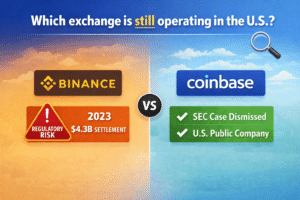
If you’re in the United States, you cannot use the global Binance.com platform. You must use Binance.US – a separate entity with different features.
Binance.US vs Global Binance
| Feature | Binance Global | Binance.US |
|---|---|---|
| Coins supported | 400+ | ~180 |
| Futures trading | Yes (up to 150x) | No |
| Staking | Extensive | Limited |
| Launchpad access | Yes | No |
| Regulatory status | Complex global | Regulated US exchange |
Binance.US vs Coinbase
| Feature | Binance.US | Coinbase |
|---|---|---|
| Coins supported | ~180 | ~200+ |
| Spot fees | Competitive (0.1-0.2% range) | 0.4-0.6% (Advanced) |
| Simple buy fees | Lower than Coinbase | Higher |
| Derivatives | No | Limited (via Deribit) |
| FDIC insurance | No (crypto only) | Yes on USD |
| States served | Most, but restricted in some | All 50, including NY |
The Verdict for US Users
For US residents, the choice is closer than global comparisons suggest. Binance.US offers lower fees but fewer coins than global Binance -and no derivatives. Coinbase offers regulatory peace of mind, FDIC insurance, and availability in all states.
Recommendation
- NY residents: Coinbase only (Binance.US not available)
- Active traders: Compare specific coins, if Binance.US has what you need, its fees are lower
- Beginners: Coinbase’s simplicity wins
- Everyone else: Test both with small amounts
Our Final Recommendation
Summary Assessment
Binance and Coinbase aren’t really competitors – they serve different masters. Binance is built for traders who want the lowest fees and widest selection. Coinbase is built for those who prioritize regulatory safety and simplicity above all else.
The Decision Framework
| Your Profile | Recommendation |
|---|---|
| US beginner, first crypto purchase | Coinbase – Learn safely, pay the premium for simplicity |
| US resident, comfortable with trading | Binance.US if it has your coins; otherwise Coinbase |
| Global user (outside US) | Binance – Lower fees, full platform access |
| Active trader, high volume | Binance – The fee difference is massive |
| Altcoin hunter | Binance – 400+ coins vs 250+ |
| Regulatory peace of mind seeker | Coinbase – Public company, FDIC insurance |
| Want both? | Use both – Coinbase for fiat on-ramp, Binance for trading |
The Bottom Line
There’s no wrong choice between these two. Both are secure, established, and trusted by millions. But they’re optimized for different users.
Match the platform to your priorities, and you’ll be happy with either. Mismatch them, and you’ll pay too much in fees or miss out on coins you want.
Our Personal Take
I use both exchanges regularly:
- Coinbase for my initial fiat deposits (ACH transfers are free, and I appreciate the regulatory clarity)
- Binance for altcoin purchases and active trading (the fee savings add up to hundreds annually)
This “two-exchange strategy” gives me the best of both worlds: Coinbase’s compliance and Binance’s low fees.
Ready to Choose?
👉 Sign Up for Coinbase – Best for US beginners
👉 Sign Up for Binance – Best for global users, lowest fees
👉 Read our Full Binance Review
👉 Read our Full Coinbase Review
Disclosure: This article contains affiliate links. If you sign up for Binance or Coinbase through these links, we may earn a commission at no extra cost to you. We only recommend platforms we’ve personally tested and trust. This comparison is based on independent research and real-world experience with both exchanges.
This comparison was last updated for the 2026 edition. Exchange fees, features, and regulatory status change frequently. Check official websites for current information.
Frequently Asked Questions
Which has lower fees, Binance or Coinbase?
Binance has significantly lower fees - 0.1% spot trading vs Coinbase's 0.4-0.6% (Advanced) and 1.5-3% (Simple). For a $1,000 trade, Binance costs ~$1, Coinbase costs $4-30 depending on method.
Is Binance available in the US?
Yes, but only Binance.US - a separate platform with fewer coins (~180) and no derivatives. Global Binance.com is not available to US residents. Coinbase operates in all 50 states.
Which exchange has more coins?
Binance global offers 400+ coins. Coinbase offers ~250+. For US users, Binance.US offers ~180 coins - closer to Coinbase's 200+.
Which is better for beginners?
Coinbase is significantly more beginner-friendly. Its interface guides users through every step, and educational resources help new users learn. Binance's feature-rich platform can overwhelm newcomers.
Does Coinbase have lower fees than Binance?
No. Binance's fees are lower across the board. Even Coinbase Advanced Trade (0.4-0.6%) is higher than Binance's 0.1% base rate.
Can I stake crypto on both exchanges?
Yes. Binance offers staking for 20+ assets with competitive yields. Coinbase offers staking for major PoS assets with slightly lower yields but regulatory clarity.
Which exchange is better for altcoins?
Binance, by a wide margin. 400+ coins means access to emerging projects months or years before they hit Coinbase.
Is Binance legal in the US?
Binance.US is legal and regulated in most US states. Global Binance.com is not available to US residents.
Which has better customer support?
Neither excels. Both rely on AI chatbots and email with slow response times during peak periods. Coinbase One ($29.99/month) offers priority support.
Can I use both exchanges?
Yes! Many users do: Coinbase for fiat on-ramp (bank transfers, regulatory safety) and Binance for lower fees and altcoin trading.
Which exchange has better mobile app?
Coinbase's app is cleaner and more intuitive for beginners. Binance's app is feature-rich but can overwhelm new users.
Does Binance have FDIC insurance?
No. Binance does not offer FDIC insurance on USD balances. Coinbase does, up to $250,000.
Which is better for day trading?
Binance - lower fees, better charting tools, and more order types make it superior for active traders.
Is Coinbase better than Binance for long-term holding?
Both work, but for long-term holding, regulatory clarity might matter more. Coinbase's public company status appeals to some long-term holders. Either way, move significant amounts to hardware wallet.
What about Coinbase's 2025 data breach?
The 2025 incident exposed user metadata (names, emails) but no funds were compromised. Coinbase enhanced security measures afterward. Binance has never had a data breach but has faced past security incidents (2019 hack, covered by SAFU).
Which exchange has better proof of reserves?
Binance publishes monthly Merkle-tree reports. Coinbase, as a public company, undergoes quarterly financial audits. Both provide transparency, just through different mechanisms.
Can I buy Bitcoin with lower fees on Coinbase?
Only if you use Coinbase Advanced Trade with bank transfers. Even then, Binance's fees are lower. Coinbase Simple Buy is significantly more expensive.
Which exchange is better for DeFi integration?
Binance has its own BNB Chain and broader DeFi ecosystem connections. Coinbase has Base (its L2) and growing dApp support. Both work, but Binance offers more options.
Do both exchanges report to tax authorities?
Yes. Both provide transaction history and tax reports. In the US, both report to the IRS. Your tax liability is your responsibility regardless of platform.
About the Author