Imagine a world where dozens of Layer 2 chains (each built by different companies, serving different users, optimized for different use cases) work together as seamlessly as pages in a single browser. That’s the Optimism Superchain vision: a unified network of interoperable rollups sharing security, governance, and liquidity.
By early 2026, it seemed to be working. Major projects like Coinbase’s Base, Sony’s Soneium, and Uniswap’s Unichain had all adopted the OP Stack. The Superchain processed over 69% of all L2 transaction fees.
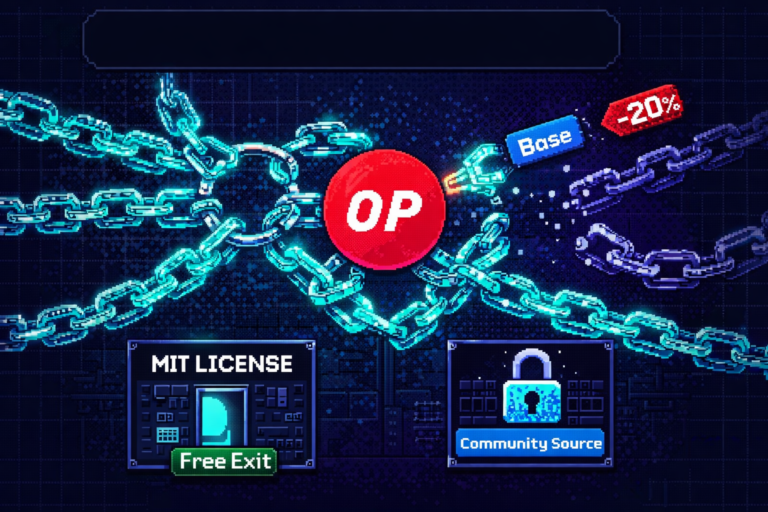
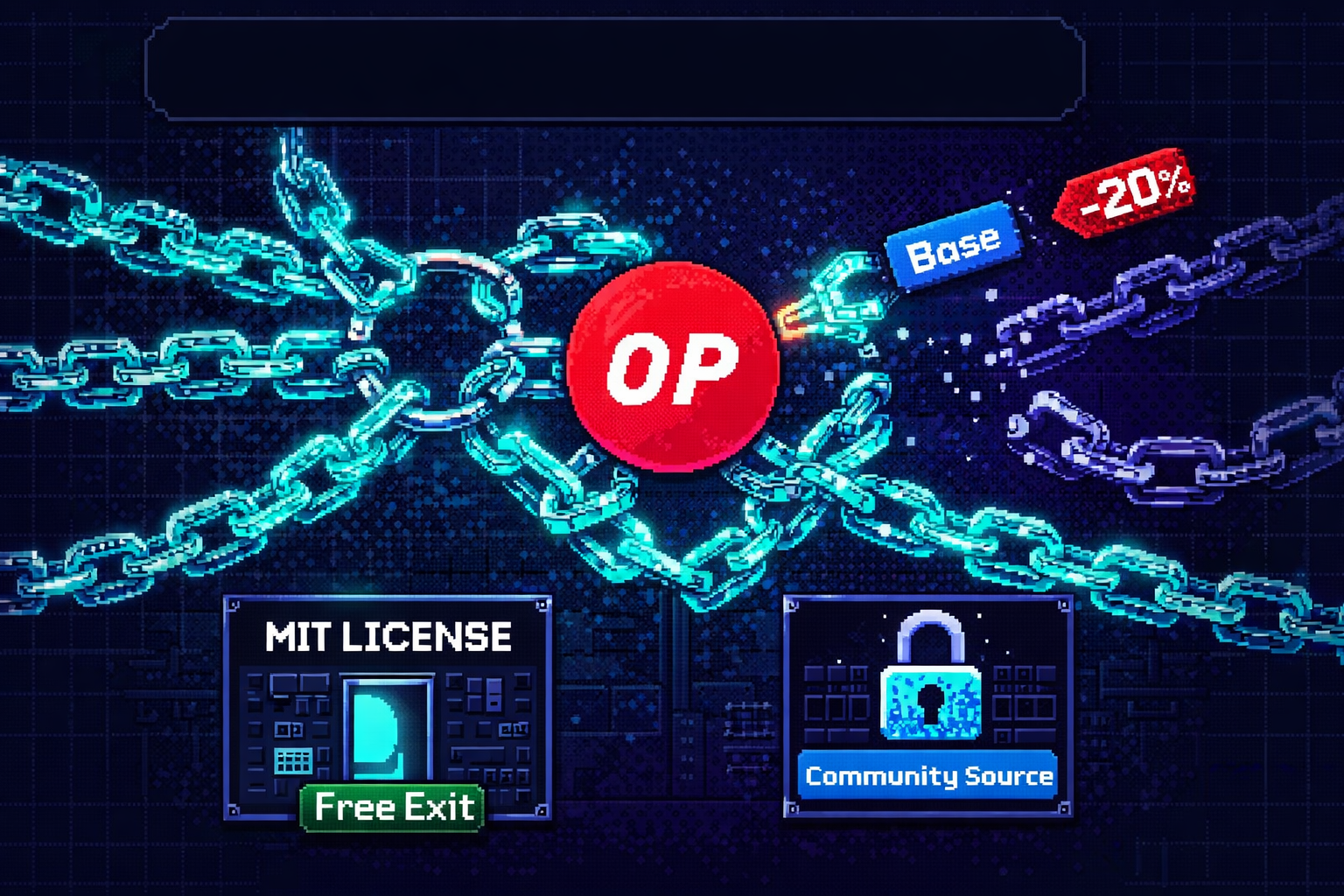
Then, on February 18, 2026, the largest chain in the Superchain announced it was leaving. Base, which alone contributed over 96% of gas fees to the Optimism Collective, would transition to a proprietary codebase. Within 24 hours, OP tokens dropped 20%. The market had just witnessed the fundamental tension in open‑source infrastructure: when there are no barriers to entry, there are also no barriers to exit.
In this guide, Optimism Superchain explained from every angle: how the OP Stack works technically, the economic model that made it the dominant L2 framework, what went wrong with Base’s departure, how it compares to Arbitrum’s approach, and, most importantly, what the future holds for the Superchain in 2026 and beyond.
The Superchain in One Sentence
The Optimism Superchain is a network of interoperable Layer 2 blockchains built using the OP Stack, a modular, open‑source framework that allows chains to share security, governance, and communication protocols while remaining independent.
Here are a few other ways to think about it:
- For developers: The Superchain is a standardized ecosystem where anyone can launch an OP Stack chain with configurable features (sequencer, data availability, rollup type) while inheriting Ethereum’s security and native interoperability with other Superchain members.
- For business audiences: Think of the Superchain as the Android of Layer 2s, an open‑source platform where companies can build their own branded chains, share a common infrastructure, and benefit from network effects.
- For the curious: Imagine if every website you visited shared the same login system, the same payment rails, and could talk to each other seamlessly. That’s what the Superchain wants to be for blockchains.
The Problem the Superchain Solves
The Fragmentation Problem
By 2023, Ethereum’s Layer 2 ecosystem was thriving, but it was also fragmenting. Each rollup operated in its own silo: liquidity was trapped, users needed different wallets and bridges for each chain, and developers had to deploy separate versions of their applications across multiple networks. This was the opposite of the “world computer” vision.
The Superchain Solution
Optimism’s answer was to create a unified framework. If every L2 shared the same underlying technology (the OP Stack), the same bridge contracts, and the same governance standards, they could interoperate natively, without the security risks of third‑party bridges.
The Three Promises of the Superchain
| Promise | Description |
|---|---|
| Shared Security | All chains inherit Ethereum’s security and use the same fault proof system. |
| Native Interoperability | Chains can communicate directly without external bridges; tokens can move seamlessly. |
| Unified Governance | Coordinated upgrades ensure all chains evolve together. |
If successful, the Superchain would solve the fragmentation problem that has plagued multi‑chain ecosystems. Users wouldn’t need to know which chain they were on. They’d just use the Superchain. Developers could deploy once and reach all Superchain users. It was an elegant solution to a messy problem.
How the OP Stack Works: The Technical Foundation
What Is the OP Stack?
The OP Stack is the modular software framework that powers every chain in the Superchain. It’s built in layers, like a computer’s operating system, allowing developers to swap out components while keeping the core compatible.
The Five Layers of the OP Stack
| Layer | Function | Customization Options |
|---|---|---|
| Sequencing | Collects and orders user transactions | Currently single sequencer; planned decentralization |
| Data Availability | Stores raw transaction data on Ethereum | Can be swapped for alternative DA layers |
| Derivation | Processes DA data into execution batches | Determines how blocks are built |
| Execution | Runs transactions to compute state | EVM‑compatible; can be replaced with other VMs |
| Settlement | Verifies state on Ethereum | Uses fraud proofs; can integrate ZK proofs |
How a Transaction Flows
- Users submit transactions to the chain’s sequencer.
- Sequencer orders transactions and batches them.
- Batch is submitted to Ethereum L1 (data availability).
- 7‑day challenge period allows fraud proofs.
- State is finalized if unchallenged.
The Shared Bridge Contract
All OP Stack chains share the same L1 bridge contract on Ethereum. This means tokens sent to any OP Chain have the same security protections, and any node can verify transaction ordering across all OP chains by checking Ethereum timestamps.
What Is the Superchain? The Network of Networks
Beyond Individual Chains
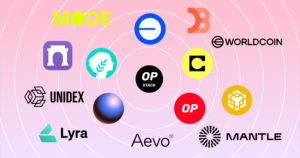
The Superchain isn’t a single blockchain. It’s the network formed by all OP Stack chains that share the unified bridge contract and governance system. Think of it as the “internet” of OP Stack rollups.
Key Superchain Components
| Component | Function |
|---|---|
| OP Stack Chains | Individual L2s built with the framework (OP Mainnet, Base, etc.) |
| Unified Bridging Protocol | Native cross‑chain communication and asset transfers |
| Governance System | Coordinated decision‑making via the Optimism Collective |
| Shared Standards | Common protocols ensure consistency across chains |
How Interoperability Works (in Theory)
Because all Superchain chains use the same bridge contract and store their state commitments on Ethereum, they can verify each other’s transactions. OP Chain A can confirm that a transaction occurred on OP Chain B by checking Ethereum’s timestamps. This shared transaction ordering is essential for native interoperability.
The Interoperability That Never Came
The Superchain’s value proposition was always built on interoperability. Chains joining the Superchain would pay 2.5% of total revenue or 15% of net profit, and in return, they’d receive native cross‑chain communication. Users and liquidity could flow freely between member chains. This was the “network effect” that justified revenue sharing. However, native interoperability was scheduled for early 2025 and never launched.
| What Was Promised | What Was Delivered |
|---|---|
| Native interoperability | Shared brand, shared governance costs |
| Seamless cross‑chain communication | Theoretical future benefit |
| Unified user experience | Revenue obligation without product |
The Economic Model: MIT License and Revenue Sharing
The MIT License Decision
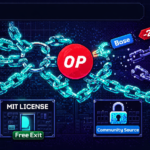
In 2023, Optimism made a defining choice: release the OP Stack under the MIT open‑source license (the most permissive license available). Anyone can take the code, modify it, commercialise it, or even fork it entirely. No royalties, no revenue sharing, no obligations. Not even a requirement to say thank you.
Why Optimism Chose MIT
The logic was simple: if you want to become the default framework, you must eliminate every reason not to adopt you. Reduce onboarding cost to zero, make the protocol uncontroversial, and allow any team with a development budget to launch an OP Stack chain without signing any documents. It worked.
The Superchain Revenue Model
While using the OP Stack is free, joining the official Superchain ecosystem comes with revenue obligations. Members must contribute either:
- 2.5% of total chain revenue, OR
- 15% of on‑chain net revenue (fees minus L1 gas costs),
whichever is higher. In return, members receive: shared governance, shared security, interoperability (theoretically), and the Superchain brand.
The Free‑Rider Problem
The structural weakness of this model is equally obvious: low barriers to entry also mean low barriers to exit. Chains using the OP Stack have limited economic obligations to the Optimism ecosystem. The higher a chain’s profits, the more economically rational it becomes to operate independently. Base’s departure is the textbook case of this dynamic.
The OP Token Buyback Pivot (January 2026)
In January 2026, the Optimism governance community approved a proposal to redirect 50% of Superchain revenue to OP token buybacks for at least 12 months. The buybacks would be executed monthly via over‑the‑counter trading partners. Based on previous Superchain performance, this would have meant roughly 2,700 ETH (about $8 million worth) used for buybacks.
The problem: this revenue model was built on Base’s contributions. With Base gone, the revenue base underpinning the buyback plan no longer exists.
The Superchain Ecosystem: Who’s Building on OP Stack
Major Superchain Projects
| Project | Owner | Focus | Status |
|---|---|---|---|
| OP Mainnet | Optimism Foundation | General‑purpose L2 | Active, $1.5B TVL |
| Base | Coinbase | Consumer, developer‑friendly | Left Superchain Feb 2026 |
| Unichain | Uniswap | DeFi‑focused | Active |
| World Chain | Worldcoin | Identity, global payments | Active |
| Soneium | Sony Block Solutions | Entertainment, digital services | Active |
| Ink | Kraken | General‑purpose | Active |
| Mode | Independent | DeFi | Active |
The Concentration Problem
Despite having 34 chains live on mainnet by mid‑2025, the Superchain was effectively a one‑chain ecosystem. In the first half of 2025:
- Base contributed 96.5% of all gas fees to the Optimism Collective
- World Chain accounted for 11.5% of computation
- OP Mainnet itself for 11.4%
- Ink, Soneium, and Unichain together contributed less than 13%
During their partnership, the Collective received about 14,000 ETH in total lifetime revenue. Base contributed 8,387 ETH of that. In the months before departure, Base’s monthly revenue share approached 100%.
The Economic Reality
Beyond its name, the Superchain had become Base’s ecosystem. The alliance was real on paper, but economically it was entirely Base. When your largest member generates nearly all the revenue, you don’t have an ecosystem, you have a landlord‑tenant relationship.
The Base Departure: What Happened on February 18, 2026
The Announcement
On February 18, 2026, Coinbase’s Base chain announced it would transition from the Optimism OP Stack to a proprietary unified codebase. The new architecture would integrate key components, including the sequencer, into a single repository while reducing external dependencies on Optimism, Flashbots, and Paradigm.
The Technical Rationale
Base’s engineering team stated that the shift would increase annual hard fork frequency from three to six times, effectively speeding up upgrades. Independent control of the security council meant no external body could delay or block network decisions. Reducing dependencies would allow Base to keep pace with Ethereum’s own upgrades without waiting for governance processes it didn’t control.
The Market Reaction
The market responded immediately: OP dropped over 20% within 24 hours, with selling volume surging 157%. Within days, the token was down 89.8% from a year ago, standing at just $0.12 at the time of writing (compared to a high of $4.85 in March 2024).
Arbitrum’s Response
Within hours of Base’s announcement, Arbitrum co‑founder Steven Goldfeder posted on X: “If a stack allows for profit without contribution, this will eventually happen.” Goldfeder noted that despite pressure to release Arbitrum’s code as fully open‑source, his team had deliberately chosen a different path years ago: the “community source” model, where external chains using Arbitrum’s technology must contribute revenue.
What Was Lost
At the time of Base’s departure, the chain contributed approximately $55 million in profit in 2025 alone – more than all other Superchain members combined. The revenue base that underpinned the OP buyback plan no longer existed. OP Labs CEO Jing Wang described it as “a blow to short‑term on‑chain revenue.”
Why Base Left: Technical, Economic, and Strategic Factors
The Official Reason: Technical Autonomy
Base’s stated reason was technical: unifying the codebase meant faster development (6 major upgrades per year vs 3), independent security council control, and the ability to keep pace with Ethereum upgrades without waiting for external governance. These are real benefits, coordinating across multiple codebases is slower than controlling your own tech stack.
The Unstated Reason: Value Capture
There was another reason, left unstated in the announcement. Morgan Stanley estimated that a Base token could bring Coinbase about $34 billion in equity value and raised its price target to $404. As long as Base was paying 15% of its net profit to the Collective of an external protocol, designing a Base token with reliable value capture mechanisms was structurally difficult. Leaving the Superchain was a prerequisite, not a side effect.
The Interoperability Failure
Perhaps the most important factor: native interoperability never launched. The Superchain’s value proposition was that members would pay for access to a unified network, but that network never materialized. A longtime governance delegate stated: “Despite years of technical development, unfortunately, this was not achieved.”
| What Base Paid | What Base Received |
|---|---|
| 15% of net profit | Shared brand |
| ~8,387 ETH in total | Shared governance costs |
| ~96% of Collective revenue | A theoretical interoperability benefit that never arrived |
The Rational Decision
In any alliance, there comes a point where the strongest participant asks the obvious question: what am I actually getting out of this? By January 2026, the answer was clear: Base was paying almost all the revenue and receiving almost nothing in return. When your largest partner can leave without legal consequences, the alliance’s survival depends entirely on its willingness to stay. Base decided it was no longer willing.
Optimism vs Arbitrum: Two Models of L2 Sustainability
The Fundamental Difference
Optimism and Arbitrum, the two leading optimistic rollup ecosystems, have taken radically different approaches to economic sustainability. Their divergence reflects a fundamental question: how do you build infrastructure that lasts?
Optimism’s Model: Openness and Network Effects
| Feature | Optimism’s Approach |
|---|---|
| License | MIT – fully open source, no restrictions |
| Revenue sharing | 2.5% of revenue or 15% of net profit for Superchain members |
| Exit cost | Low – chains can leave without legal penalty |
| Adoption speed | Fast – Base, Unichain, Sony, Worldcoin all adopted OP Stack |
| Vulnerability | Free‑rider problem; largest members may leave |
Arbitrum’s Model: Community Source
| Feature | Arbitrum’s Approach |
|---|---|
| License | Community source – code public but commercial use outside ecosystem requires contribution |
| Revenue sharing | 10% of protocol revenue for chains settling outside Arbitrum ecosystem |
| Exit cost | High – leaving means losing revenue contribution and ecosystem benefits |
| Adoption speed | Slower – enterprise adoption requires negotiation |
| Sustainability | ~20,000 ETH accumulated in DAO treasury |
The Trade‑offs Summarized
| Dimension | Optimism’s Approach | Arbitrum’s Approach |
|---|---|---|
| Adoption speed | Maximized (MIT license, zero barriers) | Moderated (contract‑based) |
| Ecosystem cohesion | Lower – chains can leave | Higher – exit costs create alignment |
| Sustainability | Relies on network effects and voluntary contribution | Direct revenue stream from Orbit chains |
| Developer freedom | Maximum – anyone can fork and modify | Moderate – commercial use requires contribution |
| Risk | Largest member can leave (Base) | Slower growth; institutional friction |
The Fundamental Insight
Optimism’s model optimized for rapid adoption, and it worked. It won the standards war, becoming the default infrastructure for L2 scaling. But it also eliminated barriers to exit. When your largest partner can leave without legal consequences, the alliance’s survival depends entirely on its willingness to stay. Arbitrum saw this logic clearly and made a different choice: enforce economic alignment from the start, even if it meant slower growth.
Lessons from Open Source History: Linux, MySQL, and WordPress
The Recurring Pattern
The tension between Optimism and Base is not new. Open‑source software has grappled with this exact dynamic for decades.
Linux and Red Hat: The Services Model
Linux is the most successful open‑source project in history. The Linux kernel is fully open under the GPL license. However, the most successful commercial enterprise built on this ecosystem, Red Hat, does not profit from the code itself. It profits from services built on top of the code. Red Hat sells technical support, security patches, and stability guarantees to enterprise customers and was acquired by IBM for $34 billion in 2019. This logic parallels Optimism’s recent launch of OP Enterprise.
MySQL and MongoDB: The Dual Licensing Model
MySQL introduced a dual licensing model: an open‑source version under the GPL license and a separate commercial license for enterprises wanting to use MySQL for commercial purposes. Code is free for non‑commercial use, but generating revenue requires payment. MongoDB took this further: in 2018, it adopted the Server Side Public License to prevent cloud giants (AWS, Google Cloud) from offering MongoDB as a hosted service without contributing back. Arbitrum’s community source model mirrors this approach.
WordPress and WP Engine: The Free‑Rider Problem
WordPress is fully open‑source under the GPL license and powers about 40% of the world’s websites. The company behind WordPress, Automattic, generates revenue through WordPress.com hosting services and plugins, but not from WordPress core itself. The platform is completely open, with the logic that ecosystem growth will enhance platform value, structurally similar to Optimism’s Superchain vision.
However, the free‑rider problem has never been resolved. In recent years, a dispute erupted between WordPress founder Matt Mullenweg and major hosting company WP Engine, with Mullenweg criticizing WP Engine for extracting substantial revenue from the WordPress ecosystem while contributing insufficiently in return. The paradox of the biggest beneficiaries of an open ecosystem contributing the least: this is the same dynamic between Optimism and Base.
What Makes Crypto Different
In traditional open‑source projects, when a major player leaves or stops contributing, the impact is gradual. In crypto, the result is immediate and highly visible: a token price drop. Base’s departure triggered a 20% drop in OP within 24 hours. The token price is both a barometer of ecosystem health and a mechanism that amplifies crises.
The Pivot: OP Buybacks, OP Enterprise, and What’s Next
The Buyback Proposal (January 2026)
Just weeks before Base’s departure, the Optimism governance community approved a proposal to redirect 50% of Superchain revenue to OP token buybacks over a 12‑month period. The proposal passed with 84.4% support. The goal: create a stronger economic link between Superchain success and OP token value. The problem: the revenue base underpinning this plan was built on Base’s contributions, which vanished with Base’s departure.
OP Enterprise: The Services Pivot
In response to the changing landscape, OP Labs is positioning itself as “the Databricks of blockchain infrastructure” – a services business offering hosted OP Stack deployments to enterprises. This is a pivot from generating compound protocol revenue through an alliance to providing technical services for a fee.
What OP Enterprise Offers:
- Hosted OP Stack deployments for institutions
- Technical support and maintenance
- Security patches and stability guarantees
- Governance‑free environment for regulated entities
The New Economic Reality
The Superchain’s revenue model has been fundamentally altered. The OP buyback plan is effectively moot without Base’s contributions. The pivot to enterprise services (OP Enterprise) is a sustainable business model, but it’s fundamentally different from a network generating compound protocol revenue through voluntary alliances.
The ether.fi Partnership
On the same day Base announced its departure, ether.fi stated it would migrate its on‑chain credit card product to OP Mainnet, bringing 70,000 active cards, 300,000 accounts, and over $160 million in TVL. This gives OP Mainnet a clearer use case in consumer payments. However, ether.fi’s annualized fee contribution is only about $13 million – a fraction of Base’s $55 million annual profit.
The Future of the Superchain
The Lessons Learned
The Base departure revealed fundamental truths about open‑source infrastructure: technology can be forked; user bases cannot. What cannot be forked is Coinbase’s relationship with its 100 million users, or Arbitrum’s tens of billions in open interest. Lasting value lies here, almost regardless of which license you choose for your codebase.
The 2026 Outlook
| Scenario | Likelihood | Implications |
|---|---|---|
| Pivot to enterprise services | Likely | OP Enterprise becomes primary revenue source |
| Interoperability finally launches | Uncertain | Core Superchain value proposition could materialize |
| Continued token buybacks | Unclear | Revenue base no longer exists |
| New chain adoption | Possible | World Chain, Unichain, Soneium, Ink continue building |
The Sustainability Question
The question is not whether the Superchain can survive, it will. The question is what form it will take. A services business selling hosted deployments to enterprises (OP Enterprise) is a sustainable model, but it’s fundamentally different from a network generating compound protocol revenue through voluntary alliances. The market understood this within hours of Base’s departure announcement.
Final Thought
Optimism’s decision to release the OP Stack under an MIT license was the right choice for its time. It led to the broadest adoption among L2 frameworks and made Optimism the infrastructure standard for an entire generation of Ethereum scaling. Without this decision, Base might have been built on other technology, or might not have appeared at all. The challenge now is to build sustainable economics on top of that open foundation. That work has just begun.
Disclaimer: This guide is for educational purposes only and does not constitute financial advice. The cryptocurrency ecosystem, including Layer 2 protocols, involves significant risks. Always do your own research.
This guide was last updated for the 2026 edition. The Optimism Superchain continues to evolve – new partnerships, technical developments, and governance decisions emerge regularly. Always verify current information through official sources.
Frequently Asked Questions
How does the OP Stack work?
The OP Stack is a modular framework with five layers: Sequencing (orders transactions), Data Availability (stores raw data), Derivation (processes data into batches), Execution (runs transactions), and Settlement (verifies state on Ethereum). Developers can swap out components while keeping chains compatible.
Why did Base leave the Optimism Superchain?
Base announced its departure on February 18, 2026, citing technical reasons: faster upgrades, independent security control, and reduced dependencies. However, underlying factors included the desire to capture more value (a Base token could bring Coinbase $34 billion in equity value) and the fact that promised interoperability never launched. So Base was paying revenue without receiving promised benefits.
What is the OP Stack MIT license?
The OP Stack is released under the MIT license, the most permissive open‑source license available. Anyone can take the code, modify it, commercialize it, or fork it without royalties, revenue sharing, or obligations. This drove rapid adoption but also enabled Base to leave without penalty.
How does Optimism revenue sharing work?
Chains that join the official Superchain ecosystem contribute either 2.5% of total revenue or 15% of on‑chain net revenue (whichever is higher). In return, they receive shared governance, shared security, interoperability, and the Superchain brand. At Base’s peak, it contributed 96.5% of all gas fees to the Collective.
What is the difference between Optimism and Arbitrum economic models?
Optimism uses an MIT license with voluntary revenue sharing for Superchain members - low barriers to entry, low barriers to exit. Arbitrum uses a “community source” model where external chains using its technology must contribute 10% of protocol revenue - higher barriers to entry, higher exit costs, and a sustainable revenue stream (~20,000 ETH accumulated).
What is retroactive public goods funding?
Retroactive Public Goods Funding (RetroPGF) is Optimism’s mechanism for rewarding contributors who build essential tools and infrastructure for the ecosystem. Projects that demonstrate impact can receive grants after the fact, creating a sustainable funding model for public goods.
What happened to OP token price after Base departure?
OP dropped over 20% within 24 hours of Base’s announcement, with selling volume surging 157%. Within days, the token was down 89.8% from a year ago, trading at just $0.12 at the time of writing, compared to a high of $4.85 in March 2024.
Is the Optimism Superchain still viable?
Yes, but its role has changed. OP Mainnet still holds $1.5 billion in TVL. New partnerships like ether.fi (bringing 70,000 active cards and 300,000 accounts) give OP Mainnet a clearer use case in consumer payments. However, the Superchain’s original vision of a unified network generating compound protocol revenue has been fundamentally challenged.
What is OP Enterprise?
OP Enterprise is Optimism’s pivot to a services business, offering hosted OP Stack deployments to institutions. It’s positioned as “the Databricks of blockchain infrastructure,” selling technical support, security patches, and stability guarantees to enterprises that want to launch their own chains without building maintenance capabilities.
How much revenue did Base contribute to Optimism?
During their partnership, the Optimism Collective received about 14,000 ETH in total lifetime revenue. Base contributed 8,387 ETH of that. In the months before departure, Base’s monthly revenue share approached 100%.
What are the key Superchain chains in 2026?
Major Superchain projects include OP Mainnet, Unichain (Uniswap), World Chain (Worldcoin), Soneium (Sony), and Ink (Kraken). Base was the largest member until its departure in February 2026.
What lessons from open source history apply to Optimism?
The pattern repeats: Linux (services model via Red Hat), MySQL/MongoDB (dual licensing to prevent free‑riding), and WordPress (free‑rider problem with WP Engine). Each shows the tension between open infrastructure and sustainable value capture. Crypto adds a token price mechanism that amplifies the consequences.
What is the OP token buyback proposal?
In January 2026, Optimism governance approved redirecting 50% of Superchain revenue to OP token buybacks over 12 months. The proposal aimed to create a stronger economic link between Superchain success and OP token value. However, the revenue base was built on Base’s contributions, which vanished with Base’s departure.
What is the future of the Superchain?
The Superchain’s future likely involves:
(1) Pivot to enterprise services (OP Enterprise) as a sustainable business model,
(2) Continued development of native interoperability (if it ever arrives)
(3) A more modest role as a technology provider rather than a unified network capturing compound protocol revenue.
About the Author