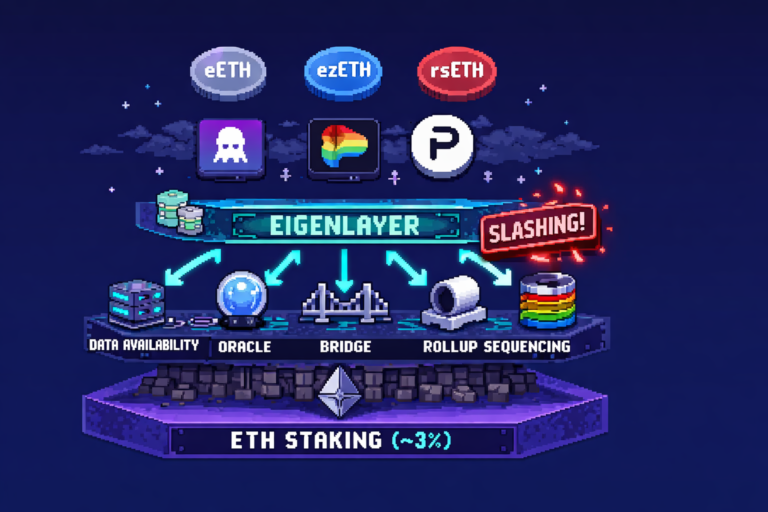



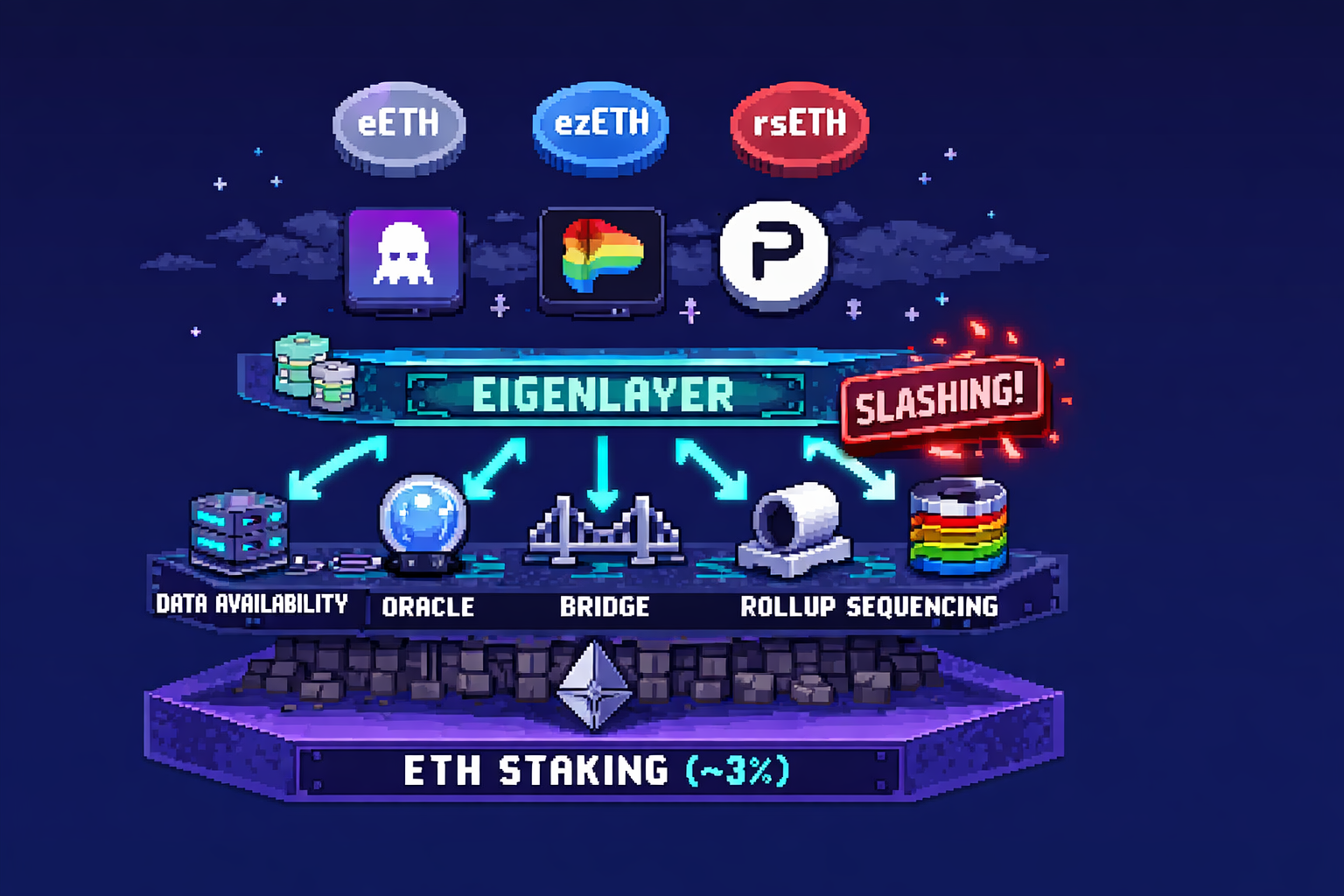
Staking your ETH earns you ~3% APY. But what if that same ETH could secure not just Ethereum, but also a data availability network, an oracle system, and a bridge – all at the same time? That’s the promise of restaking, and it’s reshaping how we think about economic security in crypto.
In less than two years, EigenLayer has grown to over $20 billion in restaked assets, powering more than 15 actively validated services (AVSs) live on mainnet. Liquid restaking tokens (LRTs) like eETH, ezETH, and rsETH have become DeFi blue chips, with combined TVL exceeding $10 billion.
But restaking is not without controversy. Critics warn of “over‑leveraging” Ethereum’s security, complex slashing conditions, and the potential for cascading failures that could destabilize the entire ecosystem. The debate over whether restaking is the future of Ethereum or a dangerous experiment is one of the most heated in crypto today.
In this comprehensive guide restaking explained. We’ll unpack exactly how restaking works, why it’s been called the “Linux kernel” of decentralized trust, the risks that keep critics awake at night, and how you can participate or decide it’s not for you.

Restaking in One Sentence
Restaking lets you reuse your staked ETH (or liquid staking tokens) to secure multiple blockchain applications simultaneously, earning additional yield while extending Ethereum’s security to other protocols.
Here are a few other ways to think about it:
- For developers: EigenLayer is a smart contract platform that allows ETH stakers to opt into securing Actively Validated Services (AVSs) by re‑staking their stake, creating a permissionless marketplace for trust.
- For DeFi users: Restaking is like taking your staked ETH and putting it to work securing other projects (like bridges, oracles, or rollups) for extra yield.
- For the curious: Imagine your savings account earning interest, and also being used as collateral for a loan, and also backing a friend’s business, all without taking your money out of the bank. That’s restaking for crypto.
The Problem Restaking Solves
The Bootstrapping Problem
Every new blockchain application, whether a bridge, oracle, or layer 2, faces a critical challenge: how to build trust. Traditionally, new protocols must create their own token and convince users to stake it to secure the network. This is expensive, slow, and often fails. The result: fragmented security and lower overall crypto safety.
The Cost of Separate Staking
Consider a rollup that wants to offer a fast bridge. It could launch its own token, distribute it, and hope enough people stake it to make the bridge economically secure. Or it could tap into Ethereum’s existing $100 billion security budget. The choice is obvious.
EigenLayer’s Answer: Shared Security
EigenLayer creates a marketplace where Ethereum stakers can choose to extend their economic trust to new services. Instead of each project building security from scratch, they can rent it from the largest, most decentralized pool of capital in crypto.
| Problem | Solution |
|---|---|
| New protocols lack security | Tap into Ethereum’s $100B+ staked |
| Fragmented security | Shared security pool |
| High cost of bootstrapping | Pay market rates for security |
| Centralized trust | Decentralized, slashing‑based guarantees |
How EigenLayer Works: The Architecture

The Core Mechanism
EigenLayer is a set of smart contracts on Ethereum that enable ETH stakers to opt into restaking. Here’s the basic flow:
- Stake ETH (either natively or via liquid staking tokens like stETH).
- Opt into EigenLayer contracts, authorizing your stake to be slashed if the services you support misbehave.
- Choose one or more Actively Validated Services (AVSs) to secure.
- Earn additional yield from those AVSs on top of your base staking rewards.
Two Types of Restaking
| Type | How It Works | Best For |
|---|---|---|
| Native Restaking | Run an Ethereum validator and point its withdrawal credentials to EigenLayer’s smart contracts | Solo staker with 32 ETH |
| Liquid Restaking | Deposit liquid staking tokens (LSTs) like stETH or rETH into EigenLayer’s pools, receiving LRTs in return | Most retail users |
The Role of Operators
Stakers don’t manage restaking themselves. Instead, they delegate their stake to operators (entities that run the actual AVS software). Operators are responsible for validating transactions, submitting proofs, and maintaining uptime. If they misbehave, stakers can be slashed.
Slashing: The Enforcement Mechanism
Slashing is the penalty mechanism that keeps restaking secure. If an operator commits a fault (like double‑signing or extended downtime), a portion of the restaked ETH is burned. This creates a strong economic incentive to behave honestly.
EigenLayer’s Modular Design
The protocol separates three roles:
- Stakers: Provide economic security.
- Operators: Run AVS software.
- AVS Developers: Build services that need security.
This modularity allows each role to specialize and creates a permissionless market for trust.
Key Concepts: AVSs, Operators, and Slashing
Actively Validated Services (AVSs)
AVSs are the applications that restaked ETH secures. They can be any service that requires economic security:
| Type | Examples |
|---|---|
| Data availability layers | EigenDA |
| Oracles | EagleEye |
| Bridges | Lagranger |
| Rollup sequencing | Espresso Systems |
| Zero‑knowledge proving | Aligned Layer |
As of 2026, over 15 AVSs are live on EigenLayer mainnet, with many more in testnet.
Operators
Operators are the entities that run the AVS software. They perform the actual work of validating transactions, generating proofs, or maintaining network uptime. Stakers delegate to operators, trusting them to behave honestly.
Choosing an operator: Operators publish their fee structure and performance metrics. Stakers should evaluate:
- Track record (uptime, slashing history)
- Commission (percentage of rewards taken)
- AVS selection (which services they secure)
- Decentralization (not all operators are equally distributed)
Slashing Conditions
Slashing is the penalty for misbehavior. Different AVSs may have different slashing conditions:
| Fault | Typical Penalty |
|---|---|
| Double signing | Severe slashing (often entire stake) |
| Extended downtime | Small penalty (a few percent) |
| Invalid state transition | Large slashing |
EigenLayer’s slashing contract is designed to be programmable, allowing each AVS to define its own slashing rules. This flexibility enables diverse security models.
Restaking Yield Composition
Total yield from restaking = base staking rewards + AVS rewards + potential LRT protocol incentives.
- Base staking rewards: ~3% APY
- AVS rewards: vary widely, from 2% to 10% depending on the service
- Total potential: 5–15% APY (variable and riskier)
Liquid Restaking Tokens (LRTs): The DeFi Bridge

What Are LRTs?
Liquid Restaking Tokens (LRTs) are the yield‑bearing tokens users receive when they deposit LSTs into restaking pools. They function like a hybrid of liquid staking tokens and restaked positions – they accrue yield from both base staking and restaking, while remaining tradable and DeFi‑composable.
Major LRTs in 2026
| LRT | Protocol | Underlying | TVL (approx) |
|---|---|---|---|
| eETH | Ether.fi | stETH, ETH | $6B+ |
| ezETH | Renzo | ETH, stETH | $3B+ |
| rsETH | Kelp DAO | stETH, rETH | $2B+ |
| weETH | Ether.fi (wrapped) | eETH | $1B+ |
| pufETH | Puffer Finance | stETH | $1B+ |
How LRTs Work
- User deposits stETH (or ETH via native restaking) into an LRT protocol.
- Protocol restakes those assets on EigenLayer.
- User receives LRT (e.g., eETH).
- LRT accrues yield from: base staking + restaking rewards.
- User can use LRT in DeFi (lend, borrow, LP) for additional yield.
The LRT Ecosystem
LRTs have become deeply integrated into DeFi. Aave has added eETH and weETH as collateral, Curve has stable pools for LRTs, and platforms like Pendle offer yield trading on future rewards.
Risks Specific to LRTs
| Risk | Description |
|---|---|
| De‑peg | LRT may trade below its NAV during stress |
| Smart contract risk | LRT protocols add extra code layers |
| Dependency risk | LRT relies on both EigenLayer and the underlying LST |
The EigenLayer Ecosystem in 2026
TVL and Growth
EigenLayer’s total value locked peaked above $20 billion in early 2025 and has stabilized around $15–18 billion in 2026. Despite a cooldown from speculative peaks, it remains one of the largest protocols in DeFi.
Major AVSs Live on Mainnet
| AVS | Type | Status |
|---|---|---|
| EigenDA | Data availability | Live, serving multiple rollups |
| Espresso | Sequencing | Testnet, mainnet soon |
| Lagranger | Bridge | Live |
| EagleEye | Oracle | Live |
| Aligned Layer | ZK verification | Live |
Operator Landscape
Over 5,000 operators are registered on EigenLayer, with the largest operators controlling a significant portion of delegated stake. Efforts to further decentralize operator distribution are ongoing.
EigenLayer Token (EIGEN)
The EIGEN token was launched in 2024 to govern the protocol. It is used to vote on protocol parameters, slashing rules, and future upgrades. EIGEN has a circulating supply of roughly 500 million and trades in the $1–3 range depending on market conditions.
The Eigen Foundation
The Eigen Foundation stewards protocol development, with a multi‑year roadmap including:
- Cross‑slashing coordination between AVSs
- Permissionless operator entry
- Enhanced slashing transparency
- Native restaking integration with Ethereum clients
Restaking Risks: The Critic’s Perspective
⚠️ CRITICAL SECTION. DO NOT SKIP
Systemic Risk to Ethereum
Critics argue that restaking “over‑leverages” Ethereum’s security. If a major AVS suffers a slashing event, the ripple effects could force mass exits of validators, destabilizing the entire Ethereum consensus.
The “Dust Bowl” Argument
Ethereum researcher Max Resnick has compared restaking to the 1930s Dust Bowl (a practice that initially boosted yields but ultimately degraded the underlying resource). By reusing stake across multiple services, restaking may create hidden correlations that only surface during crises.
Slashing Complexity and Cross‑Contamination
With different AVSs having different slashing conditions, a bug in one AVS could trigger cascading slashing across many others. The EigenLayer architecture attempts to isolate these risks, but the complexity of the system is unprecedented.
Operator Centralization
A handful of operators control a large share of restaked assets. This concentration risk could undermine the decentralization that makes Ethereum secure in the first place.
LRT Risks: Leverage and Depegs
LRTs are often used as collateral in lending protocols, creating leveraged loops. During a market crash, these loops can unwind violently, causing LRTs to depeg and triggering liquidations across DeFi.
Regulatory Uncertainty
Restaking introduces a new layer of financial complexity that may attract regulatory scrutiny. The SEC has not yet ruled on whether restaking products constitute securities offerings.
The “Too Big to Fail” Concern
EigenLayer’s size (over $20 billion at peak) means that any major failure would impact the entire Ethereum ecosystem. Some argue this makes the protocol “systemically important” without the safeguards of traditional finance.
Mitigation Efforts
| Risk | Mitigation |
|---|---|
| Slashing contagion | AVS isolation, operator diversification |
| Operator concentration | Incentives for smaller operators |
| LRT depegs | Liquidity incentives, LRT insurance |
| Regulatory | Legal wrappers, transparency |
How to Restake: Step‑by‑Step Guide
Method 1: Liquid Restaking (Easiest)
- Acquire a liquid staking token (stETH, rETH) on Ethereum or L2.
- Go to an LRT protocol (Ether.fi, Renzo, Kelp).
- Deposit LST into the protocol.
- Receive LRT (e.g., eETH) in your wallet.
- Your LRT automatically accrues restaking yields.
- (Optional) Use LRT in DeFi to compound yields.
Method 2: Native Restaking (Advanced)
- Run an Ethereum validator with 32 ETH.
- Set withdrawal credentials to point to EigenLayer’s contracts.
- Register your validator as an operator on EigenLayer.
- Choose which AVSs to support.
- Earn AVS rewards in addition to staking rewards.
Security Best Practices
- Start with small amounts.
- Use only well‑audited protocols (Ether.fi, Renzo, Kelp have multiple audits).
- Diversify across LRTs to reduce platform risk.
- Monitor slashing events and operator performance.
- Never share your private keys or seed phrase.
The Debate: Is Restaking Ethereum’s Future or a Dangerous Experiment?
The Bull Case
| Argument | Support |
|---|---|
| Shared security is inevitable | Bootstrapping new networks from scratch is inefficient; restaking unlocks innovation |
| Ethereum becomes an app chain | Rollups, bridges, oracles all built on Ethereum’s security |
| Capital efficiency | Instead of idle staked ETH, it can be productive capital |
| Ecosystem growth | Thousands of AVSs will create new demand for ETH |
The Bear Case
| Argument | Support |
|---|---|
| Over‑leveraging | Restaking creates hidden correlations and systemic risk |
| Complexity hides danger | Slashing conditions are too complex for average users to understand |
| Centralization | Operators become powerful intermediaries |
| Ethereum’s identity | Is Ethereum a settlement layer or a security marketplace? |
The Middle Ground
Many Ethereum builders see restaking as an exciting experiment that needs to be carefully managed. Vitalik Buterin has expressed enthusiasm for the concept while urging caution around slashing and AVS design. The protocol’s modularity allows for iterative improvements.
Beyond EigenLayer: Other Restaking Protocols
Symbiotic (developed by Mellow Protocol)
Symbiotic is a modular restaking protocol that emphasizes non‑custodial design. Unlike EigenLayer, it supports any ERC‑20 token as collateral, not just ETH. It has gained traction with LRT providers like Mellow, which offers the sUsDe LRT based on Ethena’s USDe.
Karak
Karak is a multi‑chain restaking protocol that focuses on securing off‑chain services. It has raised significant funding and aims to bring restaking to other chains like Arbitrum and Base.
Picasso (Composable Finance)
Picasso is a cross‑chain restaking hub that enables restaking across different ecosystems, including Solana and Cosmos. It uses IBC for interchain security.
Olympus (OHM)
Olympus has launched its own version of restaking (referred to as “protocol‑owned liquidity”) but is a separate design.
Summary
EigenLayer remains the dominant restaking protocol, but competitors are emerging with different trade‑offs (collateral types, chains, modularity). The restaking landscape is rapidly evolving.
The Future of Restaking
Short‑Term Roadmap (2026‑2027)
| Development | Expected Impact |
|---|---|
| Native restaking in Ethereum clients | Permissionless restaking without external contracts |
| Cross‑slashing coordination | Safer multi‑AVS staking |
| AVS market expansion | Hundreds of new services |
| LRT consolidation | Winners emerge, some protocols fade |
The Shared Security Thesis
If restaking succeeds, it will become the standard way to bootstrap new crypto protocols. Instead of launching a token, developers will build on EigenLayer, tap into Ethereum’s security, and focus on their application logic.
The Counter‑Thesis
If restaking fails (due to a major slashing event, regulatory action, or systemic crisis) it could set back Ethereum’s scaling ambitions for years. The ecosystem must proceed with caution.
Final Thought
Restaking represents a bet on the future of trust, a belief that economic security can be shared, reused, and scaled. Whether that bet pays off will be one of the defining stories of this decade in crypto.
Next Steps: From Learning to Participating
You now understand restaking. Here’s where to go next:
| Step | Action | Resource |
|---|---|---|
| 1. Get an LRT | Start with small amount of eETH or ezETH | Ether.fi, Renzo |
| 2. Explore DeFi | Use LRT on Aave, Curve, or Pendle | DeFi protocols |
| 3. Monitor yields | Track restaking APYs on EigenLayer dashboard | EigenLayer app |
| 4. Stay informed | Follow EigenLayer governance, slashing updates | Discord, Twitter |
Essential Next Reads
- 📚 What is Cryptocurrency Staking?
- 📚 Liquid Staking Explained: Lido, Rocket Pool, and More
- 📚 Aave Explained: Lending and Borrowing in DeFi
- 📚 How to Avoid Crypto Scams
Join the Community
Restaking is fast‑moving and complex. Join our Discord, follow us on Twitter, and subscribe to our newsletter for weekly updates on EigenLayer, new AVSs, and LRT developments.
Disclaimer: This guide is for educational purposes only and does not constitute financial advice. Restaking involves significant risks, including potential loss of principal through slashing, smart contract bugs, and systemic failures. Always do your own research and never invest more than you can afford to lose.
This guide was last updated for the 2026 edition. Restaking protocols, AVS offerings, and risk parameters change rapidly. Always verify current information on official protocol websites and dashboards.
Frequently Asked Questions
How does EigenLayer work?
EigenLayer is a set of smart contracts where ETH stakers can opt into securing Actively Validated Services (AVSs). If an AVS misbehaves, the staker’s ETH can be slashed. Stakers delegate to operators who run the actual AVS software.
Is restaking safe?
Restaking introduces new risks: slashing (you can lose part of your stake), complex dependencies, and potential systemic risk to Ethereum. Major protocols have undergone extensive audits, but no code is risk‑free. Start small and understand the risks.
What are liquid restaking tokens (LRTs)?
LRTs are tokens (like eETH, ezETH) you receive when you deposit LSTs into a restaking pool. They accrue staking + restaking yields and can be used in DeFi. They add an extra layer of smart contract risk.
How much can I earn restaking ETH?
Restaking yield = base staking (~3%) + AVS rewards (varies, 2‑10% depending on AVS) + LRT protocol incentives. Total yield can range from 5‑15% APY, but it’s variable and riskier than plain staking.
What is slashing in EigenLayer?
Slashing is a penalty mechanism where a portion of restaked ETH is burned if an operator misbehaves (e.g., double‑signing, downtime). Each AVS defines its own slashing conditions.
What are Actively Validated Services (AVSs)?
AVSs are applications that need economic security, such as data availability layers (EigenDA), oracles, bridges, or rollup sequencing. They pay operators for securing them.
Is EigenLayer live on mainnet?
Yes. EigenLayer mainnet launched in 2024, and by 2026, over 15 AVSs are live. Liquid restaking tokens like eETH, ezETH, and rsETH are widely used in DeFi.
What’s the difference between staking and restaking?
Staking secures Ethereum itself; restaking extends that security to other services. Restaking earns additional yield but also carries additional risks (slashing from AVSs).
Can I lose my ETH restaking?
Yes. If the operator you delegated to misbehaves, you can be slashed, losing a portion of your stake. Also, LRTs can depeg, and smart contract bugs can cause total loss.
What are the best LRTs in 2026?
Ether.fi (eETH), Renzo (ezETH), Kelp DAO (rsETH), and Puffer Finance (pufETH) are the largest and most integrated. Always DYOR and check audit status before depositing.
Does restaking increase Ethereum’s security or risk?
It’s debated. Proponents say it creates a shared security marketplace that strengthens the ecosystem. Critics warn it over‑leverages Ethereum’s security and creates systemic risks.
What is EigenLayer’s token (EIGEN) used for?
EIGEN is the governance token of the EigenLayer protocol. Holders vote on protocol parameters, slashing rules, and future upgrades. It does not directly capture restaking yield.
Can I restake on Layer 2?
Most restaking occurs on Ethereum mainnet because EigenLayer contracts are deployed there. However, some LRT protocols have bridges to L2s where you can hold and use LRTs.
Is restaking just for Ethereum?
EigenLayer is Ethereum‑only, but other protocols like Symbiotic and Karak are building multi‑chain restaking solutions. The concept is spreading to other ecosystems.
About the Author