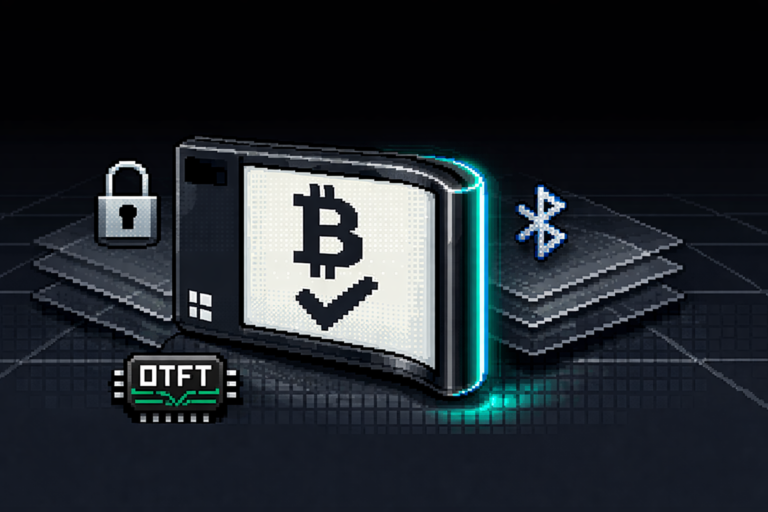

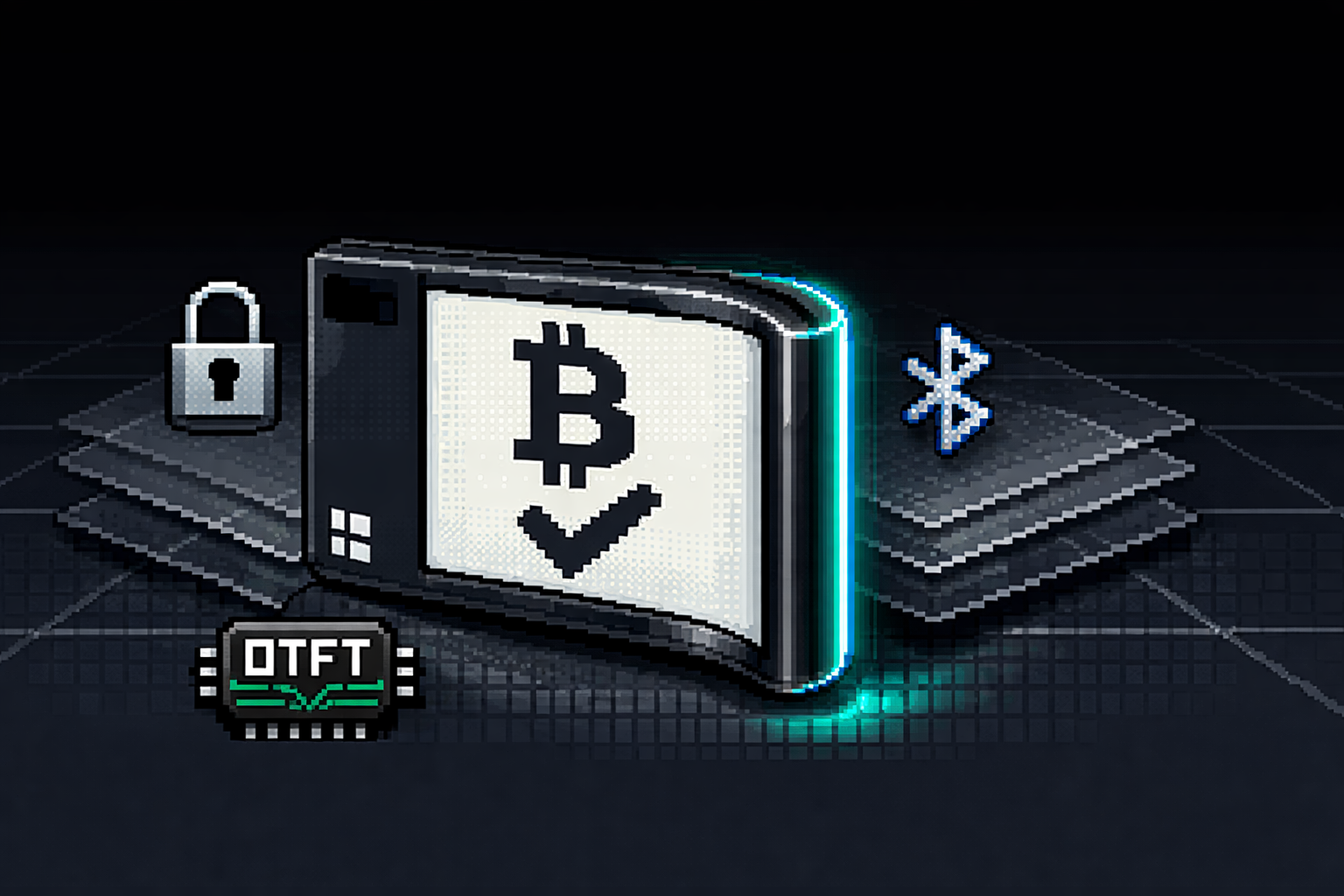
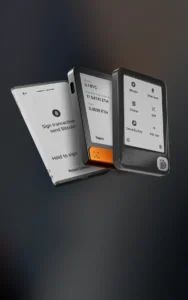
For the first time in the history of consumer electronics, a mass‑produced product incorporating organic transistor technology has begun shipping. That product is Ledger Stax – a secure crypto wallet with an E‑Ink display that wraps around a 180‑degree bend, developed by French market leader Ledger in collaboration with FlexEnable, DKE, and Giantplus.
The launch coincides with Ledger’s strategic repositioning of its hardware products as “signers”, a shift designed to emphasize their core function of signing transactions, proving intent and identity, and enabling digital consent. The Bend is not just a wallet; it’s a personal digital signer that redefines what a hardware security device can look like.
In this article, we break down everything we know so far about the Ledger Bend: the revolutionary flexible display technology, its security architecture, how it fits into Ledger’s 2026 lineup, and what it means for the future of self‑custody.
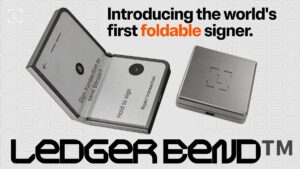
At a Glance: Ledger Bend Key Specifications
| Aspect | Specification |
|---|---|
| Product name | Ledger Bend (announced in manufacturing as Ledger Stax) |
| Form factor | Credit card‑sized |
| Display | E‑Ink screen uniquely wrapped around a 180‑degree bend |
| Display technology | Organic thin‑film transistors (OTFTs) from FlexEnable |
| Manufacturing partners | FlexEnable (OTFT IP), DKE (display lamination), Giantplus (fab) |
| Key features | Bluetooth, USB‑C, magnetic stacking design |
| Security chip | CC EAL6+ certified Secure Element |
| Target audience | Mobile‑first users, design‑conscious investors |
The Technology Inside the Bend: Flexible Displays and OTFTs
A Historic Breakthrough
The Ledger Bend is not just another hardware wallet, it’s the world’s first mass‑produced consumer product to incorporate organic thin‑film transistor (OTFT) technology. Developed and supplied by FlexEnable, the OTFTs enable an E‑Ink display with a radius of curvature never before achieved in an e‑paper product.
How It Works
Traditional displays use glass substrates that limit flexibility. The Bend replaces glass with highly flexible organic materials, allowing the screen to wrap around the device’s edge at a full 180 degrees. This is made possible through a partnership between:
- FlexEnable – supplied the OTFT IP and low‑temperature process technology
- DKE (Shanghai) – developed the volume production capability for 180‑degree bend lamination
- Giantplus (Taiwan) – implemented the unique transistor materials and low‑temperature process in its fab
Why This Matters for Crypto Users
| Benefit | Practical Impact |
|---|---|
| Credit card‑sized portability | Fits in a wallet or pocket, no more bulky USB sticks |
| Always‑on display | E‑Ink uses power only when refreshing; shows balances without charging |
| Customizable lock screen | Display your favorite NFT or transaction history at a glance |
| Clear signing | More screen real estate for reviewing transaction details before approval |
Manufacturing Milestone
Chuck Milligan, CEO of FlexEnable, described the launch as “a significant milestone, not just for our company, but for the entire display industry.” The established supply chain is now primed to support a range of future applications beyond crypto wallets, including AR/VR optics and wearable devices.
From Hardware Wallet to Signer: Ledger’s Strategic Pivot
The Rebranding Explained
In October 2025, Ledger announced a significant strategic repositioning of its core product line, officially rebranding its hardware wallets as “signers.” The term “signer” more accurately reflects the device’s core function: signing transactions, proving intent and identity, and enabling digital consent.
| Old Term | New Term |
|---|---|
| Hardware wallet | Signer |
| Store crypto | Sign transactions and prove identity |
| Passive storage | Active security device |
By requiring cryptographic confirmation of user presence and intent via a hardware signer, Ledger aims to eliminate single points of failure in the security chain. The Bend is the first device to fully embody this new philosophy, combining biometric‑grade security with a form factor that signals “this is a serious tool for digital ownership” rather than “this is a USB stick for nerds.”
The “Proof of You” Initiative
The rebranding coincided with the launch of “Proof of You” – a framework designed to combat AI fraud and deepfake identity theft. As digital identities become increasingly vulnerable to AI‑generated forgeries, Ledger’s hardware signers provide cryptographic proof that a real person with physical possession of the device authorized a transaction.
Security: The Same Fort‑Knox Protection in a New Form Factor
The Secure Element
Despite its revolutionary form factor, the Ledger Bend shares the same security architecture that has protected over 7 million Ledger devices, none of which have ever been remotely hacked. At its heart is a CC EAL6+ certified Secure Element chip, the same technology used in credit cards and passports.
Key Security Features
| Feature | What It Does |
|---|---|
| Secure Element isolation | Private keys stored in a tamper‑proof chip, never exposed to networked environments |
| Clear Signing | Every transaction decoded and displayed in human‑readable format on the secure touchscreen before signing |
| Bluetooth with isolation | Keys never leave the Secure Element – Bluetooth only transmits already‑signed transactions |
| PIN protection | Device auto‑wipes after several failed attempts |
The Recover Context
The announcement comes amid ongoing debate about Ledger’s Recover service, an optional ID‑based seed backup subscription. Critics have raised concerns about privacy and potential government access. However, the service remains opt‑in and not enabled by default. The Bend’s core security model remains unchanged: your keys, your coins.
What This Means for Users
The Ledger Bend offers the same uncompromising security as the Nano X and Stax, but in a more portable, always‑ready form factor. For users who prioritize both security and daily usability, the Bend bridges the gap between cold storage and active management.
Ledger 2026 Lineup: Where Does Bend Fit?
| Model | Approx Price | Key Features | Best For |
|---|---|---|---|
| Ledger Bend | TBD | Foldable E‑Ink, credit card‑sized, 180° wrap‑around display | Design‑conscious, mobile‑first users |
| Ledger Stax | $399 | 3.7″ curved E‑Ink, wireless Qi charging, magnetic stackable design | Premium flagship, NFT display |
| Ledger Flex | $249 | 2.84″ flat E‑Ink, metal build, durable | DeFi users, mid‑range touchscreen |
| Nano Gen5 | $179 | Touchscreen, Clear Signing, NFC & Bluetooth | Most users, best value |
| Nano X | $149 | Bluetooth, mobile app, 100+ app capacity | Mobile users, multi‑asset holders |
| Nano S Plus | $79 | USB‑only, same security | Budget‑conscious, desktop users |
The Bend’s Unique Position
While the Stax is Ledger’s premium flagship with wireless charging and a larger curved screen, the Bend focuses on extreme portability. At credit card size, it’s designed to live in your actual wallet, not your desk drawer. For users who want hardware security but find traditional devices too bulky to carry daily, the Bend is the solution.
How It Compares: Bend vs Stax vs Flex vs Nano Gen5
| Feature | Ledger Bend | Ledger Stax | Ledger Flex | Nano Gen5 |
|---|---|---|---|---|
| Form factor | Credit card‑sized, 180° wrap | Curved, stackable | Flat touchscreen | Traditional |
| Screen | 180° bend E‑Ink | 3.7″ curved E‑Ink | 2.84″ flat E‑Ink | Touchscreen |
| Wireless charging | TBD | Qi | ✗ | ✗ |
| Bluetooth | ✓ | ✓ | ✓ | ✓ (also NFC) |
| Portability | ★★★★★ | ★★★ | ★★★ | ★★★ |
| Clear Signing | ✓ | ✓ | ✓ | ✓ |
| Secure Element | EAL6+ | EAL6+ | EAL6+ | EAL5+ |
| Approx price | TBD | $399 | $249 | $179 |
The Decision Framework
| If you want… | Choose… |
|---|---|
| Maximum portability – wallet‑ready | Ledger Bend |
| Premium flagship with wireless charging | Ledger Stax |
| Touchscreen DeFi without premium price | Ledger Flex |
| Best value touchscreen signer | Nano Gen5 |
The Bigger Picture: Why Foldable Signers Matter
Beyond Crypto: The Display Industry’s Milestone
The Ledger Bend’s flexible display technology represents a breakthrough for the entire e‑paper industry, not just crypto wallets. The OTFT supply chain established for Bend production is now positioned to support AR/VR optics, wearable devices, and other applications requiring flexible, low‑power displays.
The “Signer” as a Daily Companion
By shrinking hardware security to credit card size, Ledger is making a bet that the future of digital identity is physical. As AI‑generated deepfakes and identity theft become more sophisticated, the ability to cryptographically prove “I am a real person, physically present” becomes increasingly valuable. The Bend is designed to be carried daily, not stored in a safe, because digital ownership requires daily interaction.
Implications for Self‑Custody
Hardware wallets have traditionally been “insurance” devices – bought, set up, and then forgotten in a drawer. The Bend changes that equation. When a hardware signer is as easy to carry as a credit card, self‑custody becomes not just secure, but convenient. This could be the device that finally brings hardware security to mainstream users who found previous form factors too cumbersome.
Pricing and Availability
Current Status
At the time of writing, Ledger has not officially announced the final consumer name, pricing, or release date for the foldable signer. The device has been referred to in manufacturing announcements as Ledger Stax, but may be released under a different brand name – possibly Ledger Bend.
What We Know
| Detail | Information |
|---|---|
| Manufacturing status | Customer shipments have begun |
| Partners | FlexEnable, DKE (Shanghai), Giantplus (Taiwan) |
| Production facility | Ledger has a production facility in Vierzon, France |
| Price range expectation | Likely $299‑$399 based on Stax ($399) and Flex ($249) positioning |
Where to Watch
Keep an eye on Ledger’s official website and social channels for the official unveiling. When released, we’ll update this article with final specifications, pricing, and a full hands‑on review.
Final Thought
The Ledger Bend represents more than a new product – it’s a convergence of breakthroughs: flexible displays, organic transistors, and a strategic shift from “hardware wallet” to “digital signer.” For crypto users, it promises uncompromising security in a form factor you can carry in your actual wallet.
We’ll update this article as soon as Ledger makes an official consumer announcement. Until then, keep your keys safe and watch this space.
About the Author
[Author Name] has been reviewing hardware wallets since 2020 and has tracked Ledger’s product evolution from the Nano S to the Stax. They’ve tested every major Ledger model and follow the security industry’s display technology breakthroughs closely.
Disclosure: This article is based on manufacturing announcements and industry reports. Final product specifications, pricing, and release dates have not been officially confirmed by Ledger. We will update this article as more information becomes available. This article contains affiliate links – if you purchase through them, we may earn a commission.
This article was last updated based on manufacturing announcements from April 2026. Final consumer specifications may differ.
Frequently Asked Questions
When will the Ledger Bend be released?
Customer shipments of the device have already begun, though Ledger has not yet made a public consumer announcement. The final product name, pricing, and release date are expected soon.
How does Ledger Bend’s flexible display work?
The display uses organic thin‑film transistors (OTFTs) instead of traditional glass‑based electronics. This allows the screen to bend around the device’s edge at a full 180 degrees - a radius of curvature never before achieved in an e‑paper display product.
Is Ledger Bend more secure than other Ledger wallets?
It uses the same CC EAL6+ certified Secure Element chip found in Ledger’s premium devices. Private keys are stored offline and isolated from networked environments. No Ledger device has ever been remotely hacked.
What is the difference between Ledger Bend and Ledger Stax?
Manufacturing announcements refer to the foldable device as Ledger Stax. It may be released under that name or a different brand - possibly Ledger Bend. The key innovation is the 180‑degree wrap‑around E‑Ink display in a credit card‑sized form factor.
Who manufactures Ledger’s flexible display?
The display technology is developed and supplied by FlexEnable, with volume production capability for the 180‑degree bend lamination developed by DKE (Shanghai) and manufacturing fab implemented by Giantplus (Taiwan).
What is a “signer” and why is Ledger rebranding?
Ledger has rebranded its hardware wallets as “signers” to more accurately reflect their core function: signing transactions, proving intent and identity, and enabling digital consent. The term “wallet” is being phased out to emphasize active security rather than passive storage.
How much will Ledger Bend cost?
Official pricing has not been announced. Based on Ledger’s current lineup ($399 Stax, $249 Flex, $179 Nano Gen5), the Bend is expected to be priced in the $299‑$399 range.
Does Ledger Bend have Bluetooth?
Yes. Like the Nano X and Stax, the Bend supports Bluetooth connectivity for mobile use, with the Secure Element ensuring private keys never leave the isolated chip.
Is the Ledger Recover service enabled on Bend by default?
No. Ledger Recover is an optional, opt‑in subscription service. It is not enabled by default and requires explicit user consent. The Bend’s core security model remains non‑custodial.
About the Author