
When you think of crypto exchanges, you think of Binance.
It’s the 800-pound gorilla of the industry – handling more trading volume than the next five exchanges combined, serving over 300 million users worldwide, and listing more cryptocurrencies than almost any competitor. With $22.7 billion in daily spot trading volume as of 2026, Binance isn’t just an exchange; it’s an ecosystem.
But with great size comes great scrutiny.
I’ve been trading on Binance since 2018, and I’ve watched it transform from a scrappy startup into a global financial behemoth. I’ve seen it weather regulatory storms, survive major security incidents, and emerge stronger each time. I’ve also cursed its customer support during peak congestion and watched beginners get lost in its labyrinthine interface.
Binance has evolved dramatically since its 2017 launch. It’s navigated regulatory challenges, rebuilt its compliance infrastructure, and emerged in 2026 as a platform that’s both massive and increasingly institutional-grade. But is it the right exchange for you?
In this comprehensive Binance review, we’ll cover everything: fees, security, supported coins, regulatory status, pros and cons, and exactly who should (and shouldn’t) use the world’s largest crypto exchange.
Executive Summary: Our Quick Verdict
| Aspect | Rating | Notes |
|---|---|---|
| Fees | ★★★★★ | Industry-leading low fees (0.1% spot, 0.02% futures) |
| Security | ★★★★½ | Strong measures, SAFU fund, but past incidents noted |
| Coin Selection | ★★★★★ | 400+ cryptocurrencies, 1,500+ trading pairs |
| User Experience | ★★★★ | Powerful but steep learning curve for beginners |
| Regulation | ★★★★ | Major compliance progress, ADGM license in 2026 |
| Customer Support | ★★★ | Improved but can be slow during peak periods |
Best For: Binance is ideal for intermediate to advanced traders who want low fees, access to hundreds of cryptocurrencies, and advanced trading features like futures and margin. Beginners can use it too, but may find the interface overwhelming at first.
What Is Binance?
Founding and History
Launched in July 2017 by Changpeng Zhao (CZ) , Binance rapidly became the world’s largest cryptocurrency exchange within months of its founding. What started as a simple crypto-to-crypto trading platform has grown into a comprehensive ecosystem serving over 300 million users globally.
The name “Binance” combines “binary” and “finance” – reflecting its focus on digital finance. From day one, the platform prioritized speed, low fees, and wide coin selection, quickly attracting traders from around the world.
The Binance Ecosystem
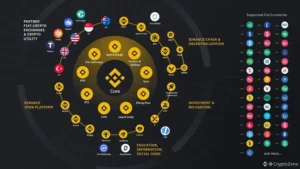
Today, Binance is far more than just an exchange. It encompasses:
| Component | Description |
|---|---|
| Spot Exchange | Traditional buy/sell trading for 400+ cryptocurrencies |
| Derivatives Platform | Futures, options, and perpetual contracts with up to 150x leverage |
| Binance Earn | Staking, savings, and yield products for passive income |
| Binance Card | Spend crypto anywhere Visa is accepted |
| Binance Labs | Venture capital arm supporting blockchain startups |
| BNB Chain | Native blockchain ecosystem (formerly Binance Smart Chain) |
| Trust Wallet | Official non-custodial mobile wallet (acquired by Binance) |
| Binance Academy | Free educational resources for crypto learners |
| Binance Research | In-depth institutional-grade reports |
Global Presence
Binance operates in most countries worldwide, though with significant regional variations:
- United States: Separate platform, Binance.US, with fewer coins and no derivatives
- Europe: Broad access, preparing for MiCA compliance
- Middle East: Fully licensed through ADGM in Abu Dhabi
- Asia: Licensed in multiple jurisdictions, varies by country
- United Kingdom: Restricted access (no derivatives or DeFi tools)
Recent Developments (2026)
In a landmark move, Binance secured full authorization from the Abu Dhabi Global Market (ADGM) Financial Services Regulatory Authority in January 2026. This represents a major shift toward institutional-grade compliance, with operations now unbundled into separate entities for exchange, clearing, and brokerage functions – mirroring traditional financial markets.
This restructuring is significant: it isolates different functions to prevent conflicts and enhance safety, much like separating a bank’s retail operations from its investment arm.
Binance Pros and Cons
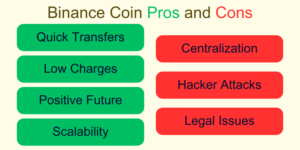
Pros
1. Deep Liquidity
As the world’s largest exchange by volume, Binance offers unmatched liquidity. This means tighter spreads, faster order execution, and the ability to trade large amounts without significant price impact. When you’re trading tens of thousands of dollars, this matters enormously.
2. Competitive Fees
Binance’s fee structure is among the industry’s lowest. Spot trading starts at just 0.1% per side, and futures trading is even cheaper at 0.02%/0.04%. BNB holders receive an additional 25% discount. We’ll dive deeper into fees shortly.
3. Massive Coin Selection
With over 400 cryptocurrencies and 1,500+ trading pairs, Binance offers access to more assets than almost any competitor. This includes major coins, emerging altcoins, and new projects through Launchpad. If you’re an altcoin investor, Binance is hard to beat.
4. Advanced Trading Tools
Professional traders appreciate Binance’s comprehensive charting tools, technical indicators, and order types, including limit, market, stop-limit, trailing stop, and more. The platform supports both simple and advanced interfaces, though beginners should start with the simple view.
5. Passive Income Opportunities
Binance Earn offers multiple ways to generate yield on idle assets, including flexible and locked savings, staking, and dual investment products. Yields vary but are generally competitive with other platforms.
6. Strong Security Infrastructure
Binance secures over $200 billion in customer assets through cold storage wallets with multi-signature protections. The SAFU (Secure Asset Fund for Users) holds $1 billion in USDC as an emergency reserve.
7. Comprehensive Ecosystem
From the Binance Card to NFT marketplace to research reports, Binance offers an all-in-one platform for crypto users. You can trade, earn, spend, learn, and explore without leaving the ecosystem.
Cons
1. Regulatory Complexity
Binance has faced regulatory scrutiny in multiple jurisdictions. While significant progress has been made in 2026, users in some regions face restrictions on certain products. The platform’s history of regulatory uncertainty concerns some users.
2. Steep Learning Curve
Beginners may find Binance overwhelming. The platform offers a simple “Buy Crypto” interface, but many advanced features require time to understand. If you’re completely new to crypto, you might feel like you’re drinking from a firehose.
3. Regional Limitations
- U.S. users: Must use Binance.US, which offers only about 180 coins and no derivatives trading
- UK users: Cannot access derivatives or some DeFi tools
- Other restricted regions: Always check local availability
4. Customer Support Delays
During peak periods, customer support response times can be slow. Binance has improved significantly investing heavily in support infrastructure, but support remains a common complaint in user reviews.
5. BNB Dependency
Some of the best features and fee discounts require holding BNB, a volatile asset. If BNB’s price drops, the value of those perks diminishes. This creates a mild lock-in effect.
6. Past Security Incidents
While no user funds were lost, Binance has faced security incidents (2019 hot wallet hack, 2022 BNB bridge exploit). These are worth noting, even if they were handled responsibly.
Binance Fees Explained
Fee Table Overview
| Fee Type | Standard Rate | With BNB Discount |
|---|---|---|
| Spot Trading (Maker/Taker) | 0.10% / 0.10% | 0.075% / 0.075% |
| Futures Trading (Maker/Taker) | 0.02% / 0.04% | 0.018% / 0.036% |
| Options Trading | 0.02% flat | N/A |
| Credit/Debit Card Purchase | ~2% | N/A |
| Bank Transfer (ACH/SEPA) | Free | N/A |
| Crypto Deposits | Free | N/A |
| Crypto Withdrawals | Variable by coin | N/A |
Spot Trading Fees Explained
Binance uses a tiered VIP system based on 30-day trading volume. Most retail traders start at the base rate of 0.1% maker/taker. As volume increases, fees decrease significantly:
| 30-Day Volume (USD) | Maker Fee | Taker Fee |
|---|---|---|
| < $1M | 0.100% | 0.100% |
| $1M – $3M | 0.090% | 0.100% |
| $3M – $5M | 0.080% | 0.095% |
| $5M – $10M | 0.070% | 0.090% |
| …and so on down to… | ||
| > $4B | 0.011% | 0.018% |
The highest VIP tiers can achieve fees as low as 0.011% – almost negligible.
BNB Discount Program
Users who hold Binance Coin (BNB) and use it to pay fees receive:
- 25% discount on spot trading fees
- 10% discount on futures trading fees
This is automatically applied when you enable “Use BNB for fee” in your account settings. For active traders, holding BNB pays for itself quickly.
Futures and Derivatives Fees
Futures trading is even more cost-effective:
- Maker orders (adding liquidity): 0.02%
- Taker orders (taking liquidity): 0.04%
Note that futures fees are calculated on the total position size, including leverage. Funding fees also apply to perpetual contracts every 8 hours.
Withdrawal Fees
Binance charges flat fees for crypto withdrawals that vary by coin and network. Examples (approximate, as of 2026):
| Coin | Withdrawal Fee | Approx USD Value |
|---|---|---|
| Bitcoin (BTC) | 0.00003 BTC | $1-2 |
| Ethereum (ETH) | 0.0002 ETH | $0.50-1 |
| USDT (ERC-20) | Variable | Higher (consider TRC-20 or BEP-20) |
| USDT (TRC-20) | 1 USDT | $1 |
| BNB (BEP-20) | 0.005 BNB | $1.25 |
Pro tip: For stablecoins like USDT, use TRC-20 or BEP-20 networks for much lower withdrawal fees than ERC-20.
Hidden Costs to Watch
- Spread: The difference between market price and execution price (typically small on Binance due to high liquidity)
- Network congestion: Higher withdrawal fees during busy periods
- Promotional rates: Some pairs offer zero fees temporarily (check current promotions)
- Funding rates: For perpetual futures, funding rates apply every 8 hours
Fee Comparison: Real-World Example
Buying $1,000 of Bitcoin:
| Method | Trading Fee | Payment Fee | Total |
|---|---|---|---|
| Binance (Bank Transfer) | 0.1% ($1) | Free | $1,001 |
| Binance (Credit Card) | 0.1% ($1) | ~2% ($20) | $1,021 |
| Coinbase (Bank Transfer) | 0.5% ($5) | Free | $1,005 |
| Coinbase (Card) | 0.5% ($5) | ~3% ($30) | $1,035 |
Binance’s fee advantage is clear, especially for larger amounts.
Security: Is Binance Safe?
Security Overview
Binance has never been hacked in terms of user funds being stolen from the exchange’s core wallets. However, it has faced security incidents, including:
- 2019: Hack of Binance hot wallet (7,000 BTC stolen)
- 2022: Approximately $570 million in BNB stolen from a cross-chain bridge
In both cases, no user funds were ultimately lost. Binance paused withdrawals, resolved the issues, and covered all losses through the SAFU fund.
Key Security Measures
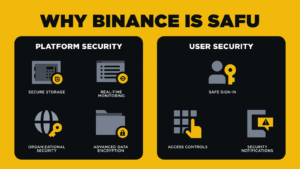
1. Cold Storage
The vast majority of user funds (over 95%) are stored in offline cold wallets with multi-signature protections. These wallets are physically disconnected from the internet, making remote hacking impossible.
2. SAFU Fund
Binance maintains a $1 billion emergency insurance fund called SAFU (Secure Asset Fund for Users) held in USDC. If a security breach ever results in user losses, this fund would compensate affected users.
3. Account Protection Features
- Two-factor authentication (2FA) with support for authenticator apps and hardware keys
- Device management and whitelisting
- Anti-phishing codes for emails
- Withdrawal address whitelisting (adds time delay for new addresses)
- Withdrawal limits configurable by users
4. Proof of Reserves
Binance publishes Merkle Tree Proof of Reserves, allowing users to verify that their assets are fully backed. As of 2026, Binance maintains a 1:1 reserve ratio for all user assets.
5. Compliance Investment
Binance has invested hundreds of millions in compliance, with over 1,500 employees dedicated to compliance and risk management – approximately 25% of its workforce. This includes 593 full-time compliance specialists.
6. SOC 2 and ISO Certifications
Binance.US has achieved SOC 2 Type II certification and ISO 27001/27701 recertification for 2026, demonstrating rigorous security and privacy controls.
Security Track Record
| Year | Incident | Outcome |
|---|---|---|
| 2019 | Hack of Binance hot wallet (7,000 BTC) | SAFU covered all user losses |
| 2022 | BNB Chain bridge exploit | Paused chain, no user funds lost |
| 2024-2026 | No major security incidents | Enhanced security measures implemented |
User Responsibility
While Binance provides robust security, users must also protect themselves:
- Enable 2FA (preferably hardware key or authenticator app, not SMS)
- Use withdrawal whitelisting (adds critical protection)
- Never share account credentials
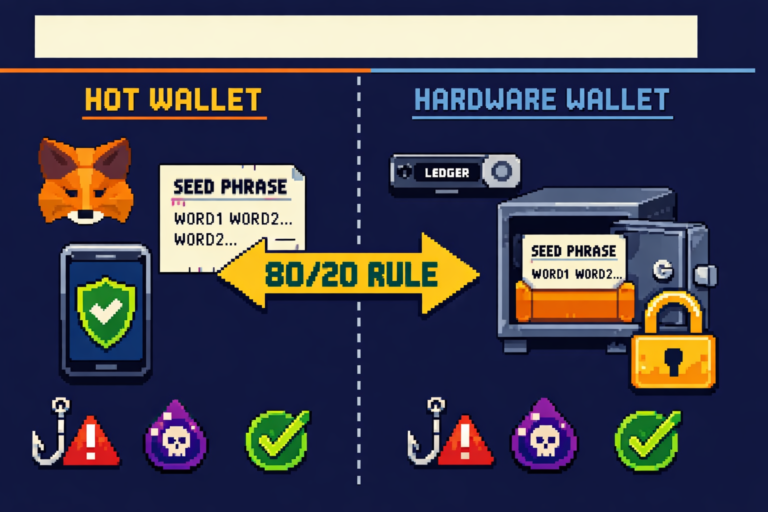
- Consider hardware wallets for long-term holdings (remember: not your keys, not your coins)
Our Take: Binance’s security is strong and continuously improving. The existence of the SAFU fund provides a backstop that few competitors offer. However, no exchange is 100% immune to risk, which is why we recommend moving long-term holdings to personal wallets.
Regulatory Status in 2026
The New Era of Compliance
2026 marks a turning point for Binance’s regulatory journey. The exchange has transformed from a decentralized, “no headquarters” operation to a structured, compliant entity with multiple licenses and regulatory approvals.
Major Regulatory Achievement: ADGM License
In January 2026, Binance received full authorization from the Abu Dhabi Global Market (ADGM) Financial Services Regulatory Authority, widely considered a gold-standard regulator.
This license represents a fundamental restructuring:
- Nest Exchange Limited: Operates as the Recognised Investment Exchange (RIE) for spot and derivatives trading
- Nest Clearing and Custody Limited: Functions as the Recognised Clearing House (RCH) for settlement and custody
- Nest Trading Limited: Licensed Broker-Dealer for OTC and conversion services
This structure mirrors traditional financial markets, isolating different functions to prevent conflicts and enhance safety.
Compliance by the Numbers
| Metric | 2026 Figure |
|---|---|
| Compliance team size | 1,500+ employees (25% of workforce) |
| Sanctions risk reduction | 97% decrease since 2024 |
| Annual compliance budget | Hundreds of millions |
| Law enforcement responses | 71,000+ requests (2025) |
| Fraud prevention | $66.9 billion saved for 5.4 million users |
| Global licenses/registrations | 20+ jurisdictions |
Regional Regulatory Status
| Region | Status | Notes |
|---|---|---|
| United States | Binance.US only | Separate regulated entity, no derivatives |
| European Union | Preparing MiCA compliance | License application submitted in Greece |
| United Kingdom | Restricted | No derivatives or DeFi tools available |
| Middle East | Fully licensed | ADGM authorization (UAE) |
| Asia | Varies by country | Licensed in multiple jurisdictions |
| Canada | Restricted | Withdrew in 2023, limited access |
| Australia | Operating | Registered with AUSTRAC |
What This Means for Users
Binance in 2026 is significantly more regulated and transparent than in previous years. While not all products are available everywhere, the exchange has made genuine progress toward becoming an institutional-grade platform.
For most users outside the U.S., Binance offers a compliant, secure trading environment. U.S. users should understand that Binance.US is a separate, more limited platform.
Supported Cryptocurrencies
Coin Selection Overview
Binance offers one of the largest selections of cryptocurrencies available on any exchange:
| Category | Count |
|---|---|
| Total cryptocurrencies | 400+ |
| Trading pairs | 1,500+ |
| Futures contracts | 600+ |
Blue Chip Cryptocurrencies
- Bitcoin (BTC)
- Ethereum (ETH)
- Solana (SOL)
- Binance Coin (BNB)
- XRP
- Cardano (ADA)
- Dogecoin (DOGE)
DeFi Tokens
- Uniswap (UNI)
- Aave (AAVE)
- Chainlink (LINK)
- Maker (MKR)
- Lido (LDO)
Layer 1 and Layer 2
- Polygon (MATIC)
- Arbitrum (ARB)
- Optimism (OP)
- Avalanche (AVAX)
- Near Protocol (NEAR)
Meme Coins and Trends
- Shiba Inu (SHIB)
- Pepe (PEPE)
- Dogwifhat (WIF)
- Bonk (BONK)
Stablecoins
- USDT (multiple networks)
- USDC
- FDUSD
- DAI
New Listings and Launchpad
Binance regularly adds new cryptocurrencies and supports emerging projects through:
- Launchpad: Initial exchange offerings for new projects
- Launchpool: Farm new tokens by staking existing assets
- Alpha: Early access to promising low-cap tokens
Projects launching on Binance often see significant price appreciation and liquidity.
Binance.US vs Global
Important distinction: Binance.US users access only about 180 cryptocurrencies, significantly fewer than the global platform. Derivatives are not available on Binance.US at all.
Trading Pairs
Most trading pairs are denominated in USDT, with significant pairs also available in USDC, FDUSD, and BTC. Users can also trade directly against fiat currencies where supported.
Binance Products and Services
Beyond Basic Trading
Binance is a comprehensive financial ecosystem. Here’s what’s available:
Spot Trading
The core exchange where users buy and sell cryptocurrencies at market prices or with limit orders. Supports over 1,500 trading pairs with deep liquidity. The interface offers both simple and advanced views.
Derivatives Platform
Binance offers extensive futures and options trading:
- Perpetual futures with up to 150x leverage
- Delivery futures (dated contracts)
- Options trading on major pairs
- Over 600 futures contracts available
Warning: Derivatives trading is high-risk and not suitable for beginners. Leverage amplifies both gains and losses.
Binance Earn
Passive income products for idle assets:
| Product | Description | Risk Level |
|---|---|---|
| Flexible Savings | Earn interest, withdraw anytime | Low |
| Locked Savings | Higher rates for fixed terms | Low |
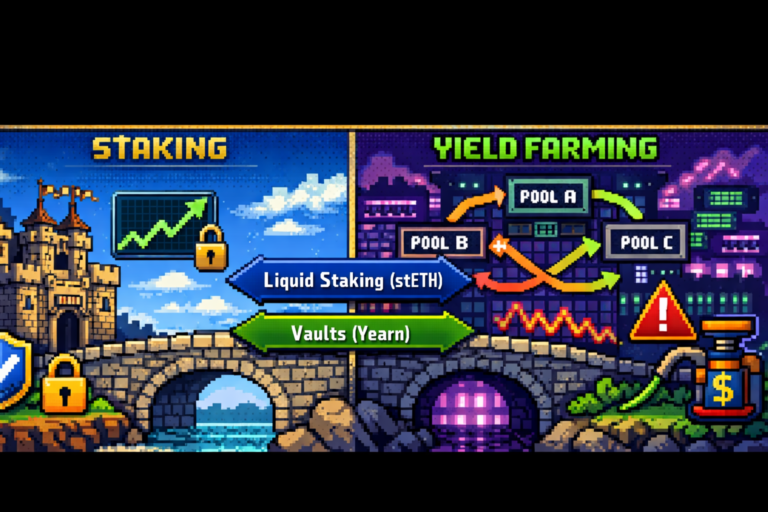
| Staking | Earn rewards by staking PoS coins | Low-Medium |
| Dual Investment | Yield enhancement with price risk | Medium-High |
| ETH 2.0 Staking | Stake ETH for validator rewards | Low |
| Liquid Swap | Provide liquidity to pools | Medium |
Binance Card
A Visa debit card that lets users spend cryptocurrency anywhere Visa is accepted. Cards are available in many regions, with cashback in crypto (typically 1-8% depending on BNB holdings).
Binance Loans
Borrow against your crypto holdings for spot, futures, or margin trading. Terms range from 7-180 days. Loan-to-value ratios vary by coin.
Copy Trading
Follow and automatically copy the trades of successful traders. Useful for beginners learning from experienced traders. You can review trader performance before committing funds.
Trading Bots
Automated trading strategies that execute based on preset parameters. Available to all users with API access. Strategies include grid trading, DCA, and rebalancing.
P2P Marketplace
Peer-to-peer trading with local payment methods. Useful for regions with limited banking integration. Supports hundreds of payment methods globally.
NFT Marketplace
Buy, sell, and mint NFTs on Binance’s integrated marketplace. Features both premium collections and user-generated content. Lower fees than specialized NFT platforms.
Binance Pay
Contactless, borderless crypto payments with zero fees. Send crypto to friends or pay merchants. Available in the Binance app.
Binance Academy
Free educational resources covering blockchain basics to advanced trading strategies. One of the best free crypto education resources available.
Binance Research
In-depth reports on cryptocurrency projects and market trends. Institutional-grade analysis available free to all users.
VIP and Institutional Services
High-volume traders access dedicated account managers, lower fees, and institutional-grade services. Requirements start at $1M in assets or 30-day volume.
Binance Coin (BNB): What It Does
Overview
Binance Coin (BNB) is the native cryptocurrency of the Binance ecosystem. Originally launched as an ERC-20 token on Ethereum in 2017, BNB now operates natively on BNB Chain (formerly Binance Smart Chain).
Market Position
As of 2026, BNB ranks as the fourth-largest cryptocurrency by market capitalization at approximately $39 billion, trading around $250.
Key Use Cases
1. Fee Discounts (Most Popular Use)
BNB holders receive significant trading fee discounts:
- 25% discount on spot trading fees
- 10% discount on futures trading fees
For active traders, these discounts pay for the BNB holdings quickly.
2. Launchpool Access
Stake BNB to farm new tokens from projects launching on Binance Launchpool. Users earn newly issued tokens simply by holding BNB.
3. Token Sales
BNB holders get priority access to token sales on Binance Launchpad. Allocation sizes depend on BNB holdings over time.
4. BNB Chain Gas Fees
BNB is the native gas token for BNB Chain, used to pay transaction fees on the network – similar to ETH on Ethereum.
5. Travel and Lifestyle
Through partnerships, BNB can be used for travel bookings, gift cards, and other real-world purchases via platforms like Travala.
6. Ecosystem Participation
BNB grants voting rights in community governance and access to exclusive events.
BNB Burning Mechanism
Binance commits to burning (permanently removing from circulation) BNB until 50% of the total supply (100 million BNB) is destroyed.
| Metric | Details |
|---|---|
| Total supply (initial) | 200 million BNB |
| Target burned | 100 million BNB |
| Burn mechanism | Quarterly based on trading volume |
| Purpose | Reduce supply, potentially increase value |
These burns occur quarterly and are verifiable on the blockchain. The deflationary mechanism benefits long-term holders.
Investment Considerations
BNB offers utility but carries risk:
- Volatility: BNB price fluctuates like any cryptocurrency
- Concentration: Tied closely to Binance’s success
- Regulatory exposure: Subject to same scrutiny as exchange
For most users, holding BNB makes sense primarily for fee discounts rather than speculative investment. If you trade frequently, the math is simple: buy enough BNB to cover your trading volume, and the fee savings will pay for the investment.
Binance vs Competitors
Comparison Table
| Feature | Binance | Coinbase | Kraken | Crypto.com |
|---|---|---|---|---|
| Spot Fee (Base) | 0.10% | 0.40-0.60% | 0.16-0.26% | 0.40% |
| Futures Fee | 0.02/0.04% | 0.05/0.20% | 0.02/0.05% | 0.02/0.06% |
| Coins Supported | 400+ | 250+ | 200+ | 250+ |
| User Base | 300M+ | 100M+ | ~15M | 100M+ |
| Regulatory Focus | Improving (ADGM) | Strong (US public) | Strong (longstanding) | Moderate |
| Beginner Friendly | Moderate | High | Moderate | High |
| Advanced Features | Excellent | Moderate | Good | Moderate |
| Unique Strength | Scale, liquidity, low fees | Compliance, ease of use | Security reputation | All-in-one app |
Binance vs Coinbase
Coinbase is simpler, more regulated, and better for absolute beginners, but you pay significantly higher fees (0.4-0.6% vs 0.1%). Binance offers more coins, lower fees, and advanced features, but has a steeper learning curve and more complex regulatory history.
Choose Coinbase if: You’re a complete beginner, prioritize regulation, or are in the U.S.
Choose Binance if: You trade actively, want low fees, or need access to many altcoins.
Binance vs Kraken
Kraken has an impeccable security record (never hacked) and strong regulatory compliance, making it attractive for security-conscious users. However, Kraken supports fewer coins (200+ vs 400+) and has lower liquidity.
Choose Kraken if: Security is your absolute priority or you’re in the U.S.
Choose Binance if: You want maximum coin selection and lowest fees.
Binance vs Crypto.com
Crypto.com offers a polished app experience with a popular Visa card program. Binance dominates in trading volume and fee competitiveness.
Choose Crypto.com if: You want an all-in-one finance app with good card rewards.
Choose Binance if: Your primary need is trading with the best fees.
The Bottom Line
Binance is the best choice for users who prioritize low fees, wide coin selection, and advanced trading features. Competitors may be better for beginners (Coinbase), security purists (Kraken), or app-based users (Crypto.com).
How to Get Started on Binance
Step-by-Step Guide
Step 1: Create Account
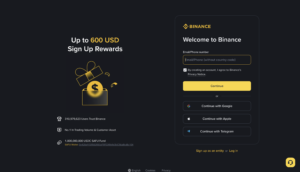
- Visit Binance.com (global) or Binance.us (U.S.)
- Click “Register” and enter email/phone
- Create strong password (use a password manager)
- Verify email/phone with code sent to you
Step 2: Complete Identity Verification (KYC)
- Navigate to verification section in user dashboard
- Select country of residence
- Upload government ID (passport, driver’s license, or national ID)
- Complete liveness check (take a selfie or short video)
- Provide additional info if requested (proof of address sometimes required)
- Wait for approval (typically minutes to hours)
Step 3: Enable Security Features
Do not skip this step. Before depositing funds:
- Set up 2FA using authenticator app (Google Authenticator, Authy), not SMS
- Add withdrawal whitelist (addresses must be approved, adds time delay)
- Set anti-phishing code (appears in all legitimate Binance emails)
- Review device management and remove unknown devices
Step 4: Deposit Funds
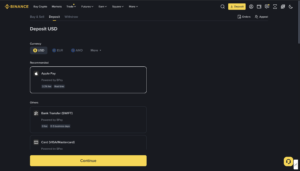
Option A: Bank Transfer (Cheapest)
- Navigate to “Deposit” → “Fiat”
- Select currency and transfer method (ACH/SEPA/wire)
- Follow bank instructions (1-3 days for ACH/SEPA)
- Zero fees for most bank transfers
Option B: Credit/Debit Card (Fastest)
- Select “Buy Crypto” → “Credit/Debit Card”
- Enter amount and card details
- Complete 3D Secure verification with your bank
- Funds available instantly (fees ~2%)
Option C: Crypto Deposit
- Navigate to “Deposit” → “Crypto”
- Select coin and network (IMPORTANT: choose correct network!)
- Copy deposit address or scan QR code
- Send from external wallet
Step 5: Make Your First Trade
Simple Method (Beginners):
- Click “Buy Crypto” on homepage
- Select coin (BTC or ETH recommended for first purchase)
- Enter amount in your local currency
- Review total including fees
- Confirm purchase
- Crypto appears in your spot wallet
Advanced Method (Spot Trading):
- Navigate to “Markets” or “Spot” trading
- Select trading pair (e.g., BTC/USDT)
- Choose order type:
- Market order: Buy at current price (instant)
- Limit order: Set price you want to pay (may not fill immediately)
- Enter amount
- Review and confirm
- Monitor your open orders
Pro Tip: Start with a small amount ($50-100) to learn the platform before trading larger sums. Test withdrawals to ensure you understand the process.
Who Should Use Binance?
Binance Is Ideal For:
| User Type | Why Binance Fits |
|---|---|
| Active traders | Lowest fees, advanced tools, deep liquidity |
| Altcoin investors | 400+ coins, early access to new projects |
| Futures traders | Comprehensive derivatives platform, up to 150x leverage |
| Yield seekers | Multiple earn products, competitive rates |
| Cost-conscious users | Industry-leading low fees, BNB discounts |
| International users | Broad global availability, multiple fiat options |
| API traders | Robust API infrastructure, extensive documentation |
Binance May NOT Be Ideal For:
| User Type | Better Alternative |
|---|---|
| Absolute beginners | Coinbase (simpler interface, more guidance) |
| Security-first users | Kraken (unhacked history, conservative approach) |
| U.S. residents wanting derivatives | Binance.US doesn’t offer them; try regulated alternatives |
| Users in restricted regions | Check local availability first |
| Those wanting phone support | Binance primarily offers chat and email support |
| Privacy-focused users | Decentralized exchanges may be preferable |
The Bottom Line
For the vast majority of cryptocurrency traders, especially those outside the U.S., Binance offers the best combination of low fees, extensive coin selection, and advanced features.
Beginners can use it too, but should:
- Start slowly with the simple “Buy Crypto” interface
- Use Binance Academy to learn
- Avoid complex products (futures, margin) until experienced
- Consider starting with Coinbase for the first $1,000, then moving to Binance
Our Final Verdict
Summary Assessment
Binance remains the king of crypto exchanges for good reason. Its combination of low fees, extensive coin selection, deep liquidity, and advanced trading features is unmatched in the industry.
Scorecard
| Category | Score | Comments |
|---|---|---|
| Fees | 10/10 | Industry-leading low fees |
| Security | 9/10 | Strong measures, SAFU fund, past scrutiny noted |
| Coin Selection | 10/10 | 400+ coins, 1,500+ pairs |
| User Experience | 8/10 | Powerful but has learning curve |
| Regulation | 8/10 | Major progress, ADGM license |
| Customer Support | 7/10 | Improved but can be slow |
| Overall | 8.7/10 | Best for most traders |
The Bottom Line
For most cryptocurrency traders, Binance is the best exchange available. If you’re outside the U.S., comfortable with a slightly steeper learning curve, and value low fees and wide selection above all else, Binance is your platform.
The 2026 upgrades, particularly the ADGM license and enhanced compliance infrastructure, address many past concerns about regulatory uncertainty. Binance has matured into a platform that balances innovation with institutional-grade safeguards.
Who Should Choose Binance
- Active traders seeking lowest fees
- Altcoin investors wanting maximum selection
- Cost-conscious users who care about fees
- International users (outside U.S.)
- Futures traders needing comprehensive derivatives
- Yield seekers exploring passive income
Who Might Look Elsewhere
- Absolute beginners (consider Coinbase first for simplicity)
- U.S. residents wanting derivatives (not available on Binance.US)
- Security purists preferring Kraken’s untouched record
- Users in restricted regions (check local availability)
- Privacy-focused users (consider decentralized exchanges)
Our Personal Take
We’ve used Binance since 2018, through bull markets and bear markets, through regulatory storms and security incidents. It remains our primary exchange for active trading because:
- The fee savings add up to thousands of dollars annually
- The coin selection means we rarely need other exchanges
- The liquidity ensures large trades execute smoothly
- The ecosystem (Earn, staking, research) keeps us within one platform
Is Binance perfect? No. Customer support can frustrate. The interface intimidates beginners. Past regulatory issues worry some users.
Is Binance the best choice for most traders? Yes. Unequivocally.
Ready to Start Trading?
👉 Binance.US for American Users
📚 Next Steps:
- Read our Best Crypto Exchanges Comparison
- Learn How to Buy Crypto Safely
- Secure Your Crypto with Hardware Wallets
Disclosure: This article contains affiliate links. If you sign up for Binance through these links, we may earn a commission at no extra cost to you. We only recommend platforms we’ve personally tested and trust with our own funds. This review is based on our independent research and experience.
This review was last updated for the 2026 edition. Exchange fees, features, and regulatory status change frequently. Check Binance’s official website for current information.
Frequently Asked Questions
Binance spot trading fees start at 0.1% for both makers and takers. With BNB discounts, fees drop to 0.075%. Futures trading is even lower at 0.02%/0.04%. Bank transfers are free, card purchases cost around 2%, and withdrawal fees vary by coin. Binance employs industry-standard security including cold storage (95%+ of funds), multi-signature wallets, 2FA, and device whitelisting. The SAFU fund provides $1 billion in emergency insurance. While Binance has faced past incidents (2019 hot wallet hack, 2022 BNB bridge exploit), no user funds were ultimately lost. Yes, but U.S. users must use Binance.US, a separate regulated platform with fewer coins (approximately 180) and no derivatives trading. The global Binance.com platform is not available to U.S. residents. Binance supports over 400 cryptocurrencies and 1,500+ trading pairs. This includes all major coins (BTC, ETH, SOL) plus extensive altcoins, DeFi tokens, and new projects through Launchpad. Binance offers custodial wallets within the exchange (for trading) and also supports Trust Wallet (acquired by Binance), a popular non-custodial mobile wallet for self-custody. Navigate to "Wallet" → "Withdraw," select the cryptocurrency, enter your external wallet address, confirm with 2FA, and pay the network fee. Always test with a small amount first. SAFU (Secure Asset Fund for Users) is an emergency insurance fund holding $1 billion in USDC. In the event of a security breach causing user losses, SAFU would compensate affected users. Yes, significantly more than in previous years. Binance has obtained licenses in over 20 jurisdictions, most notably the ADGM license in Abu Dhabi, which requires institutional-grade compliance and operational restructuring. tart with the simple "Buy Crypto" interface rather than the full spot exchange. Complete identity verification, enable 2FA, deposit funds via bank transfer (cheapest), and buy Bitcoin or Ethereum. Use Binance Academy for educational resources. Binance provides transaction history and tax reports that users can download. Tax reporting responsibility ultimately falls on users. Consult a tax professional for your jurisdiction. Yes, Binance Earn offers staking for numerous Proof-of-Stake cryptocurrencies with competitive yields. Options include flexible and locked staking. There's no minimum deposit for crypto transfers. For fiat deposits, minimums vary by payment method (often $10-50 for cards, higher for bank transfers). Yes, Binance offers highly-rated mobile apps for both iOS and Android, with full trading functionality, Earn access, and portfolio tracking. This can result in permanent loss of funds. Always double-check the network (ERC-20, BEP-20, TRC-20, etc.) before withdrawing. Binance recovery is rarely possible.
How much are Binance fees?
Is Binance safe?
Is Binance available in the US?
What coins are on Binance?
Does Binance have a wallet?
How do I withdraw from Binance?
What is Binance SAFU fund?
Is Binance regulated in 2026?
How do I use Binance as a beginner?
Does Binance report to tax authorities?
Can I stake on Binance?
What is the minimum deposit on Binance?
Does Binance have a mobile app?
What happens if I send crypto to the wrong network?
About the Author

1 thought on “Binance Review 2026: Pros, Cons, Fees and Safety”