

Remember when the internet seemed confusing? Dial-up sounds, incomprehensible URLs, and everyone talking about something called “email” that you were sure would never catch on?
That’s where cryptocurrency is today.
If you’re reading this because you feel behind – like everyone else already owns Bitcoin and you missed the boat – I have good news: You’re actually arriving at the perfect time.
When I first started in crypto back in 2017, I made every mistake you can imagine. I bought at all-time highs. I fell for a scam (lost $300 to a “giveaway” that still makes me cringe). I stored coins on an exchange that later got hacked. And I definitely didn’t understand what I was actually buying.
But here’s what I learned: You don’t need to be a technologist to use crypto, just like you don’t need to understand SMTP protocols to send an email.
By the time you finish this cryptocurrency guide for beginners (2026 edition) , you’ll understand crypto better than 90% of people who already own it. You’ll know how to buy safely, store securely, and avoid the traps that catch most newcomers.
Let’s begin.
What Actually IS Cryptocurrency? (The Simple Explanation)
Cryptocurrency is digital money that works without banks. You can send it to anyone, anywhere in the world, at any time, and no one can stop you or take it away.
That’s it. That’s the core idea.
Everything else – blockchain, mining, wallets, private keys, is just infrastructure that makes this possible. And just like you don’t need to understand how the power grid works to flip on a light switch, you don’t need to understand every technical detail to use crypto.
The 3 Core Concepts Every Beginner Must Understand
- It’s digital, not physical
There are no physical coins to hold – no gold colored Bitcoin you can keep in a safe. Everything exists as code on a distributed database called a blockchain. When you own cryptocurrency, you own a record on that database saying, “This address has this much.”
2. It’s decentralized
No single company, government, or person controls Bitcoin or Ethereum. Thousands of computers around the world work together to verify every transaction. This means no central authority can freeze your account, block your payments, or confiscate your funds.
3. It’s secured by cryptography
Complex mathematics makes it virtually impossible for anyone to fake or steal transactions. Think of it like this: The code protecting your crypto is so secure that breaking it would require more computing power than exists on Earth.
The “Email for Money” Analogy
Just as you can email anyone instantly without going through a postal service, you can send crypto to anyone without going through a bank. Your crypto wallet is like your email address, it receives funds. Your private key (more on this later) is like your password, it lets you send funds.
The “Gold 2.0” Comparison
You’ve probably heard Bitcoin called “digital gold.” Here’s why:
| Feature | Physical Gold | Bitcoin |
|---|---|---|
| Supply | Limited (hard to mine) | Limited (capped at 21 million) |
| Transfer | Heavy, expensive to move | Global, sent in minutes |
| Storage | Requires physical vault | Secured by private keys |
| Divisibility | Difficult to split | Divisible to 8 decimals |
Traditional Money vs. Cryptocurrency: A Simple Comparison
| Feature | Traditional Money | Cryptocurrency |
|---|---|---|
| Controlled by | Banks and governments | No single entity |
| Transfer time | 1-5 business days | Minutes |
| Transfer cost | $15-50 international | Pennies to few dollars |
| Can be seized? | Yes, by governments/banks | Only if you share your keys |
| Supply | Unlimited (can print more) | Limited (Bitcoin capped at 21M) |
Beginner Tip: You don’t need to understand the technology completely to use crypto, just like you don’t need to understand how email protocols work to send a message. Start with the basics, and the rest will follow.
How Blockchain Works (Without the Technical Jargon)
If cryptocurrency is the money, blockchain is the ledger that tracks it.
The “Digital Ledger” Analogy
Imagine a shared Google Sheet that records every transaction ever made. This sheet exists on thousands of computers worldwide simultaneously. To change any record – say, to add money to your account that you didn’t earn – you’d need to change it on every single computer at the exact same time.
That’s practically impossible.
This is blockchain: a permanent, unchangeable record of every transaction, maintained by thousands of independent computers working together.
What Is a Block?
Think of a block like a page in a ledger book. Each page contains:
- A list of recent transactions (who sent what to whom)
- A timestamp (when it happened)
- A unique fingerprint (called a “hash”) of the previous page
What Is the Chain?
Blocks are linked together chronologically – each new block contains the fingerprint of the block before it. This creates an unbreakable chain of history.
If someone tried to alter a transaction from block #5, they’d have to change every single block after it, on thousands of computers, faster than new blocks are being added.
This is why blockchain is considered “immutable”, once something is recorded, it’s there forever.
Who Verifies Transactions?
Computers called miners (in Bitcoin) or validators (in Ethereum) do this work.
Think of them as auditors who check that no one is trying to spend the same money twice. They verify that you actually have the funds you’re trying to send, and that you haven’t already spent them elsewhere.
For doing this work, they’re rewarded with new coins.
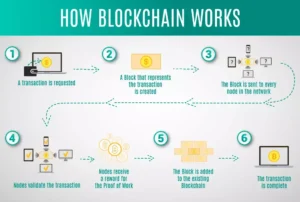
The Transaction Process
- Someone sends Bitcoin from their wallet to another address
- The network of computers receives this transaction request
- Validators verify that the sender has sufficient funds and hasn’t double-spent
- Transaction is added to a block with other recent transactions
- Block is added to the blockchain permanently
- Transaction complete – recipient sees funds in their wallet (usually within minutes)
Two Main Consensus Mechanisms Explained Simply
Proof of Work (used by Bitcoin)
“Computers compete to solve complex puzzles. The winner gets to add the next block and earn Bitcoin. This uses lots of electricity but is extremely secure, you’d need to control more than half of all computing power on Earth to cheat.”
Proof of Stake (used by Ethereum, Solana, Cardano)
“People lock up their coins as a guarantee they’ll act honestly. They’re randomly chosen to verify transactions and earn rewards. This uses 99% less energy and allows for faster transaction processing.”
Key Takeaway: You don’t need to mine or validate to use crypto. Think of blockchain as the invisible infrastructure that makes everything work, like the internet itself. You just use applications built on top of it.
Bitcoin vs. Ethereum vs. Everything Else
Think of crypto like a city.
Bitcoin is the foundation – the first, most trusted, and most secure. It’s the downtown core where everyone feels safe.
Ethereum is the innovation hub – where new ideas are built, experimented with, and launched. It’s busier, more expensive to use, but full of opportunity.
Altcoins are the surrounding neighborhoods – some are thriving communities with real value; others are empty developments that will never be completed.
Let’s explore each.
Bitcoin (The King)
Purpose: Digital gold. Store of value. Protection against inflation and monetary debasement.
Supply: Capped at 21 million coins (deflationary, no more will ever exist)
Speed: ~7 transactions per second (slow but secure)
Best for: Long-term holding (“HODLing”), large value transfers, portfolio foundation
Risk level: Lowest among crypto (but still volatile compared to traditional assets)
In my portfolio: Bitcoin is the bedrock. When I first started, I bought Bitcoin before anything else – and that’s exactly what I recommend for beginners.
Ethereum (The Innovator)
Purpose: Smart contracts (self-executing agreements), decentralized applications (dapps), DeFi (decentralized finance), NFTs
Supply: No fixed cap but has a burning mechanism that can make it deflationary
Speed: ~15-30 transactions per second on mainnet; thousands on Layer 2 solutions like Arbitrum and Optimism
Best for: Building applications, staking for yield, participating in DeFi, NFT projects
Risk level: Moderate
Stablecoins (The Safety)
Purpose: Price stability. Each stablecoin aims to be worth exactly $1.
Examples
- USDT (Tether): Most widely used, but transparency questions remain
- USDC (Circle): Regulated, transparent, regularly audited
- DAI: Decentralized, backed by crypto collateral
Best for: Trading pairs, earning yield, avoiding volatility, moving funds between exchanges
Risk level: Low (but depends on the backing. always research which stablecoin you’re using)
Major Altcoins to Know
| Coin | Purpose | Risk Level |
|---|---|---|
| Solana (SOL) | Fast, low-cost transactions for apps; competes with Ethereum | Moderate-High |
| Binance Coin (BNB) | Exchange token for Binance; offers trading fee discounts | Moderate |
| Cardano (ADA) | Research-driven, academic approach to blockchain | Moderate |
| Polkadot (DOT) | Connects different blockchains so they can communicate | Moderate-High |
| Chainlink (LINK) | Brings real-world data (prices, weather, etc.) to blockchain | Moderate |
The “Blue Chip vs. Small Cap” Analogy
Bitcoin and Ethereum are blue-chip stocks. They’re established, have massive adoption, and carry lower risk within crypto. Like Microsoft or Apple in traditional markets.
Smaller altcoins are like small-cap stocks. They have higher potential returns – a coin could 10x or 100x, but also much higher risk of losing everything. Many altcoins from previous years no longer exist.
Market Dominance Visual
Bitcoin:      ████████████████████████████████░░░░░░  ~48%
Ethereum:     ██████████████░░░░░░░░░░░░░░░░░░░░░░░░  ~18%
Others:       ██████████████████████████████████████  ~34%
(Approximate as of early 2026 – actual percentages fluctuate daily)
Important Warning: This is NOT financial advice. These are descriptions, not recommendations. Never invest in a coin just because you read about it in a guide. Always research thoroughly and understand what you’re buying.
Which Cryptocurrency Should You Buy First?
This is the most common question I receive from beginners, and my answer is always the same.
Start with Bitcoin.
Buy a small amount – $50 or $100. Learn how to purchase it, how to store it, how to transfer it. Experience the process with something where if you make a mistake, you haven’t lost your life savings.
Once you’re comfortable with Bitcoin and understand how crypto works, then you can explore Ethereum and perhaps one or two established altcoins.
How to Buy Your First Cryptocurrency Safely
This is where most beginners get nervous—and rightfully so. Moving real money into an unfamiliar system feels uncomfortable.
Follow these steps exactly, and you’ll avoid 90% of the mistakes new buyers make.
Step 1: Choose a Reputable Exchange
An exchange is where you convert regular money (USD, EUR, GBP) into cryptocurrency.
For absolute beginners, I recommend starting with Coinbase. The interface is clean, educational resources are excellent, and while fees are higher than competitors, the simplicity is worth the cost for your first purchase.
| Exchange | Best For | Fees | Security | Beginner-Friendly |
|---|---|---|---|---|
| Coinbase | Absolute beginners | Higher | Very high | ⭐⭐⭐⭐⭐ |
| Kraken | Security focus | Moderate | Very high | ⭐⭐⭐⭐ |
| Binance | Low fees, many coins | Lower | High | ⭐⭐⭐ |
| Gemini | Regulated, US-focused | Moderate | Very high | ⭐⭐⭐⭐ |
| Cash App | Bitcoin-only, simple | Moderate | High | ⭐⭐⭐⭐ |
What to Look For in an Exchange
- Regulated in your country (licenses from financial authorities)
- Strong security history (no major hacks; transparent about past incidents)
- Insurance on deposits (protection if the exchange fails)
- Good customer support (test it. Send a question and see how long they take)
- User-friendly interface (you shouldn’t need a manual to buy)
Red Flags to Avoid
- Exchanges promising unrealistic returns
- No clear company address or team information
- Poor reviews on Trustpilot or Reddit
- Unknown exchanges with “too good to be true” offers
- No identity verification requirements (legitimate exchanges require this)
Step 2: Create and Verify Your Account
- Sign up with email and create a strong password
- Complete identity verification (KYC – Know Your Customer)
- You’ll need to upload a government ID and sometimes a selfie
- This is normal and required by law in most countries3. Enable two-factor authentication (2FA) IMMEDIATELY4. Add a payment method (bank transfer, debit card, or wire)
CRITICAL SECURITY WARNING: Always enable 2FA using an authenticator app (Google Authenticator, Authy, or Microsoft Authenticator). NEVER use SMS 2FA if you can avoid it—SIM swapping (where hackers trick your phone carrier into transferring your number to their SIM card) is real and happens every day.
Step 3: Make Your First Purchase
Let’s walk through an actual purchase on Coinbase:
- Deposit funds
- Bank transfer: Cheapest but takes 1-3 days
- Debit card: Instant but higher fees
- Start with $50-100 – small enough to learn, large enough to care
2. Navigate to the trading pair
- Search for “BTC/USD” (Bitcoin priced in US Dollars)
3. Choose order type
- Market buy: Buys immediately at current price (simplest for beginners)
- Limit buy: Buys only at price you specify (more advanced)4. Enter amount ($50, $100, whatever you’re comfortable with)
5. Review and confirm
- Check the fees before confirming
- Take a screenshot of the confirmation (for your records)6. Wait a few minutes – your Bitcoin will appear in your exchange wallet
Step 4: What to Do Immediately After Buying
This is the most important lesson in this entire guide:
Most beginners make the mistake of leaving their coins on the exchange.
Remember this phrase—it might save your money someday:
“Not your keys, not your coins.”
If your crypto is on an exchange, the exchange controls the private keys. You essentially have an IOU from the exchange. If the exchange gets hacked, freezes withdrawals, or goes bankrupt, your coins could disappear.
Simple rule of thumb:
- Small amounts for trading or frequent use: Can stay on exchange
- Any amount you want to keep for more than a few weeks: Move to your own wallet
Beginner Rule: If you’re not trading actively, move your crypto off the exchange immediately. Exchanges get hacked. Your personal wallet (if secured properly) is much safer.
Crypto Wallets: Where Your Coins Actually Live
Here’s something that confuses almost every beginner.
Your coins don’t physically exist in a wallet.
Your wallet stores something far more important: the private keys – the passwords that let you access and move your coins on the blockchain.
The Keys Analogy
-
Public key = Your bank account number . Safe to share with anyone who wants to send you money
-
Private key = Your ATM PIN + online banking password combined . NEVER share this with anyone, ever
Hot Wallets vs. Cold Wallets
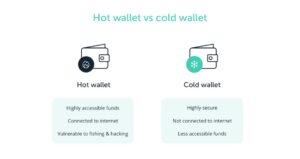
| Feature | Hot Wallets | Cold Wallets |
|---|---|---|
| What they are | Apps on your phone/computer | Physical devices (like USB drives) |
| Examples | MetaMask, Trust Wallet, Coinbase Wallet | Ledger, Trezor, SafePal |
| Best for | Small amounts, frequent transactions | Large amounts, long-term holding |
| Internet connection | Yes (always online) | No (offline until connected) |
| Security level | Good for small amounts | Maximum security |
| Cost | Free | $50-150 |
Hot Wallets Explained
MetaMask
The most popular wallet for Ethereum and DeFi. Works as a browser extension and mobile app. Free, user-friendly, but requires caution, you’ll interact with many potential scams.
Trust Wallet
Binance-owned, supports many blockchains. Good all-around mobile wallet with built-in exchange features.
Coinbase Wallet
Separate from Coinbase exchange (important distinction). Good integration with the exchange but less versatile than MetaMask for advanced use.
Cold Wallets Explained
Ledger Nano X/S
The industry standard. Looks like a USB drive. Supports thousands of coins. Has its own screen to verify transactions—even if your computer is hacked, the hacker can’t approve transactions without physically pressing the device buttons.
Trezor
The original hardware wallet. Open-source code, excellent security track record. Slightly less user-friendly than Ledger but trusted by security purists.
The “Seed Phrase” Rules (MOST IMPORTANT SECTION)
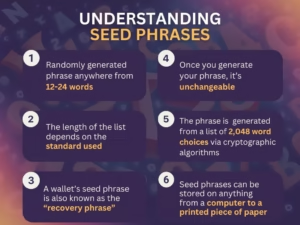
When you create any wallet, hot or cold, you’ll receive 12 or 24 random words. This is your seed phrase (also called recovery phrase).
This is the master key to ALL your funds.
If someone gets these words, they get your money. If you lose these words, you lose your money forever. No “forgot password” button. No customer support to call.
The Four Commandments of Seed Phrases
1. NEVER type it online
Not in Google Docs. Not in Notes. Not in a password manager. Not anywhere connected to the internet. Keyloggers and malware are real.
2. Write it on paper
Physically, with a pen. On paper. (Consider metal backup plates like Cryptosteel or Billfodl, paper can burn in a fire.)
3. Store it safely
In a safe, fireproof box, or safety deposit box. Multiple locations if you have significant funds.
4. Never share it
No “support agent,” no “friend,” no “exchange representative” will ever ask for your seed phrase. Anyone who does is a scammer.
Test Your Understanding: If you lose your phone with MetaMask installed, but you have your seed phrase written down, can you recover your funds?
Answer: YES! Download MetaMask on your new phone, select “Restore Wallet,” enter your seed phrase. Your funds are back. This is why seed phrases exist—they’re your universal backup.
Is Crypto Safe? Security Risks Every Beginner Must Know
I won’t sugarcoat this: Cryptocurrency comes with real risks.
But here’s the truth: Most losses happen because people ignore basic security practices, not because the technology failed. Understand these risks, follow the protection strategies, and you’ll be safer than 95% of crypto users.
Risk 1: Market Volatility
Bitcoin can drop 30-50% in weeks. Smaller coins can go to zero overnight. This isn’t a bug, it’s a feature of a new, unregulated asset class.
Protection:
- Only invest what you can afford to lose completely
- Start small – $50-100 to learn
- Don’t panic sell during drops (this is how beginners lock in losses)
- Think in years, not days
Risk 2: Exchange Hacks
Even major exchanges have been hacked. Mt. Gox (2014), Coincheck (2018), FTX (2022) and many others lost billions in customer funds.
Protection:
- Move to cold wallet for long-term storage
- Only keep trading amounts on exchanges
- Use regulated exchanges with insurance
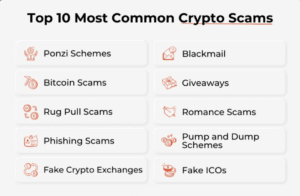
Risk 3: Scams and Phishing
| Scam Type | How It Works | Red Flags |
|---|---|---|
| Fake airdrops | “Send 0.1 ETH to receive 1000 FREE tokens!” | Never real. No one gives free money. |
| Phishing sites | Fake websites that look like real exchanges | Check URL carefully. Bookmark real sites. |
| Social media impersonation | “Elon Musk” giving away crypto | Elon doesn’t give away crypto. Ever. |
| Pump and dump groups | “Join our signal group for guaranteed profits!” | Guaranteed profits = guaranteed scam |
| Romance scams | “I love you, now invest in this coin with me” | Sadly common. Never invest for strangers. |
Protection:
- Never click links in DMs or suspicious emails
- Bookmark your exchange and wallet websites
- Ignore anyone promising guaranteed returns
- If it sounds too good to be true, it is
Risk 4: Self-Custody Risk
If YOU lose your seed phrase, your money is gone forever. No bank to call. No “forgot password” option.
Protection:
- Multiple backups (paper + metal)
- Store backups in separate locations
- Test recovery with small amount first
- Consider a safety deposit box for your primary backup
Risk 5: Regulatory Risk
Governments may change rules. Some exchanges may be blocked in your country. Tax laws are still evolving.
Protection:
- Stay informed about regulations in your country
- Use decentralized options for long-term holdings
- Keep thorough records of all transactions
The “3-2-1” Backup Rule for Seed Phrases
3 copies of your seed phrase
2 different storage methods (paper + metal)
1 off-site backup (safety deposit box or trusted family member’s safe)
Common Beginner Mistakes (And How to Avoid Them)
I made almost all of these mistakes. Learn from my pain instead of experiencing it yourself.
Mistake 1: FOMO Buying at All-Time Highs
“You see Bitcoin hitting $120,000 and panic buy because you’re afraid you’ll miss out. Then it drops to $70,000 and you panic sell because you’re afraid you’ll lose everything.”
Solution: Dollar-cost averaging (DCA). Buy small amounts regularly regardless of price – $50 every week, or $200 every month. This smooths out volatility and removes emotion from buying.
Mistake 2: Keeping Everything on Exchange
“You wouldn’t keep your life savings in your wallet on the street. Don’t keep your crypto on an exchange.”
Solution: Cold wallet for long-term storage. Exchange only for active trading.
Mistake 3: Falling for “Get Rich Quick” Promises
“If it sounds too good to be true, it is. Crypto creates wealth over years, not overnight.”
Solution: Ignore Telegram groups promising 10x returns. Stick to established projects. The real money in crypto is made by patient investors, not gamblers.
Mistake 4: Not Understanding Tax Implications
“In many countries, every trade is a taxable event. You can owe taxes even if you didn’t cash out to dollars.”
Solution: Research your local laws before trading. Use crypto tax software from day one. Keep records of every transaction.
Mistake 5: Sharing Seed Phrases or Private Keys
“No legitimate service will EVER ask for your seed phrase.”
Solution: Treat your seed phrase like your social security number + bank PIN + passport combined. Never type it online. Never share it. Never.
Mistake 6: Investing More Than You Can Afford to Lose
“Crypto is volatile. It can go to zero. If you can’t sleep at night because you’re worrying about your crypto, you’ve invested too much.”
Solution: The “idle money” rule – only invest money you wouldn’t miss for 3-5 years. If you’d be financially devastated by losing it, don’t invest it.
Mistake 7: Chasing “The Next Bitcoin”
“Every bull market brings thousands of new coins promising to be ‘the next Bitcoin.’ Almost all of them go to zero.”
Solution: Build a foundation with Bitcoin and Ethereum before exploring smaller projects. Even then, limit “speculative plays” to 5-10% of your portfolio maximum.
Mistake 8: Ignoring Security for Convenience
“Saving your seed phrase in Google Docs is convenient, until your account gets hacked.”
Solution: Security is inconvenient. That’s the point. Embrace the inconvenience; it’s protecting your money.
Crypto Taxes: What Beginners Need to Know
I am not a tax professional. Tax laws vary by country and change frequently. Consult a qualified tax professional for your specific situation.
Key Concepts
When do you owe taxes?
In most countries, these are taxable events:
- Selling crypto for fiat (USD, EUR, GBP, etc.)
- Trading one crypto for another (Bitcoin for Ethereum, for example)
- Spending crypto on goods or services
- Earning crypto (mining, staking rewards, income)
When do you NOT owe taxes?
- Buying crypto with fiat
- Transferring between your own wallets
- Holding (no tax until you sell or trade)
Short-term vs. Long-term
| Holding Period | Typical Tax Rate |
|---|---|
| Less than 1 year | Higher (ordinary income rate) |
| More than 1 year | Lower (capital gains rate) |
This is why many investors follow a “buy and hold” strategy. It’s often more tax-efficient.
Record Keeping Is Essential
Every trade. Every transaction. Every airdrop. Every staking reward.
Tools to use from day one:
- CoinTracker (connects to exchanges and wallets)
- Koinly (popular with good reporting)
- CoinLedger (easy to use)
- TaxBit (used by some exchanges directly)
Download all your exchange reports monthly. Don’t wait until tax season.
The 30-Day Rule (for some countries)
In the UK, Australia, and some other jurisdictions, there’s a “bed and breakfasting” rule: If you sell at a loss and buy the same asset back within 30 days, you can’t claim the loss for tax purposes.
Check your local rules. This catches many beginners by surprise.
Beginner Tip: Create a spreadsheet from day one. Record every transaction: date, amount, price, what you traded, and why. Future you will be incredibly grateful.
Your Next Steps: From Beginner to Confident Investor
You’ve made it through the complete guide. Now what?
The 30-Day Beginner Roadmap
| Week | Focus | Action Items |
|---|---|---|
| Week 1 | Education | Read this guide twice. Watch “Bitcoin Explained” on YouTube. Listen to a few podcast episodes. |
| Week 2 | Practice | Create exchange account. Enable 2FA. Explore the interface. Try demo trading if available. |
| Week 3 | First Purchase | Buy $50-100 of Bitcoin or Ethereum. Leave on exchange. Learn how to monitor prices. |
| Week 4 | Self-Custody | Get a hardware wallet (or software wallet for small amounts). Move your small amount to it. Practice recovery. |
Recommended Learning Resources
Books:
- “The Bitcoin Standard” by Saifedean Ammous
- “Digital Gold” by Nathaniel Popper
- “The Infinite Machine” by Camila Russo (about Ethereum)
YouTube Channels:
- Coin Bureau (comprehensive, well-researched)
- Whiteboard Crypto (excellent animations for beginners)
- Finematics (deeper dives on DeFi concepts)
Podcasts:
- The Pomp Podcast
- Unchained
- Bankless
- What Bitcoin Did
Websites to Bookmark:
- CoinMarketCap (prices and information)
- CoinGecko (alternative to CoinMarketCap)
- Your exchange’s blog (for updates and education)
- CryptoManiacs.xyz (for our future guides!)
Final Words of Wisdom
Crypto is a marathon, not a sprint.
The people who succeed aren’t the ones who get rich overnight – they’re the ones who learn consistently, secure their assets properly, and stay patient through the ups and downs.
You now know more than 90% of people who already own crypto. You understand the risks, the security practices, and the fundamentals. You’re prepared.
The next step is yours.
Start small. Stay curious. Secure everything. And welcome to the revolution.
Disclaimer: This guide is for educational purposes only and does not constitute financial advice. Cryptocurrency investing involves risk. Always do your own research and consult with a qualified financial professional before making investment decisions.
This guide was last updated for the 2026 edition. Cryptocurrency evolves quickly – check back for updates, and always verify information with multiple sources before making financial decisions.
About the Author

This guide does a great job of breaking down the basics of crypto for beginners. I found the section on hot vs cold wallets especially useful—it’s an often overlooked but essential aspect of keeping crypto secure. Posts like this make diving into crypto feel much less intimidating.