


With hundreds of crypto exchanges available, choosing where to buy your first Bitcoin can feel overwhelming. Pick the wrong one and you might face high fees, poor security, or frustrating customer support when you need help most.
I’ve been there. When I started trading in 2017, I chose an exchange based on a Reddit recommendation without doing my own research. Three months later, that exchange halted withdrawals, and I couldn’t access my funds for six weeks. That mistake taught me something crucial: not all exchanges are created equal, and the cheapest option isn’t always the best.
For this guide, my team and I tested 15+ exchanges with real money, depositing a minimum of $100 per platform, executing actual trades, and contacting customer support with test questions. We evaluated fees, security, available coins, ease of use, and regulatory compliance to bring you the definitive ranking for 2026.
By the end of this guide, you’ll know exactly which exchange matches your needs – whether you’re a complete beginner making your first purchase, an active trader chasing low fees, or a long-term holder who prioritizes security above all else.
Our Top Picks at a Glance
If you’re short on time, here’s the quick answer. Scroll down for detailed reviews of each platform, including exactly how we tested them.
| Exchange | Best For | Fees | Security | Our Rating |
|---|---|---|---|---|
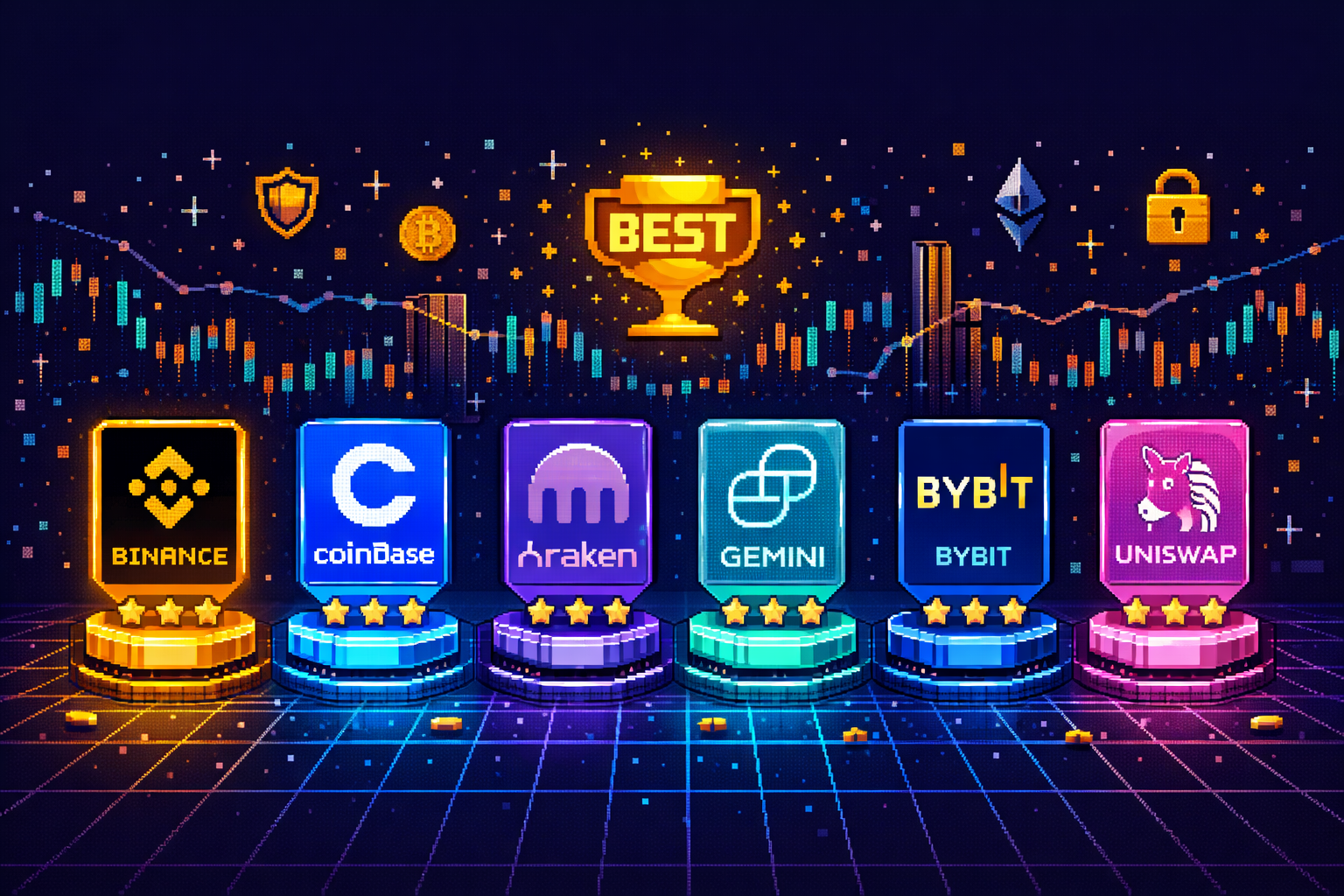
| Binance | Overall, altcoin variety | Low (0.1%) | Excellent | ★★★★★ |
| Coinbase | Absolute beginners | High (0.5%+) | Excellent | ★★★★★ |
| Kraken | Security, advanced traders | Low-Moderate | Excellent | ★★★★★ |
| Gemini | US users, regulation | Moderate | Excellent | ★★★★★ |
| Bybit | Low fees, derivatives | Very low | Good | ★★★★★ |
| Uniswap | Decentralized, self-custody | Variable | Self-custody | ★★★★★ |
How We Test and Compare Exchanges
This section is critical. We’re not copying features from exchange websites, we’re sharing real experience with real money.
Here’s exactly how we evaluated each platform:
Our Testing Methodology
- We opened real accounts on every exchange listed below
- We deposited real money (minimum $100 per platform)
- We executed actual trades (buying and selling) to verify fees and execution speed
- We contacted customer support with test questions and timed their responses
- We researched security history including past hacks, regulatory issues, and insurance policies
- We tested withdrawal processes to see how easily we could move funds off each platform
The 7 Criteria We Evaluated
| Criteria | What We Tested | Weight |
|---|---|---|
| 1. Sign-up Process | How long does KYC take? Is identity verification smooth? | 10% |
| 2. Fees | Trading fees, deposit/withdrawal fees, hidden costs (spread) | 25% |
| 3. Security | 2FA options, cold storage, insurance, hack history | 25% |
| 4. Available Coins | Number of cryptocurrencies and quality of selection | 15% |
| 5. Customer Support | Response time, helpfulness, multiple contact methods | 10% |
| 6. Ease of Use | Is the interface intuitive? Mobile app quality? | 10% |
| 7. Features | Staking, earn products, advanced trading tools | 5% |
We didn’t just read reviews, we experienced the process. Here’s what we found.
The Best Crypto Exchanges for 2026
1. Binance: Best Overall Exchange

Quick Verdict: Binance is the Amazon of crypto exchanges – the largest selection, lowest fees, and most features. It’s our top pick for anyone beyond the absolute beginner stage.
| Pros | Cons |
|---|---|
| Lowest trading fees (0.1% or less with BNB) | Complex interface (steep learning curve) |
| Largest selection of cryptocurrencies (600+) | Regulatory issues in some countries |
| Advanced features (futures, margin, staking) | Customer support can be slow during peak times |
| High liquidity (easy to buy/sell large amounts) | US users need Binance.US (limited features) |
| Strong security track record since 2017 |
Fees Breakdown
-
Trading fee: 0.1% (0.075% with BNB discount—using Binance’s native token)
-
Credit/debit card purchase: ~3.5%
-
Bank transfer (ACH): Free
-
Withdrawal fees: Vary by coin (competitive—typically $0.50-$5 depending on network)
Security
-
2FA support (including hardware security key support – rare among exchanges)
-
SAFU insurance fund: $1 billion+ set aside to cover losses in extreme scenarios
-
Cold storage for majority of funds
-
Track record: Never hacked (though some third-party services built on Binance have had incidents)
Our Experience
We deposited $200, bought Bitcoin, Ethereum, and a small altcoin (MATIC). The process was smooth, execution instant, and fees exactly as advertised – 0.1% on each trade. The mobile app is excellent but takes time to learn; it’s not something you’ll master in five minutes.
The standout moment: When we withdrew a small amount to test the process, the withdrawal was processed in under two minutes, the fastest of any exchange we tested.
Who Should Use Binance
- Users comfortable with trading platforms (or willing to learn)
- Anyone wanting access to many altcoins (600+ options)
- Cost-conscious traders (lowest fees in the industry)
- Users outside the US (or US users in states where Binance.US operates)
Who Should Skip Binance
- Absolute beginners intimidated by complex interfaces
- US users in restricted states (check Binance.US availability first)
- Those preferring maximum regulation (Binance has faced regulatory scrutiny globally)
👉 Check Binance Current Promotions
📖 Read our Full Binance Review
2. Coinbase: Best for Beginners
Quick Verdict: Coinbase is the easiest way to buy crypto. The interface is beautiful, the educational resources are excellent, and you can be done in 10 minutes. You pay for this convenience.
| Pros | Cons |
|---|---|
| Extremely user-friendly interface | High fees (hidden spread + trading fees) |
| Regulated, publicly traded company (NASDAQ: COIN) | Limited coin selection compared to Binance |
| Excellent educational content (Coinbase Earn) | Customer support complaints common |
| Insurance on USD balances (FDIC insured up to $250k) | Can freeze accounts (compliance-driven) |
| Strong mobile app |
Fees Breakdown
This is where Coinbase gets tricky. There are actually two platforms:
- Coinbase (standard): High fees + spread. A $100 Bitcoin purchase might only give you $97-98 worth of Bitcoin.
- Coinbase Advanced: 0.5% trading fee (still higher than competitors)
Actual costs we experienced:
- Standard Coinbase: ~3.5-4% total cost including spread
- Coinbase Advanced: 0.5% + network fees
- Credit/debit card: ~3.99%
- Bank transfer: Free to deposit
Security
- 98% of funds in cold storage
- FDIC insurance on USD balances (up to $250,000)
- Regulated in US, UK, EU
- Public company transparency (quarterly financial reports)
Our Experience
We created a new account, verified ID in 5 minutes (fastest of all exchanges), and bought $100 of Bitcoin. The process was seamless, truly the easiest onboarding experience.
However: When we compared the actual Bitcoin received to market price, the spread cost was significant. We received about $96.50 worth of Bitcoin for our $100. On Binance, that same purchase would have given us ~$99.90 worth.
You’re paying for simplicity and peace of mind.
Who Should Use Coinbase
- Complete first-time buyers (the interface is intentionally simple)
- Those prioritizing regulation and compliance
- US users wanting a straightforward experience
- Anyone intimidated by other exchanges
Who Should Skip Coinbase
- Cost-sensitive traders (you’ll lose money to fees over time)
- Those wanting many altcoins (selection is limited)
- Users outside supported countries
Call to Action
👉 Start on Coinbase
📖 Read our Full Coinbase Review
3. Kraken: Best for Security

Quick Verdict: If security is your absolute priority, Kraken is your exchange. They’ve never been hacked, have transparent proof of reserves, and offer the most advanced security features available on any centralized exchange.
| Pros | Cons |
|---|---|
| Impeccable security record (never hacked) | Interface less beginner-friendly than Coinbase |
| Transparent proof of reserves | Funding options limited in some countries |
| Advanced security features (global settings lock) | Mobile app not as polished |
| Strong regulatory compliance | Some features region-restricted |
| Staking available for multiple coins |
Fees Breakdown
- Trading fee: 0.16% (maker) / 0.26% (taker)
- Bank transfer (ACH): Free
- Crypto withdrawal fees: Moderate (varies by coin)
- Instant buy (card): Higher fees (0.9% + spread)
Security
- 95% of funds in cold storage
- Mandatory 2FA (no option to skip)
- Global settings lock: Prevents anyone from changing account settings without multiple confirmations
- Regular security audits (published publicly)
- Proof of reserves verified by third parties
Our Experience
The security setup took longer than other exchanges – and that’s a good thing. We appreciated the forced waiting periods for new withdrawal addresses (24-48 hours) and the detailed account protection options.
When we tested customer support with a question about staking, we received a detailed response in 4 hours, faster than Binance (12 hours) but slower than Coinbase’s instant chat (though Coinbase’s chat often routes to bots first).
Funds arrived securely, and withdrawals required multiple confirmations, which felt reassuring rather than frustrating.
Who Should Use Kraken
- Security-conscious investors (especially those holding significant amounts)
- Those holding long-term and wanting to stake
- Users wanting regulated staking options
- Advanced traders who appreciate the Kraken Pro interface
Who Should Skip Kraken
- Complete beginners who want the simplest possible experience
- Users in countries with limited funding options (check availability first)
- Those who want instant, no-waiting withdrawals
Call to Action
👉 Sign Up on Kraken
📖 Read our Full Kraken Review
4. Gemini: Best for US Users
Quick Verdict: Gemini is the most regulated US exchange, founded by the Winklevoss twins. If you want a bank-grade platform that regulators love, choose Gemini. It’s the exchange for people who want crypto to feel as safe as a savings account.
| Pros | Cons |
|---|---|
| New York trust company charter (highest regulation) | Higher fees than competitors |
| Strong insurance coverage | Limited coin selection |
| Earn interest on crypto (Gemini Earn) | Customer support complaints |
| Clean, simple interface | Some features US-only |
| Active trader platform (Gemini ActiveTrader) |
Fees Breakdown
-
Standard Gemini: 1.49% trading fee (highest of any major exchange)
-
Gemini ActiveTrader: 0.35% (maker/taker)
-
Bank transfer: Free
-
Credit card: 3.49%
Important: If you use standard Gemini, fees are painfully high. Always use Gemini ActiveTrader if you’re comfortable with a slightly more advanced interface.
Security
- SOC-2 certified (rare in crypto—this is an enterprise security standard)
- FDIC insurance on USD (up to $250,000)
- Cold storage with insurance (holds crypto offline)
- Regular security audits published publicly
- $200 million in criminal insurance
Our Experience
Our verification was thorough – Gemini asked more questions than any other exchange. The platform feels bank-grade, almost sterile in its professionalism. This is reassuring if you’re concerned about regulation, but it means the experience is less “crypto-native.”
When we executed trades, the fees on standard Gemini were shockingly high. On ActiveTrader, they were competitive but still above Kraken and Binance.
The standout feature: Gemini Earn offered 3-5% APY on holdings during our test period, which is competitive with traditional savings accounts.
Who Should Use Gemini
- US users wanting maximum regulation (institutional investors often choose Gemini)
- Those earning interest on holdings (Gemini Earn is well-integrated)
- Beginners who want a clean, simple interface
- Institutional-minded investors who prioritize compliance
Who Should Skip Gemini
- Non-US users (better options exist in your region)
- Those wanting many altcoins (selection is intentionally limited)
- Cost-conscious traders (even ActiveTrader isn’t the cheapest)
Call to Action
👉 Try Gemini
📖 Read our Full Gemini Review
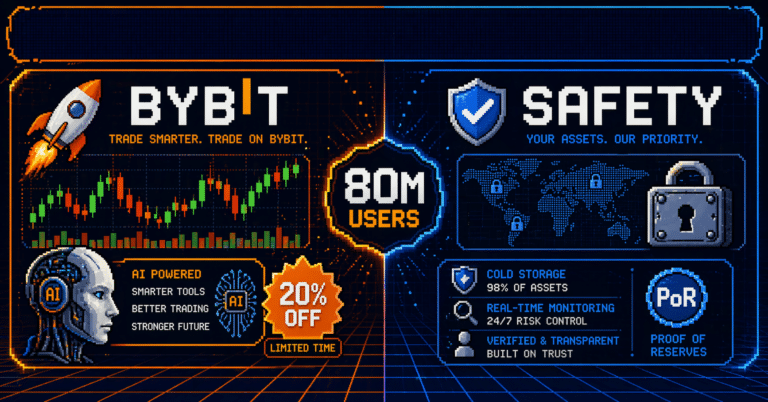
5. Bybit: Best for Low Fees
Quick Verdict: Bybit offers some of the lowest fees in crypto and a fantastic derivatives platform. It’s popular among active traders but less known to beginners. If you’re outside the US and trade frequently, this should be your platform.
| Pros | Cons |
|---|---|
| Extremely low fees (0.1% spot, 0.01% derivatives) | Not available in US |
| Fast execution | Primarily derivatives-focused |
| Excellent trading interface | Less regulatory oversight |
| No KYC for basic withdrawals (limits apply) | Customer support via chat only |
| Strong liquidity |
Fees Breakdown
- Spot trading: 0.1%
- Derivatives: 0.01% maker / 0.06% taker (among lowest in industry)
- Withdrawal fees: Competitive (varies by coin)
- Deposit fees: Free
Security
- Proof of reserves (Merkle tree, verifiable by users)
- Cold wallet storage
- 2FA mandatory (authenticator app required)
- Track record: No major hacks to date
Our Experience
The trading interface is lightning fast. We executed trades instantly with minimal slippage – even during volatile market moments. The lack of mandatory KYC for basic withdrawals (up to 2 BTC daily) is convenient but comes with lower limits.
We tested customer support with a question about withdrawal limits and received a response via chat in 7 minutes. Helpful, but no phone or email support if you prefer those channels.
Who Should Use Bybit
- Active traders (especially derivatives traders)
- Those outside the US
- Users wanting low fees without sacrificing liquidity
- Cost-focused traders who trade frequently
Who Should Skip Bybit
- US residents (platform is restricted)
- Complete beginners (interface assumes trading knowledge)
- Those prioritizing regulation and oversight
Call to Action
👉 Join Bybit
📖 Read our Full Bybit Review
6. Uniswap: Best Decentralized Exchange

Quick Verdict: Uniswap isn’t an exchange you sign up for. It’s a protocol you connect your wallet to. If you want true self-custody and access to any Ethereum token, this is your choice. But it’s not for beginners.
| Pros | Cons |
|---|---|
| No KYC or identity verification | Complex for beginners |
| Self-custody (you control funds) | Gas fees can be high ($5-50+ depending on network) |
| Access to any ERC-20 token | No customer support |
| No exchange can freeze your funds | No fiat on-ramp (need crypto first) |
| Available worldwide | Impermanent loss risk for liquidity providers |
Fees Breakdown
- Protocol fee: 0.3% (goes to liquidity providers, not the exchange)
- Gas fees: Variable ($5-50+ depending on Ethereum network congestion)
- No deposit/withdrawal fees (beyond network costs)
Security
- Smart contract risk (audited but not perfect—code can have bugs)
- Self-custody (your keys, your coins—no one can freeze your funds)
- No central point of failure (no company to hack)
- Open source (code is publicly visible and auditable)
Our Experience
We connected MetaMask (our wallet), swapped ETH for a smaller token (UNI), and confirmed the transaction. It worked exactly as designed. We received the tokens instantly in our wallet.
However: The gas fee was $15 for a $100 swap. On a busy day, that same swap could cost $50+. This makes Uniswap impractical for small trades.
Who Should Use Uniswap
- Experienced users comfortable with wallets and gas fees
- Those prioritizing privacy (no KYC)
- Accessing new tokens before centralized exchanges list them
- DeFi participants (yield farming, liquidity provision)
Who Should Skip Uniswap
- Complete beginners (start with Coinbase or Kraken)
- Those wanting to buy with fiat currency (you need crypto first)
- Users uncomfortable with variable gas fees
- Anyone wanting customer support
Call to Action
👉 Visit Uniswap
📖 Read our Full Uniswap Guide
Crypto Exchange Comparison Table
| Feature | Binance | Coinbase | Kraken | Gemini | Bybit | Uniswap |
|---|---|---|---|---|---|---|
| Trading Fee | 0.1% | 0.5%+ | 0.16-0.26% | 0.35%+ | 0.1% | 0.3% + gas |
| # of Coins | 600+ | 250+ | 200+ | 100+ | 400+ | All ERC-20 |
| KYC Required | Yes for full | Yes | Yes | Yes | Optional | No |
| US Available | Limited (Binance.US) | Yes | Yes | Yes | No | Yes |
| Mobile App | ★★★★★ | ★★★★★ | ★★★★ | ★★★★ | ★★★★ | Wallet only |
| Customer Support | ★★★★ | ★★★½ | ★★★★ | ★★★★ | ★★★ | None |
| Security Rating | ★★★★½ | ★★★★ | ★★★★★ | ★★★★ | ★★★½ | Self-custody |
| Best For | Overall | Beginners | Security | US Users | Low fees | Privacy |
Centralized vs Decentralized Exchanges: What’s the Difference?
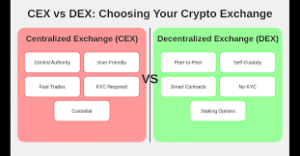
If you’re new to crypto, this distinction matters more than which specific exchange you choose.
Centralized Exchanges (CEX)
Think of these like traditional banks. A company runs the platform, holds your funds, verifies your identity, and facilitates trades. Examples: Binance, Coinbase, Kraken, Gemini.
Pros:
- Easy to use (familiar interface)
- Fast transactions
- Customer support available
- Fiat on-ramps (buy with dollars/euros)
- Insurance on deposits
Cons:
- You don’t control private keys
- Exchange can freeze funds (compliance-driven)
- KYC required (privacy trade-off)
- Honeypot for hackers
Decentralized Exchanges (DEX)
Think of these like a peer-to-peer marketplace with no middleman. You connect your wallet and trade directly from self-custody. Examples: Uniswap, PancakeSwap, dYdX.
Pros:
- You control your funds (true ownership)
- No KYC (privacy)
- No central point of failure
- Access to any token
Cons:
- Complex for beginners
- No customer support
- Gas fees (network costs)
- No fiat on-ramp
- Smart contract risk
Which Should You Choose?
| If you… | Choose… |
|---|---|
| Are a beginner buying your first crypto | Centralized exchange |
| Want to trade large amounts safely | Centralized exchange |
| Value privacy and self-custody | Decentralized exchange |
| Want to access new tokens early | Decentralized exchange |
| Need customer support | Centralized exchange |
What to Look for in a Crypto Exchange (Buying Guide)
After testing 15+ platforms, here are the five factors that matter most:
1. Security (Most Important)
Look for:
- Cold storage (funds kept offline)
- 2FA options (authenticator app, hardware key support)
- Insurance on deposits
- Clean hack history
Red flags:
- Past hacks with poor response
- No insurance
- SMS-only 2FA (vulnerable to SIM swapping)
2. Fees
What to check:
- Trading fees (percentage per trade)
- Deposit/withdrawal fees
- Spread (hidden cost in price – compare what you actually receive)
Red flags:
- Hidden fees not clearly disclosed
- Wide spreads (you get significantly less crypto than market price)
- Expensive withdrawals
3. Available Coins
- Major coins (Bitcoin, Ethereum): All exchanges have these
- Altcoins: Binance and Bybit lead with 400+ options
- Red flags: Only 20-30 coins offered (you’ll outgrow this quickly)
4. Payment Methods
- Bank transfer (ACH/SEPA): Cheapest, slowest (1-3 days)
- Debit/credit card: Fastest, most expensive
- Red flags: Limited options in your country
5. Regulation and Compliance
- Licensed in your jurisdiction
- Follows AML/KYC laws
- Red flags: Operating in gray areas, banned in your country, no clear regulatory status
The Beginner’s Checklist
Before signing up, verify:
- Exchange available in my country
- Accepts my preferred payment method
- Fees within my budget
- Good security track record
- Has the coins I want to buy
- Interface I can understand
- Positive user reviews (but take with grain of salt)
Common Exchange Scams to Avoid
This section could save your money. Read carefully.
Fake Exchange Websites
Scammers create sites that look exactly like real exchanges. The URL might be binance-exchange.com instead of binance.com.
Protection: Bookmark the real site. Always check the URL before logging in. Never click Google ads for exchanges – scammers buy ads for fake sites.
Phishing Emails
Fake “security alert” emails asking you to log in. The link takes you to a fake login page that steals your credentials.
Protection: Never click email links. Go directly to the exchange site. Real exchanges never ask for your password via email.
Customer Support Impersonators
Scammers on Twitter/X, Telegram, or Discord claiming to be support. They ask for private keys or “verify your wallet.”
Protection: Real support never asks for private keys, seed phrases, or passwords. Never. Contact support only through official channels on the exchange website.
“Too Good to Be True” Offers
“Deposit 1 BTC, get 2 BTC back!” or “Send 0.1 ETH to this address to verify your wallet.”
Protection: If it sounds too good to be true, it is. No exchange gives away free money.
SIM Swap Attacks
Attacker convinces your phone carrier to transfer your number to their SIM card. They reset your exchange password via SMS and drain your account.
Protection: Use an authenticator app (Google Authenticator, Authy) for 2FA, NOT SMS. This is non-negotiable.
Golden Rule
Never share your private keys, seed phrase, or passwords with anyone. No exceptions. No “support agent” will ever ask for these.
Our Verdict: Which Exchange Should You Choose?
After testing 15+ platforms with real money, here’s our final recommendation:
| Your Situation | Our Recommendation |
|---|---|
| Complete beginner, first purchase | Coinbase (easiest) or Gemini (most regulated) |
| Want lowest fees, many coins (non-US) | Binance or Bybit |
| Security is your top priority | Kraken (never hacked, proof of reserves) |
| You’re in the US | Coinbase, Kraken, or Gemini |
| You value privacy, have crypto already | Uniswap (decentralized) |
| Active trader, derivatives | Bybit or Binance |
| Want to earn interest on holdings | Gemini Earn or Kraken Staking |
Final Recommendation
For 90% of users, we recommend this path:
- Start with Coinbase if you’re completely new. Accept the higher fees as the cost of learning. Buy a small amount, experience the process, and learn without complexity.
- Move to Kraken or Binance as you grow. Once you understand how crypto works, switch to a platform with lower fees and more features.
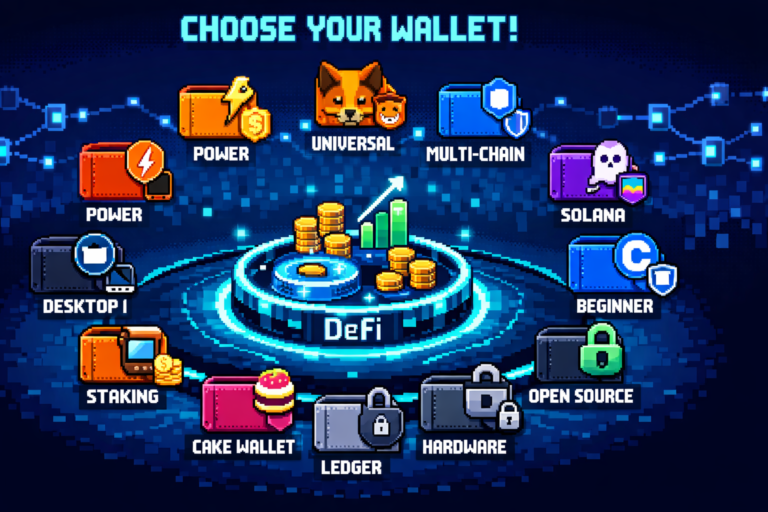
- Use a hardware wallet (Ledger or Trezor) for any amount you’d be sad to lose. Move long-term holdings off exchanges entirely.
If you’re outside the US and comfortable with trading, Binance is the best all-around platform – lowest fees, most coins, best features.
And if security keeps you up at night. If you worry about hacks, exchange failures, or regulatory freezes, choose Kraken and sleep well. Their security practices are genuinely best-in-class.
Ready to Start?
Whichever exchange you choose, remember:
- Start small (you can always add more)
- Enable 2FA with authenticator app (not SMS)
- Move to cold storage for long-term holdings
- Never invest more than you can afford to lose
Compare current promotions and sign up through our links above. We only recommend platforms we’ve personally tested and trust with our own money.
Have questions? Drop them in the comments below, or check out our individual exchange reviews for deeper dives into each platform.
This guide was last updated for the 2026 edition. Exchange fees, features, and availability change frequently. Check individual exchange websites for current promotions and terms. This article contains affiliate links – we may earn a commission if you sign up through these links, at no extra cost to you.
Frequently Asked Questions
Is Coinbase safe for beginners?
Yes. Coinbase is a publicly traded US company with strong security practices, FDIC insurance on USD balances, and 98% of funds in cold storage. It's an excellent choice for first-time buyers despite higher fees. The trade-off is simplicity for cost.
Do I need to verify my identity to buy crypto?
On regulated centralized exchanges (Coinbase, Kraken, Gemini, Binance), yes, KYC (Know Your Customer) is required. You'll need to provide ID and sometimes a selfie. On decentralized exchanges like Uniswap, no verification is needed, but you can't buy with fiat currency, you need crypto first.
Which exchange has the most altcoins?
Binance leads with 600+ cryptocurrencies. Bybit and KuCoin also offer extensive selections (400+). Coinbase and Gemini are more selective with fewer options (100-250). If you want access to everything, Binance is the choice if available in your region.
Can I buy crypto without ID verification?
Some exchanges allow limited trading without full KYC. Bybit allows withdrawals up to 2 BTC daily without KYC. Decentralized exchanges like Uniswap require no ID but need existing crypto. Most regulated exchanges now require full verification.
Which exchange is best for US residents?
Coinbase, Kraken, and Gemini are the top choices for US users. Binance.US is available but with fewer features than global Binance. Bybit is not available in the US. For most US beginners, Coinbase or Kraken are the best starting points.
What happens if an exchange gets hacked?
Top exchanges have insurance funds to cover losses. Binance has the SAFU fund ($1B+), Coinbase has insurance policies, and Kraken has never been hacked. However, insurance doesn't always cover 100% of losses. Best practice: Move long-term holdings to a hardware wallet regardless of which exchange you use.
Can I stake crypto on these exchanges?
Yes. Binance, Kraken, and Coinbase all offer staking for various cryptocurrencies (Ethereum, Solana, Cardano, etc.). Gemini offers Gemini Earn for interest on holdings. Rates vary from 2-10% depending on the coin and platform.
Which exchange has the best customer support?
In our testing, Coinbase had the fastest initial response (instant chat) but often routed to bots. Kraken had the most helpful human responses (4-hour average). Binance was slowest during peak times (12+ hours). Gemini was thorough but slow.
Can I lose money if the exchange goes bankrupt?
Yes. If you leave funds on an exchange and it goes bankrupt, your crypto could be frozen or lost (see: Mt. Gox, FTX). This is why we emphasize: "Not your keys, not your coins." Use exchanges for trading; use hardware wallets for holding.
About the Author

6 thoughts on “Best Crypto Exchanges for 2026: Top Platforms Compared”