
So you’ve learned what Bitcoin is. You understand wallets. You’re ready to buy your first crypto.
Congratulations, you’re about to join a financial revolution that’s still in its early days. But the actual process of buying can feel overwhelming: Which exchange? Which payment method? What fees? Is it safe?
I remember my first purchase vividly. It was 2017, and I’d spent weeks reading about Bitcoin. When I finally clicked “Buy,” my heart was racing. Did I do it right? Was my money safe? Would the exchange steal my funds? (Spoiler: it didn’t, but I made plenty of other mistakes along the way.)
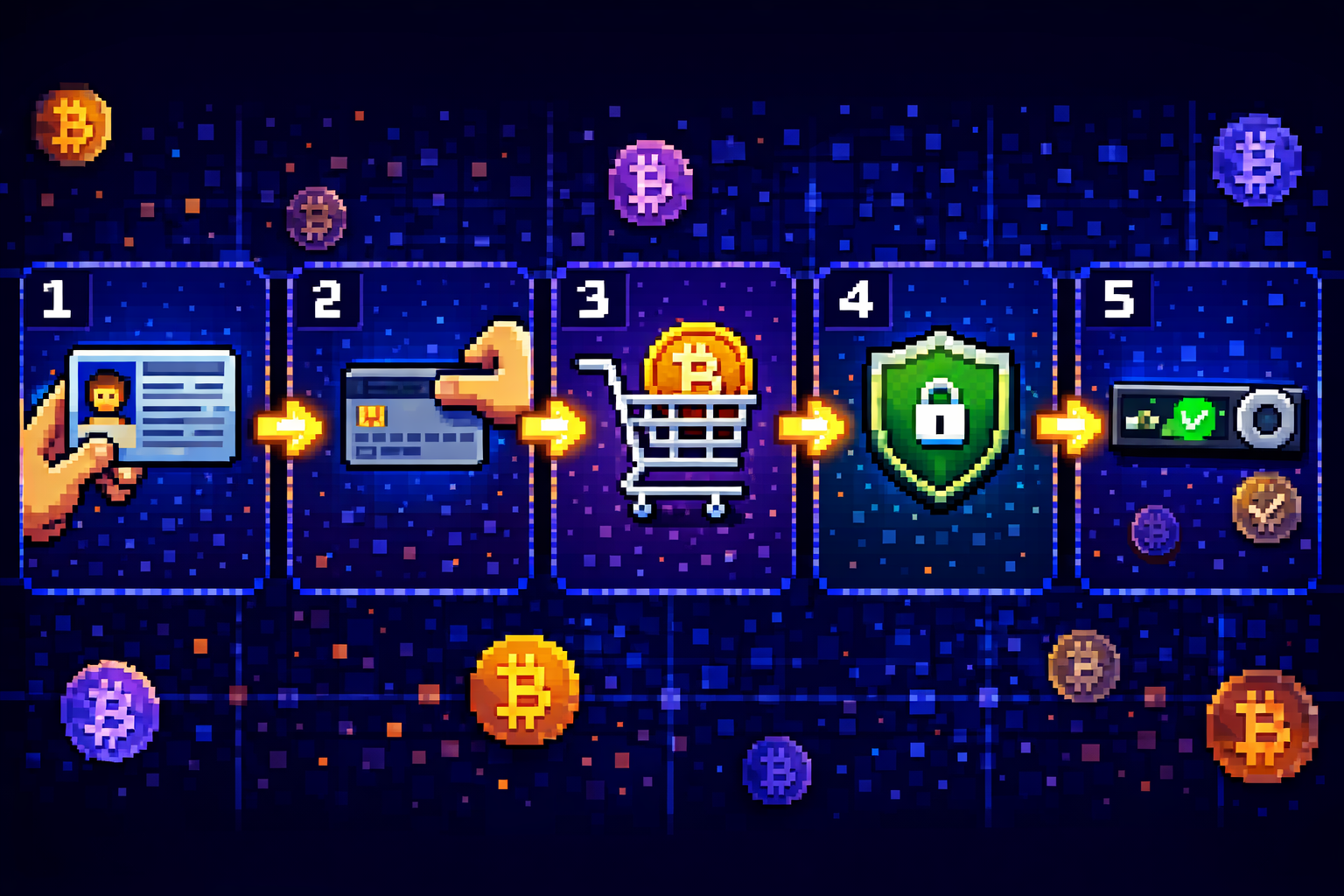
The good news: Buying crypto in 2026 is easier than ever. Exchanges have streamlined onboarding, payment options have expanded, and security tools protect beginners from most mistakes. This guide walks you through every step, from choosing where to buy to making your first transaction and securing your funds.
By the end of this guide, you will know how to buy cryptocurrency, and you’ll have made your first crypto purchase confidently and safely. Let’s get started.
What You Need Before You Start
Before you begin, gather these essentials:
| Item | Why You Need It |
|---|---|
| Government ID | Passport, driver’s license, or national ID card for verification (KYC) |
| Payment method | Bank account, credit/debit card, or cash depending on chosen method |
| Email address | For account registration and notifications |
| Smartphone or computer | To access exchange platforms |
| Authenticator app | Google Authenticator or Authy for 2FA security (non-negotiable) |
Optional but Recommended
- Hardware wallet (Ledger/Trezor) if buying more than $1,000
- Separate device for 2FA (not your main phone, if possible)
- Paper and pen to write down recovery phrases
Mindset Preparation
Crypto is volatile. Prices can drop 20% the day after you buy. This isn’t a bug, it’s the nature of a new asset class finding its value.
Only invest what you can afford to lose, and plan to hold for years, not days. The people who succeed in crypto aren’t the ones who get rich overnight. They’re the ones who stay patient through the ups and downs.
Step 1: Choose Where to Buy
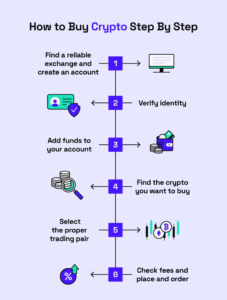
Your first decision: where to actually buy crypto. Here are your main options.
Option 1: Centralized Exchanges (Best for Beginners)
Centralized exchanges (CEXs) are the most popular way to buy crypto. They’re like online brokerages. You create an account, deposit money, and buy. They handle everything for you.
| Exchange | Best For | Key Feature |
|---|---|---|
| Coinbase | Absolute beginners | Most user-friendly interface, publicly traded |
| Binance | Low fees, many coins | Largest selection, lowest fees |
| Kraken | Security focus | Never hacked, strong reputation |
| Gemini | US users, regulation | New York trust company charter |
Option 2: Brokers and Apps
Apps like Robinhood or Cash App let you buy crypto alongside stocks. They’re convenient but often don’t let you withdraw to your own wallet (remember: not your keys, not your coins).
Option 3: Peer-to-Peer (P2P) Platforms
You buy directly from other people using local payment methods. Great for regions with limited banking or for privacy.
Option 4: Bitcoin ATMs
Physical machines where you insert cash and receive crypto to your wallet. Convenient but high fees (5-10%) .
Our Recommendation for First-Timers
For your first purchase, use a regulated centralized exchange like Coinbase or Kraken. They’re the safest, most straightforward option. Once you’re comfortable, you can explore others.
👉 Read our full Best Crypto Exchanges comparison
Step 2: Create and Verify Your Account
Registration Process
- Go to official website or app – Always type the URL yourself or download from official app stores. Never click ads.
- Sign up with email – Use a strong, unique password (not used elsewhere).
- Verify email – Click the confirmation link sent to your inbox.
- Complete KYC (Identity Verification) – This is mandatory on regulated exchanges. You’ll need to:
- Upload photo of your government ID
- Take a selfie or complete liveness check
- Provide proof of address (sometimes)
- Wait for approval (minutes to hours)
Why KYC Matters
Know Your Customer requirements prevent fraud and money laundering. While it feels intrusive, it also protects you – regulated exchanges are safer and more accountable.
Pro Tips for Smooth Verification
- Take photos in good lighting
- Ensure all ID corners are visible
- Use the same name on all documents
- Be patient—some exchanges have backlogs during busy periods
What If an Exchange Doesn’t Require ID?
Some platforms allow limited crypto-to-crypto swaps without ID. But you can’t buy with fiat currency without verification on major exchanges. If an exchange offers completely anonymous fiat purchases, be very suspicious, it’s likely a scam.
Step 3: Fund Your Account
Before you can buy, you need funds in your exchange account. Here are the main methods:
Method A: Bank Transfer (ACH/SEPA)
| Aspect | Details |
|---|---|
| Speed | 1-3 business days |
| Fees | Usually free or very low |
| Limits | Higher limits than cards |
| Best for | Larger purchases, saving on fees |
How to do it: Navigate to “Deposit” or “Buy Crypto,” select bank transfer, follow instructions to link your bank account. You’ll receive routing numbers or payment details.
Method B: Debit/Credit Card
| Aspect | Details |
|---|---|
| Speed | Instant |
| Fees | 2-4% (higher than bank transfer) |
| Limits | Lower limits |
| Best for | Small amounts, immediate purchase |
How to do it: Select “Credit/Debit Card,” enter card details, verify with 3D Secure (bank’s authentication app). Funds available instantly.
Method C: Wire Transfer
For larger amounts ($10,000+). Fast but may have fees at both sending and receiving banks. Check with your bank first.
Method D: P2P Transfer
In some countries, you can fund via mobile money (M-Pesa), local bank transfer, or even cash. See P2P section below.
Important Warning: Credit card fees add up quickly. A $100 purchase might cost $103-104. Bank transfers are almost always cheaper. Plan ahead if you can wait 1-3 days.
Step 4: Make Your First Purchase
Two Ways to Buy
Method 1: Quick Buy / Convert (Easiest for Beginners)
Most exchanges have a “Buy” or “Convert” button. This is the simplest way:
- Click Buy or Trade → Buy Crypto
- Select the cryptocurrency you want (BTC, ETH, or USDT recommended for first purchase)
- Enter amount in your local currency or crypto amount
- Review the total including fees
- Click Buy or Confirm
- Done! Crypto appears in your exchange wallet
Method 2: Spot Trading (More Control)
Once you’re comfortable, you can use the exchange’s trading interface:
- Go to Markets or Spot trading
- Find the trading pair (e.g., BTC/USD)
- Choose order type:
- Market order: Buy at current market price (instant)
- Limit order: Set price you want to pay (may not fill immediately)
- Enter amount and confirm
What to Buy First?
| Coin | Why | Risk Level |
|---|---|---|
| Bitcoin (BTC) | The original, most established | Lowest |
| Ethereum (ETH) | Second largest, powers dApps | Low |
| USDT/USDC | Stablecoins (pegged to $1), good for learning | Minimal (but not investment) |
Our Recommendation: Buy Bitcoin or Ethereum for your first purchase. They’re the safest entry points. Avoid obscure altcoins until you understand the market better.
After Purchase Confirmation
You’ll see your balance in the exchange wallet. Congratulations, you now own cryptocurrency!
Step 5: Secure Your Crypto (Crucial!)
The Most Important Step
If you leave your crypto on the exchange, you don’t truly own it. The exchange holds the private keys. Remember: Not your keys, not your coins.
| Risk | What Happens |
|---|---|
| Exchange hack | Funds stolen (Mt. Gox, many others) |
| Exchange bankruptcy | Funds frozen or lost (FTX) |
| Account freeze | Exchange blocks your account |
| Regulatory action | Withdrawals suspended |
Your Two Options
Option A: Hot Wallet (For Small Amounts, Active Use)
- Download a wallet app like MetaMask, Trust Wallet, or Coinbase Wallet
- Transfer a small amount from exchange to wallet
- Great for amounts under $1,000 or for DeFi/NFT use
Option B: Hardware Wallet (For Savings, Large Amounts)
- Buy a Ledger or Trezor (from official site only)
- Set up following instructions
- Transfer your crypto to the hardware wallet
- Essential for amounts over $1,000
How to Transfer from Exchange to Wallet
- Get your wallet address (public key) from your wallet app
- On exchange, go to Withdraw or Send
- Select the cryptocurrency
- Paste the wallet address (double-check every character!)
- Enter amount
- Confirm with 2FA
- Wait for blockchain confirmation (minutes for most coins)
Test First!
Before moving a large amount, send a tiny test transaction ($5-10). Confirm it arrives, then send the rest. This catches address errors.
CRITICAL: After moving to your own wallet, your seed phrase is your only backup. Write it on paper, store securely, NEVER share it. No recovery if you lose it.
Buying Methods Compared
| Method | Speed | Fees | ID Required | Best For |
|---|---|---|---|---|
| Credit/Debit Card | Instant | 2-4% | Yes | Small amounts, immediate need |
| Bank Transfer (ACH/SEPA) | 1-3 days | 0-1% | Yes | Larger purchases, saving fees |
| Wire Transfer | Same day | $15-50 flat | Yes | Very large amounts |
| P2P Trading | 5-60 min | 0-2% | Varies | Regions with limited banking, local currency |
| Bitcoin ATM | Instant | 5-10% | Varies | Cash users, privacy |
| Broker App | Instant | 1-3% | Yes | Convenience (but may not allow withdrawals) |
How to Choose the Right Payment Method
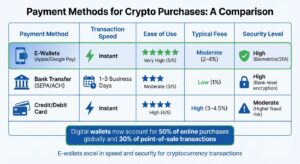
Decision Flow
| If you… | Choose… | Why |
|---|---|---|
| Want crypto right now | Credit/Debit card | Instant, despite higher fees |
| Are buying $500+ | Bank transfer | Save 2-4% in fees |
| Are in a region with limited banking | P2P | Use local payment methods |
| Value privacy | P2P or ATM | Less personal data shared |
| Want to buy regularly | Bank transfer | Set up recurring buys |
| Have cash only | Bitcoin ATM | Only option for cash |
Regional Considerations
- United States: Bank transfer (ACH) cheapest, Coinbase/Kraken easiest
- Europe: SEPA transfer free or cheap, Bitpanda popular
- Africa/Asia: P2P often best, Binance P2P supports mobile money
- Australia/Canada: Local exchanges with PayPal/e-Transfer
Buying Crypto with Credit/Debit Card (Detailed)
Step-by-Step
- Navigate to Buy: On exchange homepage, click “Buy Crypto”
- Select Card: Choose credit/debit card option
- Choose currency and amount: Select your fiat currency and enter amount
- Select crypto: Choose BTC, ETH, or other
- Add card: Enter card details (Visa/Mastercard accepted most places)
- Verify: Complete 3D Secure verification with your bank’s app
- Review: Check total including fees (displayed before confirmation)
- Confirm: Click buy, crypto arrives instantly
Pros and Cons
| Pros | Cons |
|---|---|
| Instant | Higher fees (2-4%) |
| No pre-funding needed | Lower purchase limits |
| Widely available | Some banks block crypto purchases |
| Good for small amounts | Interest charges if not paid off |
Fee Example
Buying $100 of Bitcoin with a card might cost $103-104 total. The same purchase via bank transfer might cost $100.50. For larger amounts, the savings add up.
Buying Crypto with Bank Transfer (Detailed)
Step-by-Step
- Link your bank account: On exchange, go to “Payment Methods” or “Deposit”
- Verify micro-deposits (ACH): Exchange sends two tiny deposits to your bank (1-2 days). Enter amounts to verify.
- Deposit funds: Initiate transfer from exchange. You’ll receive bank routing details
- Wait 1-3 days: Funds appear in your exchange balance
- Buy crypto: Use your balance to purchase at lower fees
SEPA (Europe)
- Usually free
- Arrives next business day
- Works across Eurozone
Pros and Cons
| Pros | Cons |
|---|---|
| Lowest fees (0-1%) | Slower (1-3 days) |
| Higher limits | Requires advance planning |
| No credit card interest | Bank may have daily transfer limits |
Buying Crypto via P2P (Peer-to-Peer)
What Is P2P Trading?
You buy directly from other people, not the exchange. The exchange acts as escrow, holding the crypto until payment is confirmed. This enables local payment methods like mobile money, bank transfers, or even cash.
When to Use P2P
- Your country has limited banking integration
- You want to pay with local methods (M-Pesa, GCash, etc.)
- You’re looking for better rates than card purchases
- You prefer more privacy
Step-by-Step P2P Process
- Go to P2P section on exchange (Binance P2P, etc.)
- Select Buy and choose cryptocurrency (USDT recommended first)
- Filter by payment method (mobile money, bank transfer, etc.)
- Choose a seller. Look for:
- High completion rate (95%+)
- Verified merchant badge
- Positive feedback
- Fast release time
- Enter amount and click Buy
- Contact seller via chat (follow their payment instructions)
- Make payment using your local method
- Mark as paid in the app
- Wait for release – seller releases crypto from escrow
- Confirm receipt – transaction complete
Safety Tips for P2P
- Start with small trades
- Never release crypto before receiving payment (you’re buying, so you pay first, but verify seller reputation)
- Use only in-app chat for communication
- Report suspicious behavior
Fees Explained: What You’ll Actually Pay
The Four Types of Fees
1. Trading Fees (Spot Fees)
Charged when you buy or sell. Usually a percentage of the transaction.
| Exchange | Spot Fee (Standard) |
|---|---|
| Binance | 0.1% |
| Coinbase | 0.5% (Advanced) to 1.5% (standard) |
| Kraken | 0.16-0.26% |
| Bybit | 0.1% |
2. Payment Method Fees
| Method | Typical Fee |
|---|---|
| Credit/Debit Card | 2-4% |
| Bank Transfer (ACH/SEPA) | 0-1% |
| Wire Transfer | $15-50 flat |
| P2P | 0-2% (varies by seller) |
3. Spread
The difference between the market price and the price you actually get. Some exchanges (especially beginner-friendly ones) hide fees in a wider spread. Coinbase standard interface is known for this. Their Advanced version shows true market price.
4. Withdrawal Fees
When you move crypto to your own wallet, you pay network fees:
| Asset | Typical Fee Range |
|---|---|
| Bitcoin | $1-5 (varies with network congestion) |
| Ethereum | $1-10 (higher during congestion) |
| USDT (ERC-20) | $1-5 |
| USDT (TRC-20) | $0.50-2 |
How to Minimize Fees
- Use bank transfer instead of cards
- Choose exchanges with competitive fees (Binance, Kraken)
- Withdraw during low network activity (weekends often cheaper)
- Consider exchanges that offer fee discounts for holding their tokens (BNB for Binance)
Real-World Example
Buying $500 of Bitcoin:
| Method | Trading Fee | Payment Fee | Spread | Total Cost |
|---|---|---|---|---|
| Coinbase (Card) | 1.5% | 3% | 0.5% | ~$525 |
| Coinbase Advanced (Bank) | 0.5% | 0% | 0.1% | ~$503 |
| Binance (Bank) | 0.1% | 0% | 0.1% | ~$501 |
Common Beginner Mistakes to Avoid
Mistake 1: Buying Without Research
Don’t buy a coin just because someone on social media promoted it. Research what you’re buying. Stick to Bitcoin and Ethereum first.
Mistake 2: Falling for Scams
The WEF 2026 Cybersecurity Report confirms crypto fraud is rampant. Common scams include:
- Fake exchange websites (typosquatting – binance-exchange.com instead of binance.com)
- Social media giveaways (“Send 1 BTC, get 2 back!”)
- Phishing emails pretending to be from exchanges
- Fake customer support on Telegram/Discord
Mistake 3: Leaving Crypto on Exchanges
We said it before, we’ll say it again: Not your keys, not your coins. Move to your own wallet, especially for amounts over $1,000.
Mistake 4: Not Using 2FA
SMS-based 2FA can be bypassed via SIM swapping. Use Google Authenticator or Authy. Better yet, use a hardware security key.
Mistake 5: Ignoring Fees
That 3% card fee plus spread might mean you’re paying 5% more than you realize. Check all costs before buying.
Mistake 6: Panic Selling
Crypto is volatile. Prices drop 30-50% regularly. If you sell in panic, you lock in losses. Those who hold through cycles have historically done well.
Mistake 7: Not Testing Withdrawals
Before sending a large amount to your wallet, test with $5. Confirm you can receive AND send back. This proves your setup works.
Mistake 8: Buying More Than You Can Afford to Lose
Crypto can go to zero (unlikely for Bitcoin, but possible for smaller coins). Only invest what you can afford to lose completely.
Security Checklist for First-Time Buyers
Before You Buy
- Exchange is reputable (check reviews, avoid unknown platforms)
- URL is correct (no typos, no ads)
- You have 2FA set up (authenticator app, not SMS)
- You understand the fees
- You’re investing what you can afford to lose
During Purchase
- Double-check receiving addresses
- Verify amounts before confirming
- Keep records of transaction
- Never share screen with others
After Purchase (Immediate)
- Move to your own wallet (if not keeping on exchange for trading)
- Write down seed phrase (paper only)
- Store seed phrase securely (safe, not digital)
- Test recovery with small amount
- Enable all security features on exchange (whitelist addresses, etc.)
Ongoing Security
- Update wallet software/firmware
- Monitor accounts for suspicious activity
- Never share private keys or seed phrases
- Be skeptical of unsolicited messages
What to Do After You Buy
Immediate Next Steps
| Timeframe | Action |
|---|---|
| First hour | Move to your wallet (if not keeping on exchange) |
| First day | Write down and secure seed phrase |
| First week | Test sending small amount back to exchange (confirm you can) |
| First month | Continue learning – read our guides on wallets, security, DeFi |
| Ongoing | Consider dollar-cost averaging (buy small amounts regularly) |
For Long-Term Holders
- Move to hardware wallet
- Consider multi-sig for very large amounts
- Create inheritance plan (instructions for family)
- Store seed phrase in multiple secure locations
For Active Users
- Keep some funds in exchange wallet for trading
- Use hot wallet (MetaMask) for DeFi/NFTs
- Learn about Layer 2 networks for lower fees
Tracking and Taxes
- Use portfolio tracker (CoinTracker, Koinly, etc.)
- Keep records of all transactions for tax purposes
- In most countries, crypto sales are taxable events
Next Steps: From Buyer to Owner
You’ve bought crypto. Now what?
The Beginner’s Path Forward
| Stage | Focus | Resource |
|---|---|---|
| Week 1 | Secure what you bought | Crypto Wallet Guide |
| Week 2 | Learn about the ecosystem | What is Ethereum? |
| Week 3 | Explore beyond Bitcoin | Altcoins Explained |
| Week 4 | Consider passive income | Staking and Earning Guide |
| Month 2 | Dive into DeFi (optional) | DeFi for Beginners |
Recommended Next Reads
- 📚 What is a Crypto Wallet? Hot vs Cold Storage Explained
- 🔒 Best Hardware Wallets 2026
- 🛡️ Crypto Security: Complete Guide
- 📖 Complete Cryptocurrency Guide for Beginners
Join the Community
Learning is easier with others. Join our Discord, follow us on Twitter, and subscribe to our newsletter for weekly tips and updates.
Final Thought
You’ve taken the most important step – moving from learning to owning. The crypto journey is just beginning.
I remember staring at my first Bitcoin balance, refreshing the page every few minutes, wondering if I’d done something wrong. I hadn’t. I was just experiencing what millions before me had: the feeling of actually owning a piece of this new digital economy.
Stay curious, stay secure, and welcome to the revolution.
Disclosure: This guide is for educational purposes only and does not constitute financial advice. Cryptocurrency is volatile and involves risk. Only invest what you can afford to lose. This article contains affiliate links – if you sign up for an exchange through these links, we may earn a commission at no extra cost to you.
This guide was last updated for the 2026 edition. Exchange fees, availability, and processes change frequently – check individual exchange websites for current information.
Frequently Asked Questions
What do I need to buy crypto?
Government ID, payment method (bank account or card), email address, and a smartphone or computer. Optional but recommended: authenticator app for 2FA.
Can I buy crypto with a credit card?
Yes, most exchanges accept Visa/Mastercard. Fees are higher (2-4%) but purchase is instant. Some banks block crypto purchases. Check with your bank first.
Is it safe to buy crypto online?
Yes, if you use reputable, regulated exchanges and follow security best practices: enable 2FA, use strong passwords, withdraw to your own wallet, and never share private keys.
How much does it cost to buy crypto?
Total cost includes: trading fee (0.1-1.5%), payment fee (0-4%), and spread. Bank transfers are cheapest; credit cards most expensive. Example: $100 purchase via bank transfer might cost $100.50; via card might cost $104.
Do I need ID to buy cryptocurrency?
On regulated exchanges, yes, KYC (identity verification) is required. This is normal and protects against fraud. Some platforms allow limited crypto-to-crypto swaps without ID, but you can't deposit fiat currency.
What is the easiest way to buy crypto?
Coinbase is widely considered the easiest for complete beginners. Their interface is simple, and they guide you through each step. You'll pay higher fees for this convenience.
How long does it take to buy crypto?
Account creation and verification: minutes to hours. Bank transfer funding: 1-3 days. Card purchase: instant. Total time from start to owning crypto: as little as 15 minutes with card, 1-3 days with bank transfer.
Can I buy crypto without ID verification?
Some decentralized exchanges and P2P platforms allow limited trading without ID, but you generally can't deposit fiat currency (USD/EUR) without KYC. For most beginners, using a regulated exchange with ID is safer.
What happens after I buy cryptocurrency?
The crypto appears in your exchange wallet. From there, you can hold it, trade it, or withdraw it to your personal wallet. For long-term holding, withdraw to your own wallet (hardware recommended).
Which cryptocurrency should I buy first?
Bitcoin (BTC) or Ethereum (ETH) are the safest choices for beginners. They're the most established, have the most liquidity, and are less risky than smaller altcoins.
Can I lose more than I invest in crypto?
With regular purchases (not margin trading), no - you can only lose what you put in. Crypto prices can go to zero theoretically, but major coins like Bitcoin have never done so. Never invest more than you can afford to lose.
What's the minimum amount I need to buy crypto?
Most exchanges allow purchases as low as $10-50. You can buy fractions of Bitcoin (satoshis), you don't need a whole coin.
Can I buy crypto and send it to someone else?
Yes. After purchase, you can withdraw to any wallet address. Just double-check the address. Transactions are irreversible.
What happens if I send crypto to the wrong address?
Unfortunately, it's likely gone forever. Blockchain transactions are irreversible. This is why testing with small amounts and double-checking addresses is critical.
About the Author

1 thought on “How to Buy Cryptocurrency: Step-by-Step Guide for Beginners (2026)”