



A scheduled update to global bank capital rules could fundamentally reshape how traditional financial institutions interact with Bitcoin.
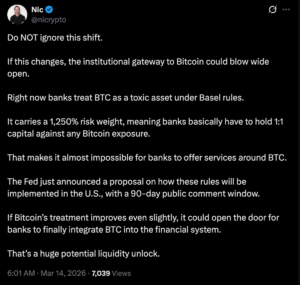
Market analyst Nic Puckrin says a lower risk rating for Bitcoin under the revised Basel III framework could trigger a “huge” influx of liquidity into the asset, potentially opening the door for banks to finally integrate Bitcoin into mainstream financial services.
Under the existing Basel rules, Bitcoin and similar digital assets carry a 1,250% risk weight. This means banks must hold $1 in reserve for every $1 of Bitcoin on their balance sheets, making it “almost impossible” for them to offer Bitcoin-related services to clients.
The Federal Reserve has opened a 90-day public comment window on how the revised rules will be implemented in the United States. Industry executives and trade associations have formally called for recalibration, arguing the current treatment misprices risk and effectively locks banks out of the digital asset economy.
In this analysis, we’ll break down what the Basel III crypto framework actually requires, why industry executives call it a “quiet chokepoint,” what’s changing in 2026, and what a lower risk weight could mean for Bitcoin’s institutional adoption.

What is the Basel Framework?
The Global Banking Rulebook
The Basel Framework, established by the Basel Committee on Banking Supervision (BCBS) at the Bank for International Settlements (BIS), sets global standards for how much capital banks must hold against different types of assets. These rules are designed to ensure banks can absorb losses without failing – protecting depositors and the broader financial system.
How Risk Weights Work
Under Basel rules, assets are assigned “risk weights” based on their perceived riskiness. A bank’s total risk-weighted assets (RWA) determine its minimum capital requirements. The math is straightforward:
| Asset Type | Risk Weight | Capital Required per $100 Exposure |
|---|---|---|
| Government bonds | 0% | $0 |
| Investment-grade corporate bonds | Up to 75% | Up to $7.50 |
| Unrated corporate loans | 100% | $10 |
| Bitcoin (current) | 1,250% | $100 |
The Crypto Framework (SCO60)
In December 2022, the Basel Committee finalized its prudential treatment for cryptoassets (SCO60), creating a two-tiered classification system:
| Group | Definition | Treatment |
|---|---|---|
| Group 1 | Tokenized traditional assets + qualifying stablecoins | Treated under existing rules (0-1,250% depending on underlying) |
| Group 2 | Unbacked cryptoassets (Bitcoin, Ethereum) and non-qualifying stablecoins | Subject to 1,250% risk weight + exposure caps |
The Effective Date
These rules took effect on January 1, 2026, with banks now required to disclose detailed information about their cryptoasset exposures under new reporting templates.
The 1,250% Risk Weight: A ‘Quiet Chokepoint’
What 1,250% Actually Means
A 1,250% risk weight is the highest category available under the Basel Framework – reserved for assets considered so risky that banks must hold capital equal to the full value of their exposure. For Bitcoin, this means:
- $1 of Bitcoin on balance sheet → $1 of capital must be held in reserve
- $100 million in Bitcoin custody → $100 million in capital tied up
The Economic Reality
Chris Perkins, president of investment firm CoinFund, describes this as a “very nuanced way of suppressing activity” – more subtle than outright bans, but equally effective:
“It’s a very nuanced way of suppressing activity by making it so expensive for the bank to do those activities.” – Chris Perkins, CoinFund
Why It’s Called a ‘Chokepoint’
The capital charge directly attacks bank profitability. Holding Bitcoin would reduce banks’ return on equity – a critical metric for investors. In practice, this makes crypto custody and trading services economically unviable for traditional banks, funneling institutional custody to specialized non-bank firms like Coinbase and BitGo.
The 1-2% Exposure Cap
Beyond the risk weight, Group 2 cryptoassets are also subject to exposure limits:
- Tier 1 capital limit: Group 2 exposures capped at 1% of bank’s Tier 1 capital
- Hard cap: Absolute limit of 2% of Tier 1 capital
For a bank with $100 billion in Tier 1 capital, total Group 2 crypto exposure is expected to stay below $1 billion. If it exceeds $2 billion, all Group 2 exposure would be subject to the harsher Group 2b treatment.
Perkins’ Assessment
“The Basel capital requirements are a covert form of choking off the crypto industry, and are more subtle than efforts to debank crypto companies under Operation Chokepoint 2.0.”
How Bitcoin’s Treatment Compares to Other Assets
The Disparity is Stark
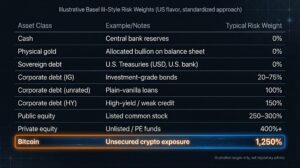
Jeff Walton, chief risk officer at Bitcoin treasury company Strive, highlights the dramatic difference in how Basel treats various assets:
| Asset Class | Basel Risk Weight |
|---|---|
| Physical cash | 0% |
| Gold | 0% |
| Government bonds | 0% |
| Investment-grade corporate bonds | Up to 75% |
| Residential mortgages | 35-50% |
| Unsecured corporate loans | 100% |
| Publicly traded equities | 250-300% |
| Bitcoin (Group 2 crypto) | 1,250% |
Walton’s Verdict
“Risk is mispriced.”
The Irony of Gold vs Bitcoin
Gold, physically heavy, expensive to store, and difficult to transport, carries a 0% risk weight. Bitcoin, instantly transferable, cryptographically verifiable, and globally accessible, carries a 1,250% weight. This disparity reflects regulators’ caution toward novel assets rather than any objective measure of risk.
Investment-Grade Corporate Bonds
Even investment-grade corporate bonds, which carry default risk, require only up to 75% risk weight. A bank could hold $100 million in Apple or Microsoft bonds with minimal capital impact, while $100 million in Bitcoin would require $100 million in capital reserves.
The 2026 Update: What’s Changing?
Scheduled Revision
The Basel III rules are due for an update in 2026. This isn’t speculative, it’s a scheduled part of the regulatory process. The Basel Committee itself has signaled openness to a “different approach”.
Chairman’s Statement
In November 2025, Basel Committee Chair Erik Thedeen confirmed the committee is actively considering revisions to the 2022 guidance, directly challenging the 1,250% risk weight. The committee is preparing to publish changes in 2026.
What Could Change
| Potential Revision | Impact |
|---|---|
| Lower risk weight | Reducing from 1,250% to something closer to corporate bonds (50-100%) would dramatically reduce capital charges |
| Risk-based tiering | Different treatment for highly liquid, regulated cryptoassets vs speculative tokens |
| Internal models | Allowing banks to use their own risk models for crypto (currently prohibited) |
| Exposure cap relaxation | Raising or eliminating the 1-2% Tier 1 capital limits |
The Fed’s Role
The Federal Reserve has opened a 90-day public comment window on how the revised rules will be implemented in the United States. This gives the crypto industry a direct channel to advocate for more favorable treatment before the updated rules are finalized.
Puckrin’s Take
“The Fed just announced a proposal on how these rules will be implemented in the US, with a 90-day public comment window. If BTC’s treatment improves even slightly, it could open the door for banks to finally integrate BTC into the financial system.”
Industry Advocacy: Trade Groups Push for Recalibration
Joint Trades Letter (August 2025)
A coalition of global financial trade associations – including the Bank Policy Institute, Futures Industry Association, ISDA, SIFMA, and the Institute of International Finance – formally petitioned the Basel Committee to pause implementation and reconsider key provisions.
Their Core Argument
“The Cryptoasset Standard’s restrictive qualification standards, combined with otherwise punitive market and credit risk capital treatments, effectively make it uneconomical for banks to meaningfully participate in the cryptoasset market.”
Specific Recommendations
The joint trades urged the BCBS to:
- Eliminate the permissioned/permissionless distinction – Prudential requirements should reflect risk, not ledger type
- Recognize regulated stablecoins as eligible financial collateral
- Revise the 1-2% exposure cap – Current limits discourage meaningful bank participation
- Recalibrate risk weights – Suggesting 54% based on empirical data (versus current 1,250%)
- Permit internal models – Allowing banks to apply existing risk frameworks to crypto
- Remove outdated segmentation rules – Recognize diversification benefits across cryptoassets
Strategy CEO Phong Le’s Statement
Phong Le, CEO of Strategy, called for rethinking how banks treat Bitcoin exposures under Basel rules, stating that the framework “fundamentally shapes how banks interact with digital assets, including Bitcoin.” He linked this directly to US ambitions:
“If the US wants to become the world’s crypto capital, our implementation of Basel capital treatment warrants careful review.”
Conner Brown’s Critique
Conner Brown, strategy director at the Bitcoin Policy Institute, emphasized the practical impact:
“It’s hard to overstate how much of a bad policy mistake this is. The 1,250% risk weight means banks must hold $1 in capital for every $1 of Bitcoin exposure, while gold has essentially zero capital cost.”
Brown argued the policy erroneously penalizes Bitcoin, which has operating characteristics favorable for risk management, including continuous trading, rapid auditability, fixed supply, and transparent pricing.
Expert Perspectives: What Analysts Are Saying
Nic Puckrin (Market Analyst)
“A lower risk rating for Bitcoin under the revised Basel III framework could trigger a ‘huge’ influx of liquidity into the asset.”
Chris Perkins (President, CoinFund)
“The Basel capital requirements are a covert form of choking off the crypto industry, and are more subtle than efforts to debank crypto companies under Operation Chokepoint 2.0. It’s a very nuanced way of suppressing activity by making it so expensive for the bank to do those activities.”
Jeff Walton (CRO, Strive)
“Risk is mispriced.”
Erik Thedeen (Basel Committee Chair, November 2025)
Confirmed the committee is considering a “different approach” to the 1,250% risk weight, directly challenging the existing framework.
Joseph Edwards (Head of Research, Enigma Securities)
“If something is to be treated as a universal asset, it effectively needs to meet quorum with regards to how many parties will handle it. This should move the needle somewhat on that.”
Federal Reserve Comment Window: A Critical Opportunity
What’s Happening
The Federal Reserve has opened a 90-day public comment period on how the revised Basel rules will be implemented in the United States. This is a formal rulemaking process – not just a consultation .
Why It Matters
| Aspect | Significance |
|---|---|
| Industry input | Crypto advocates, banks, and trade groups can submit formal comments |
| Timeline | Comments will inform final US implementation |
| Potential outcomes | US could adopt more permissive approach than EU (which has finalized 1,250% rule) |
| Regulatory arbitrage | Divergent rules could drive banking activity to favorable jurisdictions |
The Window of Opportunity
Puckrin notes that even a “slight” improvement in how regulators treat Bitcoin could open the door for banks to finally integrate BTC into mainstream financial services. The comment window gives the industry a direct channel to push for meaningful change.
How to Participate
Stakeholders can submit comments through the Federal Reserve’s rulemaking portal. Industry groups are likely to coordinate comment campaigns aligned with the joint trades’ recommendations.
Potential Outcomes
As CryptoSlate’s analysis outlines, the Fed proposal could take several paths :
| Scenario | What the proposal would imply | What it means for Bitcoin |
|---|---|---|
| Bull case | More workable path for certain hedged or lower-risk exposures | Bitcoin becomes more bankable |
| Bear case | Harsh treatment stays clear and restrictive | Bitcoin stays mostly outside core banking |
| Black swan | Proposal hardens further under AML/national-security framing | US effectively keeps Bitcoin on banking periphery |
What a Lower Risk Weight Could Mean for Bitcoin
The Math of Unlocking Liquidity
If the risk weight were reduced from 1,250% to, say, 50% – comparable to investment-grade corporate bonds—the capital required for Bitcoin exposure would drop from 100% to roughly 4% of exposure value.
Flow Scenarios
| Scenario | Market Impact |
|---|---|
| Banks offer Bitcoin custody | Institutional investors gain trusted, regulated custodians |
| Balance sheet allocation | Banks could hold Bitcoin as treasury asset |
| Lending and derivatives | Banks could offer Bitcoin-backed loans, options, futures |
| Prime brokerage | Institutional clients could trade Bitcoin through existing prime relationships |
The Institutional Gateway
A lower risk weight wouldn’t just allow banks to hold Bitcoin – it would signal regulatory acceptance, potentially triggering allocation from pension funds, endowments, and insurance companies that require Basel-compliant counterparties.
The Structural Shift
Currently, capital rules determine what banks can do economically, not just what they can do legally. If the capital treatment remains harsh, large banks will still have a strong incentive to avoid meaningful Bitcoin inventory, financing, and market-making services. If it softens, the long-run effect could be more bank custody, financing, execution, and infrastructure for Bitcoin.
Puckrin’s Vision
“Even a modest improvement in how regulators treat Bitcoin could open the door for banks to integrate Bitcoin into mainstream financial services.”
Disclaimer: This article is for informational purposes only and does not constitute financial advice. Regulatory developments are subject to change. Always consult with qualified professionals before making investment decisions.
This analysis reflects March 2026 developments. Regulatory processes are fluid – check official sources for current information.
Frequently Asked Questions
Why do banks have to hold 1:1 reserves for Bitcoin?
Regulators classify Bitcoin as a "Group 2" cryptoasset with "unique risks" including volatility, operational risk, and lack of underlying asset backing. The 1,250% risk weight is designed to ensure banks can absorb a complete loss of their crypto exposure without affecting depositors.
How could Basel rule changes affect Bitcoin price?
A lower risk weight would reduce capital charges, making it economically viable for banks to hold Bitcoin and offer related services. This could unlock institutional demand and improve market liquidity, potentially driving price appreciation.
What is the 1,250% risk weight meaning?
Risk weights determine how much capital banks must hold against assets. A 1,250% risk weight means banks must hold capital equal to the full value of their Bitcoin exposure. For example, $1 million in Bitcoin requires $1 million in capital reserves.
Are banks allowed to hold Bitcoin?
Technically yes, but the capital requirements make it economically prohibitive. Most banks avoid Bitcoin because the 1,250% risk weight destroys profitability. This has funneled institutional custody to specialized non-bank firms like Coinbase and BitGo.
When will Basel III crypto rules be updated?
The Basel Committee is scheduled to update the framework in 2026. Chair Erik Thedeen has indicated the committee is considering a "different approach" to the 1,250% risk weight. The Federal Reserve has opened a 90-day public comment window on US implementation.
What is Operation Chokepoint 2.0 in crypto?
"Operation Chokepoint 2.0" refers to alleged regulatory pressure on banks to avoid crypto clients. Chris Perkins of CoinFund describes Basel capital requirements as a more subtle form of the same phenomenon - suppressing activity by making it economically prohibitive rather than explicitly illegal.
How do Basel rules compare Bitcoin vs gold?
Gold carries a 0% risk weight under Basel rules - meaning no capital charge. Bitcoin carries 1,250% - the highest possible category. Industry executives argue this misprices risk given Bitcoin's liquidity, security, and global accessibility.
What did Nic Puckrin say about Basel and Bitcoin?
Analyst Nic Puckrin said a lower risk rating under revised Basel rules could trigger a "huge" influx of liquidity into Bitcoin. He noted the Federal Reserve's 90-day comment window as a critical opportunity for industry advocacy.
Can banks offer Bitcoin custody services?
Currently, most banks cannot offer competitive Bitcoin custody because the capital charges make it unprofitable. A reduced risk weight in the 2026 Basel update could change this, allowing banks to compete with specialized custodians like Coinbase and BitGo.
About the Author