


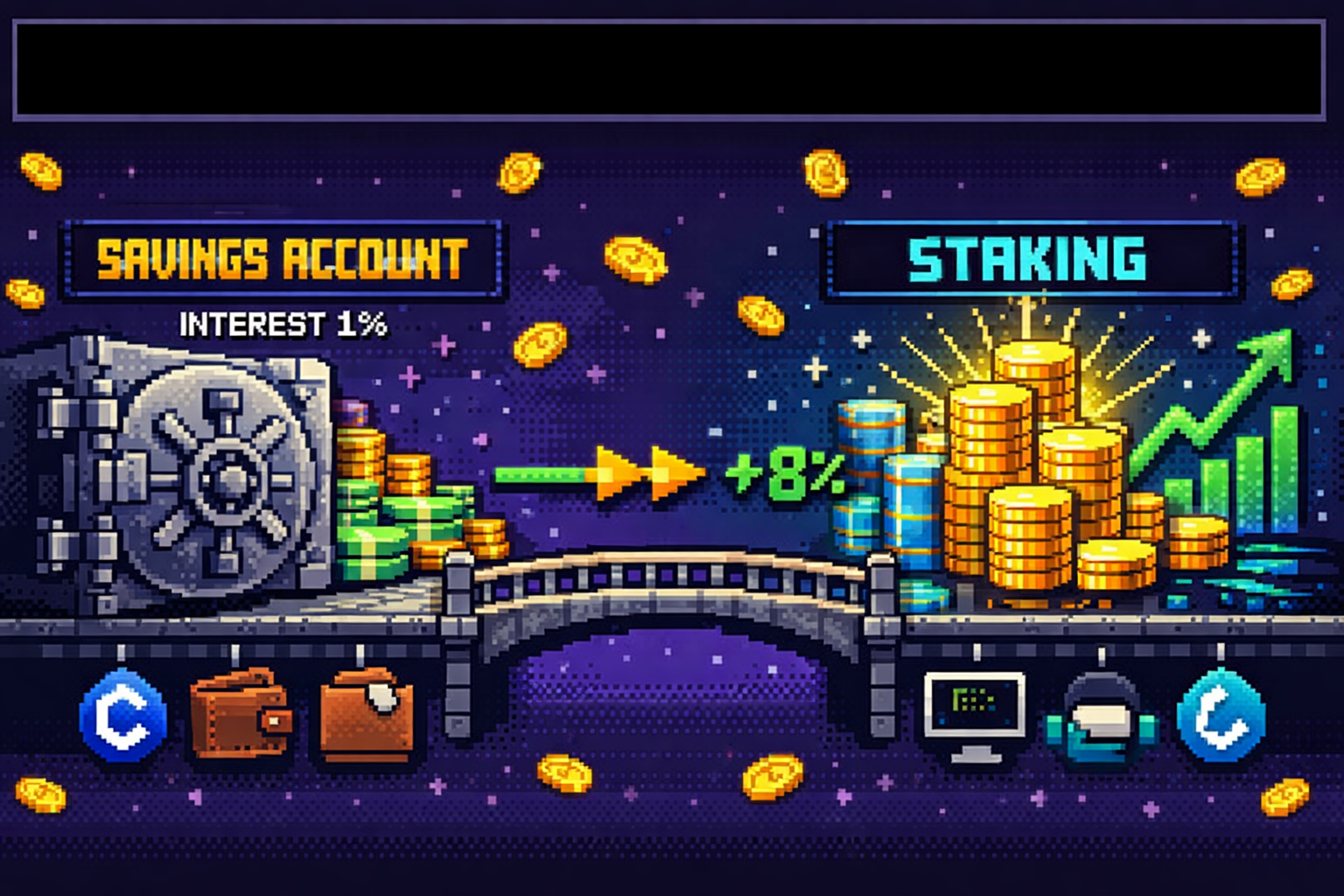
Imagine buying a savings bond and choosing not to collect the interest. That’s what crypto holders do when they don’t stake their Proof-of-Stake assets.
In traditional finance, investors earn dividends, bond coupons, or interest for putting their capital to work. In crypto, staking plays a similar role – except rather than the “issuer” being a company or government, it’s the token’s native blockchain.
I remember my first staking experience vividly. I’d held Ethereum for years, just watching the price go up and down. Then I discovered I could actually use that ETH to earn more ETH. I staked through Lido, received stETH, and watched my balance grow while still having access to liquidity. It felt like discovering my savings account could earn interest and I could still spend the money.
Staking is the process of locking up your cryptocurrency to support a blockchain network and earn rewards. It’s like putting your money in a high-yield savings account. But instead of a bank lending your deposits, you’re helping secure a decentralized network and getting paid in more crypto.
In this guide, we’ll explain what is crypto staking in plain English: how it works, what you can earn, the different ways to stake (exchanges, wallets, liquid staking), the risks you need to understand (slashing, lock-ups, volatility), and how to get started safely.

Staking in One Sentence
Staking is the process of locking up your cryptocurrency to help secure a blockchain network and earn rewards – like earning interest on a savings account, but with higher potential returns and greater risks.
Here are a few other ways to think about it:
- For traditional finance people: Staking is like earning dividends on stocks, except instead of a company paying you, the blockchain protocol pays you for helping run its network.
- For crypto people: If you hold PoS assets and don’t stake them, you’re leaving money on the table. Staking is the baseline strategy for long-term holders.
- For the curious: Think of staking as putting your crypto to work. Instead of sitting idle in your wallet, it’s actively helping the network run, and you get paid for it.
The Problem Staking Solves
Why Blockchains Need Staking
Blockchains need a way to agree on which transactions are valid. This is called “consensus.” Bitcoin uses Proof-of-Work (PoW), where miners compete using powerful computers to solve puzzles. This consumes massive amounts of electricity but is very secure.
The Energy Problem
Proof-of-Work mining requires enormous energy consumption. Bitcoin mining uses more electricity than some countries. This isn’t sustainable for every blockchain, especially those aiming to process thousands of transactions per second.
The Staking Solution
Proof-of-Stake (PoS) offers a more energy-efficient alternative. Instead of computational work, validators are chosen based on how many coins they “stake” as collateral. This aligns incentives: validators who act honestly earn rewards; those who try to cheat lose their staked funds.
The Investor Benefit
For crypto holders, staking solves a different problem: what to do with idle assets. Before staking, the only way to profit from crypto was price appreciation. Now, long-term holders can earn yield on top of potential price gains, turning a passive asset into an income-generating one.
How Staking Works: Validators and Delegators

Two Key Roles
Staking involves two main participants: validators and delegators.
Validators (The Network Operators)
Validators run specialized software that proposes and validates new blocks of transactions. They’re responsible for keeping the network running and secure. Becoming a validator requires:
- Staking a minimum amount (e.g., 32 ETH for Ethereum)
- Running 24/7 infrastructure with reliable uptime
- Technical expertise to maintain nodes
- Putting their stake at risk – misbehavior leads to slashing
In return, validators earn rewards from block creation and transaction fees, plus they may receive MEV (Maximal Extractable Value) opportunities.
Delegators (The Token Holders)
Most people don’t have the technical skills or minimum capital to run validators. Instead, they can “delegate” their tokens to existing validators.
| Role | Action | Reward |
|---|---|---|
| Validator | Runs node, validates transactions | Keeps commission (5-15%) |
| Delegator | Assigns tokens to validator | Receives remaining rewards |
The Delegation Process
- You choose a validator (research uptime, commission, track record)
- You delegate your tokens through a wallet or platform
- The validator includes your stake with theirs, increasing their total stake
- You earn a proportional share of rewards, minus the validator’s commission
- Your tokens remain in your control – the validator can’t spend them
Validator Selection Tips
When choosing a validator, look for:
- High historical uptime (99%+)
- Reasonable commission rates (not the lowest. Too low may indicate unreliability)
- Strong community reputation
- No history of slashing events
Proof-of-Stake vs Proof-of-Work
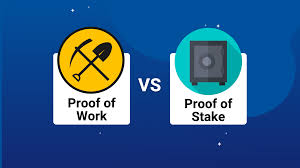
| Aspect | Proof-of-Stake (PoS) | Proof-of-Work (PoW) |
|---|---|---|
| Energy consumption | Low (99.9% less than PoW) | Extremely high |
| Hardware required | None (just tokens) | Specialized mining rigs |
| Entry barrier | Token ownership | Expensive equipment |
| Security model | Economic penalties (slashing) | Computational work |
| Environmental impact | Minimal | Significant |
| Examples | Ethereum, Solana, Cardano | Bitcoin, Litecoin |
The Ethereum Transition
Ethereum’s transition to PoS in 2022 (The Merge) demonstrated this model’s viability at scale. Energy consumption dropped by approximately 99.95% , while security remained robust.
Why This Matters for Stakers
PoS networks are inherently designed for staking – it’s not an add-on feature. When you stake, you’re directly participating in the network’s security model. This is different from Bitcoin, which can only be “mined” with hardware, not staked with coins.
The Bitcoin Exception
Traditionally, Bitcoin couldn’t be staked because it uses PoW. However, new protocols like Babylon now enable Bitcoin holders to stake their BTC to help secure other PoS chains, without bridging or wrapping their coins.
Staking vs Holding: What’s the Difference?
| Aspect | Just Holding | Staking |
|---|---|---|
| Income | None (price appreciation only) | Staking rewards + price appreciation |
| Liquidity | Full. Can sell anytime | Locked during staking period |
| Network participation | None | Contributes to security, may include governance |
| Risk | Price volatility only | Price volatility + slashing + lock-up |
| Tax treatment | Capital gains on sale | Staking rewards = income at receipt |
The “Leaving Money on the Table” Argument
For long-term token holders, staking is no longer optional, it’s a baseline strategy to avoid leaving yield on the table. If you believe in a project’s long-term future and plan to hold anyway, why not earn rewards while you wait?
The Compounding Effect
When you stake, your rewards can be re-staked to earn compound returns. Over time, this can significantly outperform simple holding, but only if the token price doesn’t fall.
Types of Staking
Exchange Staking (Custodial)
What It Is: Platforms like Coinbase, Binance, Kraken, and Bitget hold your assets and manage staking on your behalf. You click a button, they handle the rest.
Pros
- Extremely beginner-friendly
- No technical knowledge required
- Often has flexible or short lock-up options
- Some exchanges have protection funds (Bitget $300M+, Binance SAFU $1B+)
Cons
- You don’t control the private keys
- Platform fees reduce net returns
- Counterparty risk (exchange could fail)
- Some exchanges restrict staking in certain jurisdictions
Best for: Absolute beginners, those with small amounts, users who prioritize convenience over maximum returns.
Delegated Staking (Non-Custodial)
What It Is: You keep your tokens in your own wallet (like MetaMask, Phantom, or Keplr) and delegate them to a validator. Your tokens never leave your control. You’re just assigning voting power.
Pros
- You control your private keys
- No counterparty risk
- Often higher returns than exchanges
- Direct participation in network governance
Cons
- Requires more technical knowledge
- Need to research validators
- Gas fees for delegation transactions
- Still subject to validator slashing risk
Best for: Intermediate users comfortable with wallets, those with larger amounts who prioritize security.
Solo Staking (Running Your Own Validator)
What It Is: You run your own validator node, staking the minimum required amount (e.g., 32 ETH) and operating infrastructure 24/7.
Pros
- Maximum rewards (no commissions)
- Full control
- Direct contribution to decentralization
Cons
- High capital requirements
- Technical expertise needed
- Must maintain uptime or risk slashing
- Infrastructure costs (server, monitoring)
Best for: Advanced users, institutions, those with significant holdings.
Liquid Staking
What It Is: Protocols like Lido, Rocket Pool, and Frax let you stake and receive a tradable token (stETH, rETH, sfrxETH) representing your staked assets. You can use these tokens in DeFi while still earning staking rewards.
How It Works
- You deposit ETH into Lido
- You receive stETH (1:1 representation of your staked ETH)
- Your stETH earns staking rewards automatically (balance increases)
- You can trade, lend, or use stETH in other DeFi protocols
- When ready, you convert stETH back to ETH (1:1 plus earned rewards)
Pros
- Maintain liquidity while staking
- Can earn multiple layers of yield
- No lock-up periods
- Low minimums
Cons
- Smart contract risk
- Derivative tokens may trade at discount (depeg risk)
- Protocol fees
- Added complexity
Best for: DeFi users, those wanting capital efficiency, intermediate to advanced users.
DeFi Staking and Liquidity Pools
What It Is: Beyond native network staking, DeFi protocols offer “staking” of LP tokens (liquidity provider tokens) or governance tokens to earn yield.
Examples:
- Staking UNI tokens to vote on Uniswap governance
- Staking LP tokens from PancakeSwap to earn CAKE rewards
- Providing liquidity on Aave or Compound
⚠️ IMPORTANT: This is different from native PoS staking. These activities carry additional risks like impermanent loss and smart contract vulnerabilities.
How Much Can You Earn? Staking Rewards by Asset (2026)
Current Staking Yields (March 2026)
| Cryptocurrency | APY Range | Typical Lock-up/Unbonding | Notes |
|---|---|---|---|
| Ethereum (ETH) | 3-4% | 1-5 days unbonding | Most popular, highly secure |
| Solana (SOL) | 5-8% | 2-4 days | Fast network, high throughput |
| Cardano (ADA) | 3-5% | None (instant) | No lock-up, highly accessible |
| Polkadot (DOT) | 10-15% | 28 days | Higher yields, longer lock |
| Cosmos (ATOM) | 15-20% | 21 days | Higher yields, active ecosystem |
| Avalanche (AVAX) | 7-10% | 14 days | Moderate yields |
| Polygon (MATIC) | 5-8% | 1-2 days | Layer-2 scaling |
Why Yields Vary
Yields aren’t fixed – they fluctuate based on:
| Factor | Impact |
|---|---|
| Network inflation rate | How many new tokens are minted for rewards |
| Total stake percentage | More stakers = lower individual rewards |
| Validator commissions | Fees taken by validators (5-15%) |
| Participation rate | What percentage of circulating supply is staked |
2026 Yield Context
Staking yields have compressed across major chains as more users participate. Ethereum now averages 3-4% vs 5-6% in previous years. Higher yields on newer networks reflect higher risk and lower participation – not guaranteed returns.
The “Net Return” Reality
Analysts emphasize that headline APY means nothing if the underlying token price drops. A 10% staking yield with a 30% price decline means a net loss of 20%. Always consider total return: staking yield minus price change.
The Risks of Staking (Important!)
⚠️ CRITICAL SECTION. DO NOT SKIP
Risk 1: Price Volatility Risk
The biggest risk isn’t slashing or hacks, it’s price movement. If your staked token drops 30% while you earn 5% in rewards, you’ve still lost 25% in net value.
Example: Staking 10 ETH at $3,000 ($30,000 total) earning 4% APY. After one year, you have 10.4 ETH. But if ETH drops to $2,000, your portfolio is worth $20,800 – a $9,200 loss despite “earning” rewards.
Risk 2: Lock-up and Unbonding Periods
Many networks require you to lock your tokens for a set period. During this time, you cannot sell, even if the market crashes.
| Network | Unbonding Period | Risk Level |
|---|---|---|
| Ethereum | 1-5 days | Moderate |
| Solana | 2-4 days | Low |
| Polkadot | 28 days | High |
| Cosmos | 21 days | High |
Even with “flexible” staking, most platforms have a waiting period before funds are accessible.
Risk 3: Slashing Risk
Slashing is a penalty mechanism that destroys a portion of staked funds if a validator misbehaves – either through malice (double-signing) or negligence (extended downtime).
Slashing Penalties by Network
- Ethereum: Up to 1-2% for downtime, higher for malicious acts
- Cosmos: Up to 5% for double-signing
- Polkadot: Up to 100% in extreme cases
Mitigation
- Choose reputable validators with high uptime
- Use exchange staking (platforms often shield users from slashing)
- Diversify across multiple validators
Risk 4: Smart Contract Risk
Liquid staking and DeFi staking rely on smart contracts. Bugs or exploits could result in partial or total loss of funds.
Examples: Major DeFi hacks have drained billions over the years. Always use audited protocols with proven track records.
Risk 5: Custodial and Platform Risk
Exchange staking introduces counterparty risk. If the exchange fails (FTX 2022) or suspends withdrawals, your staked assets could be frozen or lost.
Mitigation
- Choose exchanges with protection funds (Binance SAFU $1B+, Bitget $300M+)
- Consider non-custodial options for larger amounts
- Don’t keep all assets on one platform
Risk 6: Regulatory Risk
Staking has attracted regulatory attention. In 2023, Kraken paid $30 million and shut its staking service for US customers after SEC action. While many exchanges still offer staking, the regulatory landscape remains uncertain.
Current Status (2026): Congress is actively discussing staking tax reform, including potential elective deferral for income recognition. Currently, staking rewards are taxable as income when received, even if you’re locked and can’t sell.
The Safety Checklist
- Research validators’ uptime and slashing history
- Understand lock-up periods before staking
- Never invest more than you can afford to lose
- Use reputable platforms with proven security
- Consider hardware wallets for self-custody staking
- Keep records for tax purposes
How to Choose Where to Stake
Decision Framework
| If you are… | Recommended Method | Why |
|---|---|---|
| Absolute beginner, small amounts | Exchange staking (Coinbase, Binance) | Easiest, no technical knowledge required |
| Comfortable with wallets, moderate amounts | Delegated staking via wallet (Keplr, Phantom, MetaMask) | More control, higher returns |
| Large holder, technically skilled | Solo staking or dedicated validators | Maximum returns, network contribution |
| DeFi user, want liquidity | Liquid staking (Lido, Rocket Pool) | Maintain access to funds while earning |
Key Selection Criteria
- Security infrastructure – Cold storage, insurance, track record
- Fee structure – Exchange fees vs validator commissions
- Supported assets – Does it have the tokens you want to stake?
- Lock-up terms – Flexible vs fixed, unbonding periods
- Regulatory compliance – Platform’s standing in your jurisdiction
- Historical performance – Uptime, slashing incidents, customer reviews
How to Start Staking: Step-by-Step
Option A: Exchange Staking (Simplest)
Step 1: Choose an Exchange
Select a platform that supports staking for your assets (Coinbase, Binance, Kraken, Bitget)
Step 2: Buy or Deposit Crypto
Purchase the cryptocurrency you want to stake, or transfer existing holdings to the exchange
Step 3: Navigate to Staking Section
Look for “Earn,” “Staking,” or “Rewards” in the platform menu
Step 4: Select Asset and Terms
- Choose your cryptocurrency
- Select flexible or locked staking (if options available)
- Review APY and lock-up period
Step 5: Confirm Staking
- Enter amount and confirm the transaction
- For locked staking, note the maturity date
Step 6: Monitor Rewards
- Rewards typically accrue daily or weekly
- Track in your account dashboard
- Consider auto-staking to compound returns
Option B: Delegated Staking via Wallet
Step 1: Set Up Compatible Wallet
- For Ethereum: MetaMask
- For Solana: Phantom
- For Cosmos: Keplr
- For Cardano: Daedalus or Yoroi
Step 2: Fund Your Wallet
- Transfer tokens from exchange to your wallet
- Ensure you have small amount for gas fees
Step 3: Choose a Validator
- Research validators (uptime, commission, reputation)
- Look for validators with 99%+ uptime
- Check slashing history
Step 4: Delegate
- Navigate to staking section in wallet
- Enter amount to delegate
- Confirm transaction (pay gas fees)
Step 5: Monitor
- Track rewards in wallet interface
- Redelegate if validator underperforms
- Withdraw when ready (respect unbonding period)
Pro Tips
- Start with small amounts to learn the process
- Keep records of all transactions for taxes
- Never share your private keys or seed phrase
- Use hardware wallets for larger amounts
Staking Taxation: What You Need to Know
General Tax Principles
In most jurisdictions (US, UK, Australia, Canada), staking rewards are treated as income at the time of receipt – valued at the fair market price when you receive them.
Tax Events in Staking
| Event | Tax Treatment |
|---|---|
| Receiving staking rewards | Taxable as ordinary income |
| Selling staked tokens later | Capital gains/loss (cost basis = price when received) |
| Swapping staked tokens | Taxable event (disposal) |
| Liquid staking derivative tokens | Complex – may trigger taxable events |
What You Need to Track
- Date and time of each reward payment
- Fair market value at time of receipt (in your fiat currency)
- Type and amount of reward token
- Transaction IDs for all staking activities
Software Solutions
Consider using crypto tax software (CoinTracker, Koinly, CryptoTaxCalculator) that integrates with exchanges and wallets to automatically track staking rewards.
Important Note
Tax laws vary by jurisdiction and are evolving. The US Congress is actively discussing staking tax reform, including potential elective deferral for income recognition. Consult a tax professional familiar with crypto in your country.
Next Steps: From Learning to Earning
You now understand staking. Here’s where to go next:
The Beginner’s Path
| Step | Action | Resource |
|---|---|---|
| 1. Get a Wallet or Exchange Account | Choose where you’ll stake | Exchange Reviews / Wallet Guide |
| 2. Acquire Stakeable Assets | Buy ETH, SOL, or other PoS tokens | How to Buy Crypto |
| 3. Start Small | Stake a modest amount to learn | Follow step-by-step guides |
| 4. Monitor and Learn | Track rewards, understand mechanics | Staking Platform Comparisons |
| 5. Explore Advanced Options | Try liquid staking, DeFi | DeFi Guide |
Essential Next Reads
- 📚 Best Crypto Exchanges for Staking 2026
- 📚 Liquid Staking Explained: Lido, Rocket Pool, and More
- 📚 Ethereum Staking Guide: From Solo to Pooled
- 📚 Staking Taxation Guide by Country
Join the Community
Staking strategies evolve as networks change. Join our Discord, follow us on Twitter, and subscribe to our newsletter for weekly staking updates, yield comparisons, and security alerts.
Final Thought
Staking transforms crypto from a purely speculative asset into an income-producing investment. It’s not without risks, but for long-term believers, it’s the difference between letting your crypto sit idle and putting it to work.
When I first staked ETH, I checked my rewards daily, amazed that my crypto was actually doing something. Now it’s just part of my routine. A quiet compounding machine running in the background.
Start small, stay informed, and let your crypto earn its keep.
Disclaimer: This guide is for educational purposes only and does not constitute financial advice. Staking involves significant risks, including potential loss of principal. Always do your own research and never invest more than you can afford to lose.
This guide was last updated for the 2026 edition. Staking yields, network parameters, and regulatory treatment change frequently. Always verify current information with official sources before staking.
Frequently Asked Questions
How much can you earn from staking crypto?
Staking rewards vary by cryptocurrency, ranging from 3-4% for established coins like Ethereum to 15-20% for newer networks like Cosmos or Polkadot. Rewards fluctuate based on network participation, inflation rates, and validator performance.
Is staking crypto safe?
Staking carries several risks: price volatility (your token value could drop), lock-up periods (can't sell during market crashes), slashing (penalties if your validator misbehaves), and platform risk (exchange failures). Choose reputable validators, understand lock-up terms, and never stake more than you can afford to lose.
What is the difference between staking and mining?
Mining (Proof-of-Work) uses powerful computers to solve puzzles and consumes massive energy. Staking (Proof-of-Stake) uses coins as collateral, requires no special hardware, and uses 99.9% less energy. Mining requires equipment investment; staking requires token ownership.
Which cryptocurrencies have the best staking rewards?
Higher yields are typically found on newer or smaller networks: Cosmos (ATOM) 15-20% , Polkadot (DOT) 10-15% , Solana (SOL) 5-8% . Major networks like Ethereum offer more modest yields (3-4%) but greater stability and lower risk.
Can you lose money staking crypto?
Yes. Even if you earn staking rewards, the token's price could fall, resulting in a net loss. You can also lose principal through slashing penalties, validator failures, exchange hacks, or smart contract exploits.
How do I start staking crypto?
The easiest way is through an exchange like Coinbase, Binance, or Kraken. Just navigate to their staking section and click a button. For more control, use a non-custodial wallet like MetaMask or Phantom and delegate to validators directly.
What is slashing in crypto staking?
Slashing is a penalty where a portion of staked funds is destroyed if a validator misbehaves (double-signing) or goes offline for extended periods. Delegators can be affected if they stake with a misbehaving validator. Choose validators with high uptime and good reputations.
How long do you have to lock up crypto when staking?
Lock-up periods vary by network: Ethereum requires 1-5 days unbonding, Solana 2-4 days, Polkadot 28 days, Cosmos 21 days. Exchange staking may offer flexible options with shorter (or no) lock-ups, often at lower yields.
Is staking on exchanges safe?
Exchange staking is convenient but introduces counterparty risk. Choose established exchanges with strong security track records and protection funds (Binance SAFU $1B+, Bitget $300M+). For larger amounts, consider non-custodial options where you control your private keys.
What is liquid staking?
Liquid staking protocols (Lido, Rocket Pool) give you a tradable token (stETH, rETH) representing your staked assets. You can use these tokens in DeFi while still earning staking rewards - maintaining liquidity that traditional staking locks up.
Do I have to pay taxes on staking rewards?
In most jurisdictions, yes. Staking rewards are generally treated as ordinary income at the time you receive them, valued at fair market price. When you later sell, you may owe capital gains tax on any appreciation.
What's the minimum amount needed to stake?
Exchange staking often has no minimum or as low as $10-50. Delegated staking typically has low minimums (sometimes 1 token). Solo staking requires significant amounts (e.g., 32 ETH for Ethereum). Liquid staking protocols accept any amount.
Can I unstake anytime?
It depends on the network and staking method. Some networks have fixed lock-up periods or unbonding delays (days to weeks). Exchange staking may offer "flexible" options with instant or next-day withdrawal, often at lower yields.
What happens to my staked crypto if the validator goes offline?
Short downtime typically results in missed rewards. Extended downtime may lead to slashing penalties (partial loss of stake). Choose validators with proven reliability and high uptime (99%+).
About the Author

1 thought on “What is Cryptocurrency Staking? A Beginner’s Guide to Earning Passive Income (2026)”