
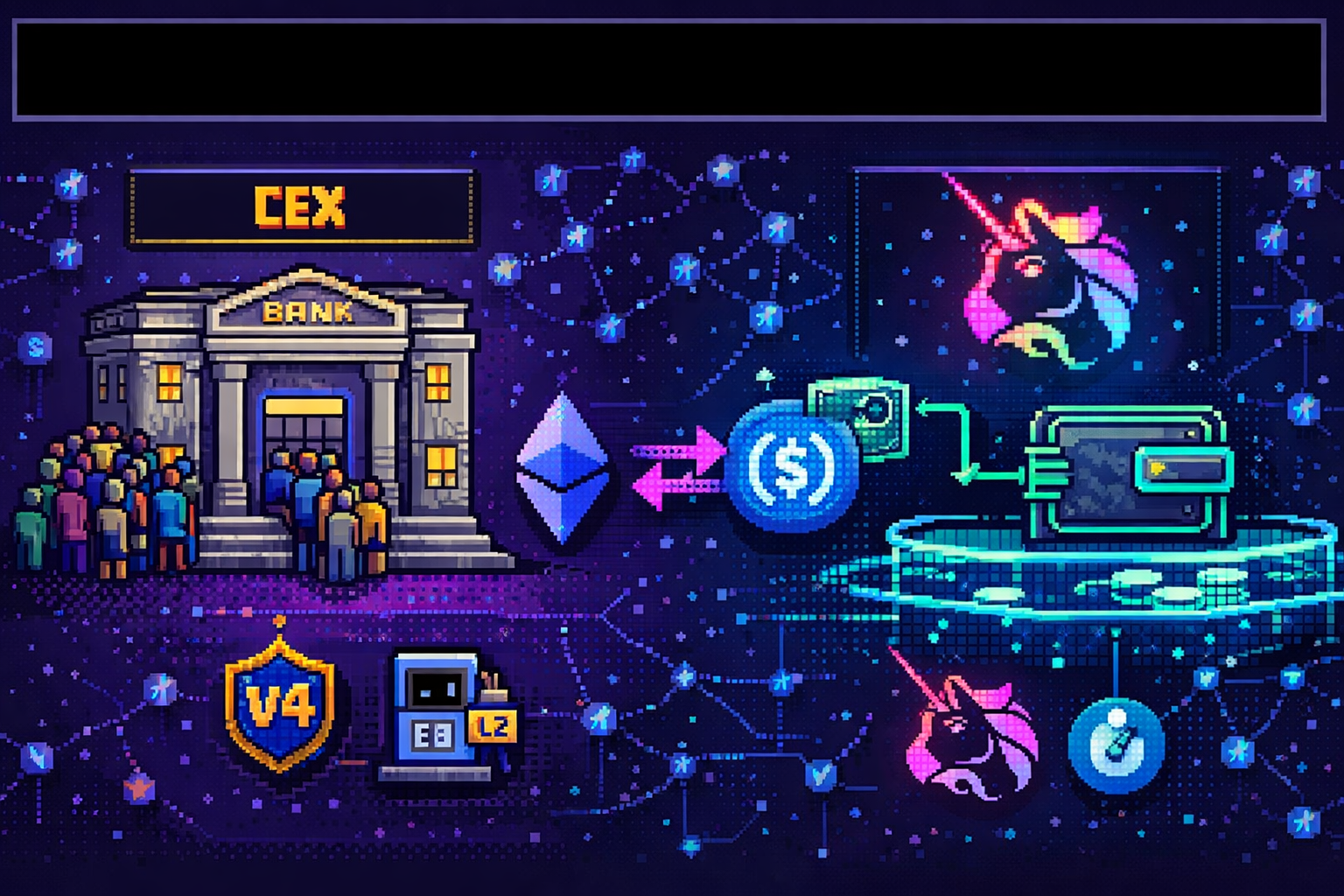
Imagine if you could trade cryptocurrencies directly with other people – no company in the middle, no account creation, no withdrawal limits, and no one who can freeze your funds.
That’s what Uniswap enables.
It’s the world’s largest decentralized exchange (DEX), processing billions in trading volume every week without a single employee handling your money. Every swap happens automatically, 24/7, through code that anyone can audit and verify.
I remember my first Uniswap transaction. I’d been using Coinbase for years, but when I wanted to buy a new token that wasn’t listed anywhere else, I had to venture into the world of DEXs. I connected my MetaMask, swapped some ETH for the token, and watched it appear in my wallet minutes later. No approval process, no waiting for deposits to clear, no customer support, just pure, permissionless trading.
Uniswap isn’t a company you sign up for, it’s a protocol, a set of smart contracts on Ethereum and other blockchains that lets anyone swap tokens directly from their wallet. Launched in 2018 by Hayden Adams, it pioneered a new way of trading called Automated Market Making (AMM) , replacing traditional order books with liquidity pools.
In this guide, we’ll explain Uniswap in plain English: how it works, how to swap tokens safely, what liquidity provision means, the risks you need to know (impermanent loss, scam tokens, gas fees), and, most importantly, whether Uniswap is right for you or if you’d be better off starting with a centralized exchange.

Uniswap in One Sentence
Uniswap is a decentralized exchange (DEX) that lets you trade cryptocurrencies directly from your wallet using automated liquidity pools – no account, no KYC, no middleman.
Here are a few other ways to think about it:
- For traditional finance people: Uniswap is like a stock exchange that runs entirely on code – no brokers, no trading floor, just algorithms matching buyers and sellers automatically.
- For crypto people: Uniswap is the backbone of DeFi trading – the protocol that made AMMs mainstream and enabled anyone to become a liquidity provider and earn fees.
- For the curious: Imagine if you could swap currencies at an airport kiosk, but instead of a machine owned by a company, it’s a smart contract owned by everyone and no one.
The Problem Uniswap Solves
The Traditional Exchange Problem
Before Uniswap, trading crypto on decentralized platforms was difficult. Early DEXs tried to replicate centralized exchange order books on-chain, but this was slow, expensive, and impractical. Centralized exchanges (like Coinbase or Binance) worked well but required you to trust them with your funds, and we all know what happens when exchanges fail (Mt. Gox, FTX).
The Order Book Challenge
Order books need continuous matching of buyers and sellers. On a blockchain, this is technically challenging and gas-intensive. For every order placed, modified, or canceled, you’d pay transaction fees. For every trade matched, more fees. It just wasn’t viable.
Uniswap’s Solution: The Automated Market Maker
Uniswap flipped the model. Instead of matching buyers with sellers, it created liquidity pools – smart contracts containing pairs of tokens (like ETH and USDC). Prices are set algorithmically by a simple formula: x * y = k. This means trades can happen instantly, 24/7, without waiting for a counterparty.
Why This Matters
For the first time, decentralized trading became practical. Anyone with a wallet could swap tokens. Anyone could become a market maker by depositing into pools and earning fees. Uniswap didn’t just create an exchange, it created a new financial primitive that powers hundreds of other protocols.
How Uniswap Works: The AMM Revolution
Liquidity Pools: The Heart of Uniswap
Instead of an order book, Uniswap uses liquidity pools. Smart contracts that hold reserves of two tokens. For example, an ETH/USDC pool might contain 1,000 ETH and 3 million USDC. The ratio between these reserves determines the price.
The Constant Product Formula: x * y = k
This is Uniswap’s magic equation. It’s simple but powerful:
- x = amount of Token A in the pool
- y = amount of Token B in the pool
- k = a constant (the product of x and y must remain unchanged after trades)
How a Swap Works
| Step | What Happens |
|---|---|
| 1. You initiate a swap | You want to trade 1 ETH for USDC |
| 2. The formula calculates | Adding 1 ETH to the pool changes the ratio; the formula determines how much USDC you receive |
| 3. Price adjusts | The more you buy of one token, the more expensive it becomes (slippage) |
| 4. Liquidity providers earn fees | A small fee (0.05% to 1%) is taken from your trade and distributed to LPs |
Why This Works
The constant product formula ensures that pools always have liquidity. No matter how large your trade, you’ll always get some tokens—though the price may move significantly for large trades relative to pool size.
Uniswap’s Evolution: From V1 to V4 (2026)
Timeline of Innovation
| Version | Year | Key Innovation |
|---|---|---|
| V1 | 2018 | Original AMM, ETH/ERC-20 pools only |
| V2 | 2020 | Direct ERC-20/ERC-20 swaps, flash loans |
| V3 | 2021 | Concentrated liquidity, multiple fee tiers (0.05%, 0.30%, 1%), L2 support |
| V4 | 2026 | “Hooks” for dynamic fees, Singleton architecture (99% lower gas for complex routes), enhanced oracles |
V3: Concentrated Liquidity (Still Dominant in 2026)
V3 was a game-changer. Instead of providing liquidity across all price ranges, LPs can concentrate their capital in specific bands where trading activity is highest. This increases capital efficiency up to 4,000x compared to V2.
If you believe ETH will trade between $3,000-3,500, you can put all your liquidity there and earn fees only from trades in that range.
V4: Hooks and Singleton (2026’s Big Upgrade)
V4 introduces “hooks” – custom logic that can be attached to pools. This enables:
- Dynamic fee structures
- New order types
- Sophisticated strategies directly in the pool contract
The “Singleton” architecture pools all liquidity in a single contract, reducing gas costs for multi-hop swaps by up to 99% .
Multi-Chain Expansion (2026)
Uniswap now operates on multiple chains beyond Ethereum:
- Ethereum mainnet (original)
- Arbitrum and Optimism (Layer 2s for lower fees)
- Base (Coinbase’s L2)
- Polygon
- X Layer (OKX’s zkEVM L2, added January 2026 with zero Uniswap Labs fees)
The X Layer Launch
In January 2026, Uniswap deployed on X Layer (OKX’s zkEVM L2). Users can swap and provide liquidity with zero Uniswap Labs fees, making decentralized trading more accessible than ever.
Step-by-Step: How to Swap Tokens on Uniswap
Prerequisites
| Requirement | Details |
|---|---|
| Non-custodial wallet | MetaMask, Trust Wallet, Coinbase Wallet, or Uniswap Wallet |
| Funds | Tokens to swap + native currency for gas (ETH on Ethereum, etc.) |
| Network selection | Mainnet or L2 (Arbitrum, Optimism, Base, Polygon, X Layer) |
| Small test amount | Never test with funds you can’t afford to lose |
Step 1: Connect Your Wallet
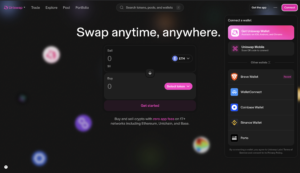
- Go to app.uniswap.org (official site – bookmark it to avoid phishing)
- Click “Connect Wallet” in the top-right corner
- Select your wallet provider and follow prompts
- Approve connection in your wallet
Step 2: Select Tokens and Network
- In the swap panel, choose your network (Ethereum mainnet for highest liquidity, L2s for lower fees)
- Select the token you want to swap FROM (e.g., USDC)
- Select the token you want to swap TO (e.g., UNI)
- Uniswap automatically shows the estimated rate based on current pool liquidity
⚠️ CRITICAL: Verify Token Addresses
Scam tokens are everywhere on Uniswap. Always verify the contract address from official sources (CoinGecko, CoinMarketCap, project’s official site). Look for the verified blue checkmark next to popular tokens.
Step 3: Adjust Swap Settings
Click the settings icon (⚙️) to customize:
| Setting | Recommendation |
|---|---|
| Slippage tolerance | 0.5-1% for stable pairs, 2-3% for volatile tokens |
| Transaction deadline | 20-30 minutes (longer during congestion) |
| Auto-router | Keep enabled for best prices across pools |
Step 4: Review and Confirm
- Click “Swap”
- Review the details in your wallet: amount, fees, total cost
- Check the “Price impact” warning – if it’s high (>5%), consider a smaller trade or different pool
- Confirm the transaction in your wallet
Step 5: Monitor Transaction
- Wait for confirmation (seconds on L2s, minutes on mainnet)
- Track via your wallet’s activity tab or block explorer (Etherscan)
- Tokens appear in your wallet once confirmed
Testnet Practice (Recommended)
Before using real funds, practice on a testnet. Uniswap supports multiple testnets. Use Sepolia ETH (free from faucets) to learn without risk.
Liquidity Provision: Earning Fees as an LP
What Is Liquidity Provision?
Liquidity providers (LPs) deposit pairs of tokens into Uniswap pools and earn a share of trading fees – typically 0.05% to 1% of every trade, proportional to their share of the pool.
How It Works
- You deposit equal value of two tokens (e.g., $1,000 ETH and $1,000 USDC)
- You receive LP tokens representing your share of the pool
- Every trade in that pool generates fees, which accumulate in the pool
- When you withdraw, you get your share of the pool plus earned fees
V3 Concentrated Liquidity (Advanced)
In V3, you can concentrate your liquidity in specific price ranges. This increases your fee earnings if trades happen in your range, but you earn nothing if price moves outside it. You’re essentially betting that price will stay in your chosen band.
Real-World Example: ETH/USDC Pool
| Scenario | V2 (Full Range) | V3 (Concentrated $3,000-3,500) |
|---|---|---|
| Capital required for same fees | $100,000 | $25,000 (4x efficient) |
| If price drops to $2,800 | Still earning (lower fees) | Earn nothing (out of range) |
| If price stays in range | Good earnings | Excellent earnings |
Risks of Liquidity Provision
| Risk | Description |
|---|---|
| Impermanent Loss | If token prices diverge, you’d have been better off just holding |
| Concentration risk | In V3, price moving outside your range means zero fees |
| Smart contract risk | Bugs in code could lead to loss of funds |
| Gas costs | Creating and adjusting positions costs gas |
The Math of Impermanent Loss
Impermanent loss occurs when the price ratio of your deposited tokens changes. The more they diverge, the greater the loss. For example, if ETH doubles against USDC, you might have 30% less ETH and more USDC than if you’d just held. The fees you earn need to exceed this loss to be profitable.
Who Should Provide Liquidity
Liquidity provision isn’t for beginners. Data from 2026 shows that the top 3 LPs account for over 98% of minted liquidity during stress periods, and many are sophisticated MEV bots and institutional players, not retail users.
UNI Token: Governance and Community Control

What Is UNI?
UNI is Uniswap’s governance token, launched in September 2020 with a historic airdrop to early users – 400 UNI per eligible wallet, worth up to $10,000 at peak. Today, UNI remains one of the top 20 cryptocurrencies by market cap, with a total supply of 1 billion tokens.
What UNI Does
| Function | Description |
|---|---|
| Governance voting | UNI holders vote on protocol upgrades, treasury allocations, and parameter changes |
| Fee Switch | UNI governance decides whether protocol fees go to developers, treasury, or are burned |
| Staking rewards | Some platforms offer 3-7% APY for staking UNI in governance pools |
The Fee Switch Debate
The “Fee Switch” is a hot topic in Uniswap governance. It allows UNI holders to decide if a portion of trading fees should be directed to the protocol treasury or distributed to UNI stakers. As of 2026, this feature remains under active discussion.
How to Participate in Governance
- Acquire UNI tokens
- Delegate your voting power (to yourself or a trusted delegate)
- Monitor governance forums for active proposals
- Vote when proposals reach on-chain voting
Where to Buy UNI
| Platform | Notes |
|---|---|
| Centralized exchanges | Binance, Coinbase, Kraken, Bitget – easiest for beginners |
| Uniswap itself | Buy directly on the DEX (requires existing crypto) |
| Other DEXs | Available on most major DEXs |
Uniswap vs Centralized Exchanges: Key Differences
Comparison Table
| Aspect | Uniswap (DEX) | Centralized Exchanges (Coinbase, Binance, Bitget) |
|---|---|---|
| Account needed | No – just a wallet | Yes – email, password, KYC |
| Custody | You control private keys | Exchange holds your funds |
| Fees | 0.05-1% swap fee + gas | 0.01-0.6% trading fee (no gas) |
| Coin selection | 16,200+ (any ERC-20) | 250-1,500+ (curated) |
| Scam risk | High – anyone can list | Low – projects vetted |
| Fiat on-ramp | No | Yes (bank transfer, card) |
| Customer support | None | 24/7 chat, email |
| Regulation | Decentralized, no legal entity | Licensed in multiple jurisdictions |
When to Use Uniswap
| Scenario | Why Uniswap Fits |
|---|---|
| Trading new tokens | New projects launch on DEXs first |
| Privacy-focused | No KYC, no personal data |
| Self-custody advocate | You hold your own keys |
| Accessing DeFi | Many DeFi protocols require DEX interaction |
When to Use Centralized Exchanges
| Scenario | Why CEX Fits |
|---|---|
| First crypto purchase | Fiat on-ramp, simple interface |
| Large trades | Deeper liquidity, less slippage |
| Regulatory comfort | Licensed platforms, insurance funds |
| Customer support needed | Help when things go wrong |
Real-World Cost Comparison
Trading 1 ETH (~$3,000) on Uniswap might cost $9 in swap fees plus $10-50 in gas on Ethereum mainnet – total $19-59. On Bitget or Binance, the same trade costs $3-6 with no gas and executes instantly.
The Hybrid Strategy
Many experienced users use both: a centralized exchange for fiat on-ramp and large trades, and Uniswap for accessing new tokens and DeFi protocols.
The Risks of Using Uniswap (Important!)
⚠️ CRITICAL SECTION. DO NOT SKIP
Risk 1: Scam Tokens and Rug Pulls
Because Uniswap is permissionless, anyone can create a token and add liquidity – including scammers. Fake tokens mimicking popular projects are everywhere. Always verify contract addresses from official sources.
| Red Flag | What to Check |
|---|---|
| No verified contract | Look for blue checkmark on Etherscan |
| Low liquidity | Small pools = easier to manipulate |
| Anonymous team | Legitimate projects have public teams |
| Too-good-to-be-true promises | High yields often mean scams |
Risk 2: Smart Contract Vulnerabilities
Uniswap’s core contracts are extensively audited, but third-party tokens and interfaces may not be. Bugs can lead to loss of funds. In 2023, several DeFi protocols lost millions to hacks.
Risk 3: Impermanent Loss (for LPs)
As explained earlier, providing liquidity can result in impermanent loss if token prices diverge. Many retail LPs end up with lower returns than simply holding – especially during volatile markets.
Risk 4: Gas Fees and Network Congestion
On Ethereum mainnet, gas fees can spike to $50-100+ during busy periods. For small trades, gas can exceed the trade value. Use Layer 2s (Arbitrum, Optimism, Base, X Layer) for lower fees.
Risk 5: Slippage and MEV Bots
In low-liquidity pools, large trades can move prices significantly (slippage). MEV bots may front-run your transactions, extracting value at your expense. During the March 2026 volatility event, Uniswap maintained stability while other DEXs struggled, but MEV remains a concern.
Risk 6: User Error
No customer support means you’re on your own. Send tokens to the wrong address? Lost. Approve a malicious contract? Lost. Forget your seed phrase? Lost. You are your own bank.
Risk 7: Regulatory Uncertainty
DeFi operates in a gray area globally. Future regulations could restrict access or deem certain activities illegal. While Uniswap itself is decentralized, your access to it could be affected by your jurisdiction.
The Safety Checklist
- Start small – test with tiny amounts first
- Verify token addresses on multiple sources
- Use Layer 2s for lower fees
- Never share your seed phrase
- Revoke unused token approvals (use Revoke.cash)
- Consider hardware wallets for large amounts
Who Should Use Uniswap?
Uniswap Is Ideal For
| User Type | Why Uniswap Fits |
|---|---|
| DeFi explorers | Access to thousands of tokens and protocols |
| Self-custody advocates | Full control of private keys |
| Early adopters | New projects launch on DEXs first |
| Privacy-conscious users | No KYC, no personal data |
| Experienced traders | Familiar with wallets, gas, and slippage |
Uniswap May NOT Be Ideal For
| User Type | Better Alternative |
|---|---|
| Absolute beginners | Start with Coinbase or Kraken |
| Those with small amounts (<$500) | Gas fees may eat profits |
| Users needing fiat on-ramp | Centralized exchanges |
| Anyone uncomfortable with self-custody | CEXs offer account recovery |
| High-volume traders | CEXs offer lower fees, no gas |
The Bottom Line
Uniswap is a powerful tool, but it’s not for everyone. If you’re comfortable managing your own wallet, understanding gas fees, and researching tokens before buying, Uniswap opens up the entire DeFi universe. If that sounds overwhelming, start with a centralized exchange and return to Uniswap when you’re ready.
Next Steps: From Learning to Trading
You now understand Uniswap. Here’s where to go next:
The Beginner’s Path
| Step | Action | Resource |
|---|---|---|
| 1. Get a Wallet | Download MetaMask or Uniswap Wallet | Wallet Guide |
| 2. Fund It | Buy ETH on Coinbase/Kraken, transfer | How to Buy Crypto |
| 3. Practice on Testnet | Use Sepolia ETH (free) to learn | Testnet Guide |
| 4. Start Small | Swap $20 on Uniswap (L2 recommended) | Follow step-by-step |
| 5. Explore Further | Try providing liquidity (small amounts) | Liquidity Guide |
| 6. Stay Safe | Revoke approvals, use hardware wallet for large amounts | Security Guide |
Essential Next Reads
- 📚 What is DeFi? A Beginner’s Guide
- 📚 Layer 2 Scaling: Arbitrum, Optimism, and Base
- 📚 How to Avoid Crypto Scams: Complete Guide
- 📚 Best Crypto Wallets for DeFi
Join the Community
Uniswap moves fast. New tokens launch daily, gas prices fluctuate, and governance proposals shape the protocol’s future. Join our Discord, follow us on Twitter, and subscribe to our newsletter for weekly Uniswap updates, new token listings, and security alerts.
Final Thought
Uniswap represents everything that makes crypto revolutionary: permissionless access, self-custody, and community governance.
But with great power comes great responsibility – you’re in control, which means you’re also on the hook if things go wrong.
When I made my first swap, I triple-checked every address, held my breath during confirmation, and felt a rush when the tokens appeared in my wallet. Now, using Uniswap is second nature, but I never forget that I’m my own bank.
Start small, stay curious, and welcome to the world of decentralized trading.
Disclaimer: This guide is for educational purposes only and does not constitute financial advice. Decentralized exchanges involve significant risks, including potential loss of funds. Always do your own research and never invest more than you can afford to lose.
This guide was last updated for the 2026 edition. Uniswap evolves rapidly – new versions launch, chains expand, and token listings change daily. Always verify current information before trading.
Frequently Asked Questions
Is Uniswap safe for beginners?
Uniswap's core contracts are secure, but the platform itself has risks: scam tokens, high gas fees, and no customer support. Beginners should start small, verify token addresses, and use Layer 2s for lower fees.
How much are Uniswap fees?
You pay two types of fees: swap fees (0.05% to 1%, depending on pool) and gas fees (network transaction costs). On Ethereum mainnet, gas can be $20-50+; on Layer 2s, it's often under $1.
Do I need an account to use Uniswap?
No. Uniswap has no accounts. You need a non-custodial wallet like MetaMask or Trust Wallet. Your wallet is your identity.
How do I connect MetaMask to Uniswap?
Go to app.uniswap.org, click "Connect Wallet," select MetaMask, and approve the connection in the extension. Ensure you're on the correct network.
What's the difference between Uniswap and Coinbase?
Coinbase is a centralized exchange where Coinbase holds your funds. Uniswap is decentralized - you hold your own keys. Coinbase requires KYC and offers customer support; Uniswap has no KYC and no support.
Can you lose money on Uniswap?
Yes. Beyond normal trading losses, you can lose money to: scam tokens, impermanent loss (if providing liquidity), high gas fees eating profits, and user error.
What is a liquidity pool in Uniswap?
A liquidity pool is a smart contract containing two tokens (like ETH and USDC). Traders swap against these pools, and liquidity providers earn fees from trades.
How do I avoid scam tokens on Uniswap?
Always verify contract addresses on official sources (CoinGecko, project website). Look for the verified blue checkmark. Start with small amounts. Never trust random tokens sent to your wallet.
What is impermanent loss?
Impermanent loss happens when you provide liquidity and the price ratio of your deposited tokens changes. You end up with less value than if you'd simply held the tokens. The loss becomes "permanent" only if you withdraw at that point.
Does Uniswap work on iPhone?
Yes. Use Uniswap's mobile wallet app or connect via WalletConnect to access Uniswap through mobile browsers.
What is Uniswap V4?
Uniswap V4 (2026) introduces "hooks" for custom pool logic and "Singleton" architecture that reduces gas costs for complex swaps by up to 99%.
Can I buy Bitcoin on Uniswap?
Yes, if there's a liquidity pool. You can swap ETH for WBTC (wrapped Bitcoin) on Uniswap. But you can't deposit fiat currency directly. You need crypto first.
What is the UNI token used for?
UNI is a governance token. Holders vote on protocol upgrades, fee structures, and treasury allocations. It has no direct economic claim on protocol fees (yet), but that may change.
Should I use Uniswap or a centralized exchange?
It depends. Use Uniswap for new tokens, privacy, and DeFi access. Use centralized exchanges for first purchases, large trades, and when you want customer support. Many users use both.
About the Author

mfehfgnlmverrrswsdhjuirftdwpeg