




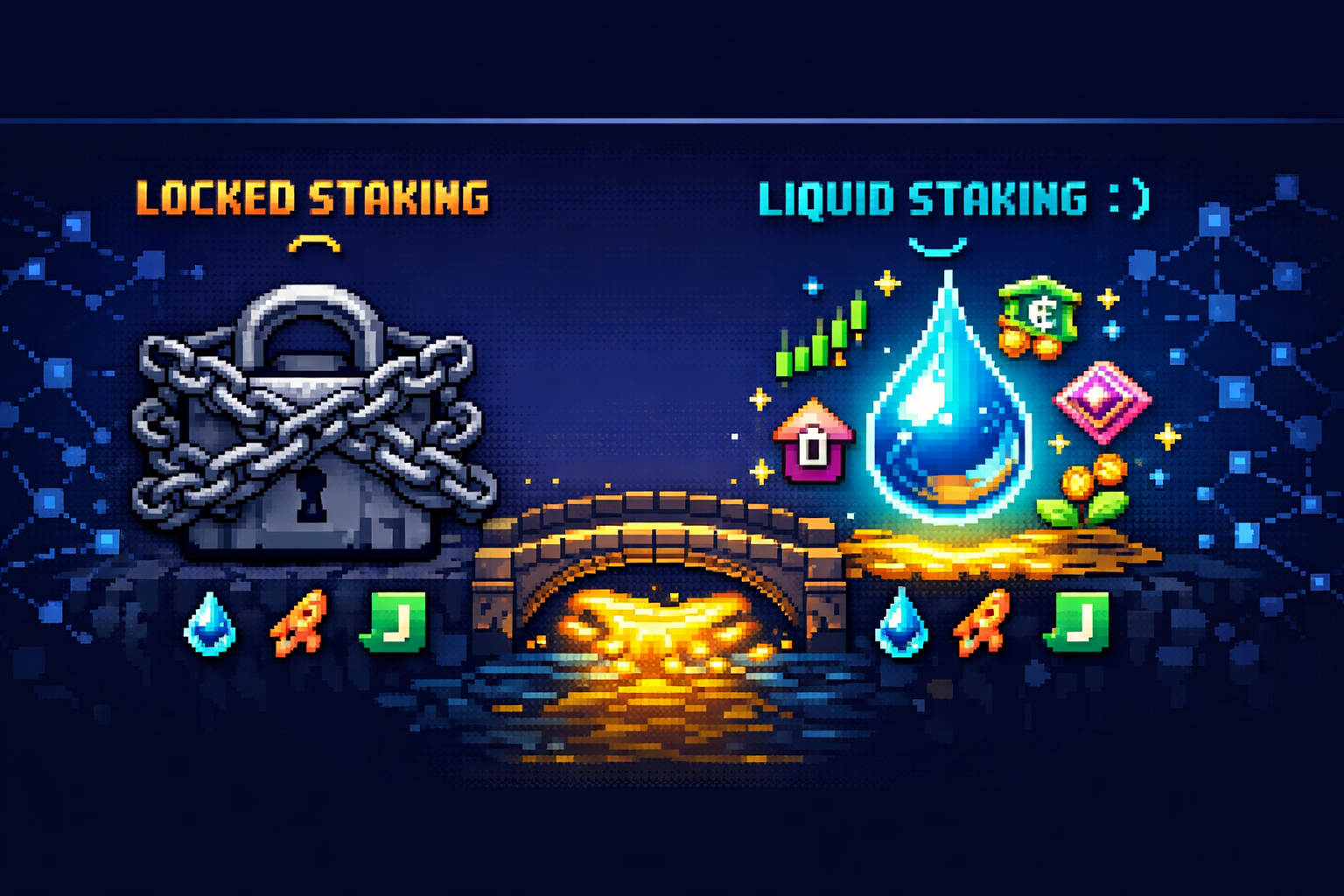
For years, staking came with an uncomfortable trade-off: lock up your assets to earn yield, but lose the ability to sell or use them.
During bull markets, this meant watching prices soar while your funds were trapped in unbonding periods. During crashes, it meant helplessly watching your portfolio plummet with no exit. And for DeFi enthusiasts, it meant idle capital that could otherwise be deployed across lending protocols, liquidity pools, and yield farms.
Liquid staking changes everything.
When I first staked ETH directly, I felt that lock-up anxiety every time the market moved. Then I discovered liquid staking. I deposited my ETH into Lido, received stETH, and suddenly my staked position was alive. I could lend it on Aave, provide liquidity on Curve, or simply hold it knowing I could exit anytime. The feeling was liberating.
Liquid staking lets you have your crypto and stake it too. You deposit your tokens into a protocol, receive a liquid staking token (LST) in return, and continue earning rewards while your LST can be traded, lent, or used across DeFi. It’s staking without the shackles.
In this comprehensive guide, we’ll explain how liquid staking works, compare the leading protocols (Lido, Rocket Pool, Jito, Marinade), break down the risks you need to understand, and help you choose the right solution for your portfolio.

Liquid Staking in One Sentence
Liquid staking is a mechanism that lets you stake your cryptocurrency and receive a tradable token in return. So you can earn staking rewards while still being able to sell, trade, or use your assets in DeFi.
Here are a few other ways to think about it:
- For traditional finance people: Think of liquid staking like a certificate of deposit that you can trade on the secondary market while it’s still earning interest.
- For crypto people: Liquid staking turns your staked position into a DeFi-ready asset. You get the yield AND the liquidity.
- For the curious: Imagine if your savings account paid interest but you could also spend the money while it was earning. That’s liquid staking.
The Problem Liquid Staking Solves
The Liquidity Trade-Off
Traditional staking forces you to choose between earning yield and maintaining liquidity. Once you stake your tokens, they’re locked, sometimes for days or weeks of unbonding periods. During that time, you can’t sell, trade, or use them as collateral.
Why This Matters
| Scenario | Problem |
|---|---|
| Bull market | Your tokens are locked while prices soar – you miss selling opportunities |
| Bear market | Your tokens are locked while prices crash – you can’t exit |
| DeFi opportunities | Your tokens sit idle instead of being deployed for additional yield |
The Capital Efficiency Problem
Long-term holders accept this trade-off, but for active investors, locked capital is dead capital. Liquid staking transforms staked assets from static positions into dynamic, productive capital that can move throughout the DeFi ecosystem.
How Liquid Staking Works: LSTs and Exchange-Rate Accrual
The Basic Mechanism
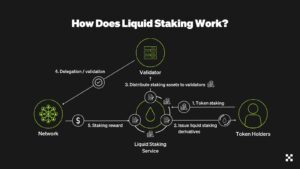
Liquid staking protocols operate through smart contracts that pool user deposits and stake them with professional validators. In return, users receive liquid staking tokens (LSTs) that represent their claim on the staked assets.
Step-by-Step Process
- You deposit tokens (e.g., 1 ETH) into a liquid staking protocol’s smart contract
- The protocol stakes your tokens by delegating to validators across the network
- You receive LSTs (e.g., stETH, rETH, JitoSOL) in your wallet
- Rewards accrue through exchange-rate appreciation – your LST balance stays constant, but each token represents more underlying ETH over time
- You can use your LSTs in DeFi protocols – lend them, provide liquidity, or use as collateral
- To unstake, you exchange your LSTs back for the original asset (via the protocol or secondary markets)
Exchange-Rate Accrual Explained
Unlike traditional staking where you receive periodic reward payments, most LSTs use an exchange-rate model. For example:
- You stake 1 ETH and receive 1 stETH
- Staking rewards are 4% annually
- After one year, your 1 stETH will be redeemable for 1.04 ETH
- The token count doesn’t change – the redemption value increases
This is different from rebasing tokens where your balance increases. With exchange-rate LSTs, the value accrues in the token’s price rather than its quantity.
The Role of Validators
Protocols like Lido and Rocket Pool don’t stake your tokens themselves, they distribute them across networks of independent validators. This decentralization reduces slashing risk and aligns with crypto’s trust-minimized ethos.
Traditional Staking vs Liquid Staking: Key Differences
| Aspect | Traditional Staking | Liquid Staking |
|---|---|---|
| Liquidity | Locked during staking period; unbonding delays | Instant via LST trading; protocol withdrawals may have queues |
| Capital efficiency | Low – assets sit idle | High – LSTs can be deployed in DeFi |
| Reward mechanism | Periodic payouts (increase token count) | Exchange-rate accrual (increase redemption value) |
| Validator selection | User must research and choose | Protocol manages delegation |
| Slashing risk | Borne by individual staker | Socialized across protocol participants |
| DeFi composability | None | Full integration with lending, DEXs, and yield protocols |
| Minimum stake | Often high (32 ETH for solo staking) | Any amount (as low as 0.01 ETH) |
The Mental Model
A useful analogy is the difference between a fixed-term bank deposit and a money market fund. Both generate income, but the money market fund’s shares can be sold anytime and used as collateral. Liquid staking brings this flexibility to crypto.
Major Liquid Staking Protocols Compared
Lido: The Market Leader (stETH)

Overview: Lido is the dominant liquid staking protocol, with over $22 billion in total value locked (TVL) as of March 2026. It supports staking on Ethereum, Solana, Polygon, and Polkadot, though Ethereum remains its primary focus.
How It Works: Users deposit ETH and receive stETH, which accrues value through an exchange-rate mechanism. Lido distributes deposits across a curated set of professional node operators, ensuring high performance and reliability. A 10% fee is charged on staking rewards.
Key Features:
- stETH/wstETH: stETH is a non-rebasing token; wstETH (wrapped stETH) is used in DeFi for compatibility
- Deep liquidity: stETH is accepted across 27+ DeFi protocols, including Aave, Curve, and MakerDAO
- Governance: LDO token holders vote on protocol parameters and operator selection
Recent Developments (2026): Lido’s new “Identified DVT Cluster” (IDVTC) design, launching with CSM v3 in Q2-Q3 2026, lets verified solo stakers form distributed validator clusters using DVT. This reduces collateral requirements while hardening validator resilience.
Tradeoffs
- Centralization concerns due to curated operator set
- stETH has experienced de-pegging during market stress
- Governance/oracle risk
Best For: Users who prioritize liquidity, deep DeFi integrations, and a proven track record over decentralization purity.
Rocket Pool: The Decentralized Alternative (rETH)

Overview: Rocket Pool is the leading decentralized staking protocol, designed to maximize trust minimization and community participation. With ~$1.3 billion TVL and about 1,500 independent node operators, it offers a permissionless alternative to Lido’s curated model.
How It Works: Rocket Pool uses a two-tier system: node operators stake a minimum of 8 or 16 ETH (depending on the minipool type) plus RPL collateral, while users deposit any amount and receive rETH. The protocol’s smart contracts match user deposits with node operators, and rETH accrues value through the exchange-rate mechanism.
Key Features:
- Permissionless node operation: Anyone with 8/16 ETH and technical expertise can become a node operator
- RPL token: Used for governance and as collateral by node operators
- Low minimum: Users can stake with as little as 0.01 ETH
- rETH liquidity: Available on major DEXs and bridges
Fees: Protocol fee of 15% on staking rewards, with node operators earning commission on user deposits.
Tradeoffs:
- Lower liquidity than stETH (rETH is less widely integrated)
- Node operator complexity requires technical expertise
- Lower yields due to node operator commissions
Best For: Users who value decentralization, open participation, and trust minimization over absolute liquidity.
Jito: MEV-Enhanced Solana Staking (JitoSOL)

Overview: Jito is Solana’s premier liquid staking protocol, distinguished by its MEV-enhanced yield mechanism. By exclusively delegating to validators running the Jito-Solana client, the protocol captures additional value from transaction ordering (MEV) and distributes it to stakers.
How It Works: Users stake SOL and receive JitoSOL, which accrues both standard staking rewards and MEV tips. The Jito-Solana client minimizes negative MEV effects (like spam trades) while maximizing efficiency and additional profits.
Key Metrics:
- APY range: 5-8% (vs standard Solana staking at ~6-7%)
- TVL: ~$1.19 billion
- Unbonding: Epoch-based (~2-3 days); instant exits via AMMs
Tradeoffs:
- MEV-enhanced yields are more variable than standard staking
- Relies on Jito-Solana validator client adoption
Best For: Solana holders seeking maximum yield and comfortable with MEV mechanics.
Marinade: Solana’s Original LST (mSOL)

Overview: Marinade was Solana’s first native liquid staking solution, launched in March 2021. It offers both liquid staking (via mSOL ) and native staking (automated delegation without smart contracts).
How It Works: Users stake SOL and receive mSOL, which can be deployed across Solana DeFi protocols like Kamino and Drift. Marinade’s automated delegation strategy optimizes validator selection to maximize returns.
Key Features:
- MNDE rewards: Additional token incentives for participants
- Native staking option: For users who prefer no smart contract risk
Blaze: Solana’s Largest Validator Set (bSOL)

Overview: Blaze features the largest validator set of any Solana stake pool, with over 200 validators. It leverages the official stake pool smart contracts from Solana Labs, which have undergone extensive auditing.
Key Features:
- Custom Liquid Staking: Stake to specific validators or groups via the Custom Liquid Staking protocol
- bSOL token: Yield-bearing LST representing staked SOL
- Maximum decentralization: Broad validator distribution reduces concentration risk
Sanctum: Custom LST Infrastructure

Overview: Sanctum enables the creation of custom LSTs, allowing projects to use LSTs as delivery mechanisms for extra yields, NFT whitelist spots, or subscription services. Its primary use case is validator LSTs like laineSOL, bonkSOL, and compassSOL.
Key Features:
- Validator LSTs: Combine native staking benefits (zero fees, validator choice) with liquid staking benefits (instant liquidity, DeFi usage)
- LST router: Buy, sell, and trade any Solana LST instantly with limited slippage
Lido vs Rocket Pool: Head-to-Head Comparison

The Core Philosophical Difference
Lido and Rocket Pool represent two competing visions for Ethereum staking infrastructure: optimized efficiency vs decentralized participation.
Detailed Comparison Table
| Feature | Lido (stETH) | Rocket Pool (rETH) |
|---|---|---|
| Launch date | 2020 | 2016 |
| TVL (March 2026) | $22+ billion | ~$1.3 billion |
| Minimum stake | None | 0.01 ETH |
| Node operators | Curated set of professionals | Permissionless (~1,500 operators) |
| Protocol fee | 10% on rewards | 15% on rewards |
| Governance token | LDO | RPL |
| Liquidity | Deepest in DeFi (27+ protocols) | Good but less widespread |
| Slashing risk | Socialized; curated operators reduce risk | Socialized; permissionless operators increase risk |
| APY (typical) | ~2.5-5% | ~2-3.5% |
| De-peg history | stETH traded at discount during crises | rETH more stable but lower liquidity |
When to Choose Lido
| Priority | Why Lido Fits |
|---|---|
| Maximum liquidity | stETH works everywhere |
| DeFi integrations | 27+ protocols, easiest composability |
| Institutional comfort | Curated operators, proven track record |
When to Choose Rocket Pool
| Priority | Why Rocket Pool Fits |
|---|---|
| Decentralization matters | Permissionless node operation |
| Ethereum alignment | More aligned with crypto’s open ethos |
| Avoiding dominance | Helps prevent Lido’s supermajority risk |
The Supermajority Concern
Lido’s dominance (over 30% of staked ETH ) has raised concerns about Ethereum’s decentralization. Some argue that Lido’s growth threatens the network’s resilience. Rocket Pool offers a way to stake ETH while supporting a more distributed validator set.
Solana Liquid Staking: A Different Ecosystem
Solana’s Staking Architecture
Solana’s Proof of Stake mechanism differs from Ethereum’s in key ways – faster epochs, lower minimums, and no slashing for downtime. This creates a different landscape for liquid staking, with multiple competitive protocols.
Major Solana LSTs Compared
| Protocol | LST | APY Range | Unique Feature |
|---|---|---|---|
| Jito | JitoSOL | 5-8% | MEV-enhanced yields |
| Marinade | mSOL | 6-7% | Native staking option, MNDE rewards |
| Blaze | bSOL | 6-7% | Largest validator set (200+) |
| Sanctum | Various | Varies | Custom validator LSTs, LST router |
Phantom Integration
Phantom wallet has made liquid staking accessible to everyday users through its built-in staking interface. Users can stake SOL directly to receive PSOL, a yield-bearing LST that offers higher average rewards than native staking by sharing MEV tips and priority fees.
Key Differences from Ethereum LSTs
| Aspect | Ethereum LSTs | Solana LSTs |
|---|---|---|
| Validator diversity | Lido dominant; others smaller | Multiple competitive protocols |
| Unbonding | Queue-based + AMM exits | Epoch-based (~2-3 days) + AMM exits |
| MEV capture | Limited | Jito leads with MEV integration |
| Governance | LDO, RPL | JTO, MNDE, etc. |
The Risks of Liquid Staking (Important!)
⚠️ CRITICAL SECTION. DO NOT SKIP
Risk 1: De-pegging and Liquidity Risk
LSTs are designed to trade at parity with the underlying asset, but they can de-peg during market stress. In June 2022, stETH traded at a 5% discount to ETH due to selling pressure from leveraged positions. During high volatility, converting LSTs back to the underlying asset may require accepting unfavorable rates.
Mitigation: Use protocols with deep liquidity (Curve pools, etc.) and avoid panic selling during de-pegs.
Risk 2: Smart Contract Vulnerabilities
Liquid staking relies on complex smart contracts. Despite multiple audits (Lido: Certora, Sigma Prime, ChainSecurity; Rocket Pool: Sigma Prime, Trail of Bits), bugs can exist and be exploited. A critical vulnerability could lead to partial or total loss of funds.
Risk 3: Slashing Risk (Socialized)
Validators who misbehave can be slashed – penalized by having a portion of their staked ETH destroyed. In liquid staking protocols, slashing losses are typically socialized across all participants, meaning your LST’s value could decrease if the protocol’s validators are slashed.
Risk 4: Protocol Governance Risk
Protocol parameters – fees, validator selection, risk parameters, are controlled by governance token holders. Malicious or incompetent governance decisions could harm users. Lido and Rocket Pool have strong track records, but governance attacks remain possible.
Risk 5: Concentration and Censorship Risk
Lido’s dominance (~30%+ of staked ETH) has raised concerns about Ethereum’s censorship resistance. If Lido were forced to comply with regulations that censor transactions, it could impact the entire network.
Risk 6: Regulatory Uncertainty
The regulatory landscape for liquid staking is still evolving. Changes could impact protocol operations, the legal status of LSTs, or tax treatment of staking rewards.
The Safety Checklist
- Start with small amounts to understand the mechanics
- Use established protocols with multiple audits and long track records
- Monitor de-pegging risk during market volatility
- Never invest more than you can afford to lose
- Understand the protocol’s slashing history and validator quality
- Consider diversification across multiple LSTs
How to Use Liquid Staking Tokens in DeFi
The Composability Advantage
LSTs unlock a world of DeFi opportunities that are impossible with traditionally staked assets. Here’s how you can put your LSTs to work.
Common LST Strategies
| Strategy | How It Works | Example |
|---|---|---|
| Lending | Supply LSTs as collateral to borrow other assets | Supply stETH on Aave, borrow USDC |
| Liquidity provision | Add LST/ETH pairs to DEXs, earn trading fees | stETH/ETH on Curve |
| Yield farming | Stake LP tokens for additional rewards | Curve stETH pool on Convex |
| Restaking | Use LSTs to secure other networks via EigenLayer | Restake stETH for AVS rewards |
| Collateral for stablecoins | Mint stablecoins against LST collateral | Mint DAI against stETH on Maker |
Real-World Example: The Loop
A sophisticated strategy: stake ETH → receive stETH → deposit stETH on Aave → borrow ETH → stake borrowed ETH again for more stETH → repeat. This can amplify yields but also risks.
Important Considerations
- Each DeFi interaction adds smart contract risk
- Impermanent loss applies to liquidity provision
- Leverage amplifies both gains and losses
- Gas costs can eat profits on small positions
The Future: DVT, Restaking, and 2026 Innovations
Distributed Validator Technology (DVT)
DVT splits validator keys across multiple nodes, so no single operator can take a validator down, misconfigure a client, or disappear without the cluster absorbing the shock. Lido’s new IDVTC design, launching in Q2-Q3 2026, uses DVT to lower collateral requirements while hardening validator resilience.
Restaking and Liquid Restaking Tokens (LRTs)
Restaking protocols like EigenLayer let you reuse staked ETH (or LSTs) to secure additional networks (AVSs) in exchange for extra yield. Liquid restaking tokens like Ether.fi’s eETH** combine liquid staking with restaking in a single wrapper, offering convenience at the cost of added complexity.
The Competitive Landscape
As of 2026, the liquid staking market is evolving rapidly:
- Lido maintains dominance but faces decentralization pressure
- Rocket Pool grows steadily as the decentralized alternative
- Ether.fi and Swell offer restaking-integrated LSTs
- Jito leads on Solana with MEV-enhanced yields
- Babylon enables BTC staking (a different paradigm)
Next Steps: Getting Started with Liquid Staking
You now understand liquid staking. Here’s where to go next:
The Beginner’s Path
| Step | Action | Resource |
|---|---|---|
| 1. Get a Wallet | Download MetaMask (Ethereum) or Phantom (Solana) | Wallet Guide |
| 2. Acquire ETH/SOL | Buy on exchange, transfer to wallet | How to Buy Crypto |
| 3. Start Small | Stake minimal amount on your chosen protocol | Lido, Rocket Pool, Jito, etc. |
| 4. Monitor Your LST | Track value and understand exchange-rate accrual | Protocol dashboards |
| 5. Explore DeFi | Try lending or providing liquidity (small amounts) | DeFi Guide |
Essential Next Reads
- 📚 What is DeFi? A Beginner’s Guide
- 📚 Best Crypto Wallets for DeFi
- 📚 Restaking Explained: EigenLayer and Beyond
- 📚 Lido vs Rocket Pool: Full Comparison
Join the Community
Liquid staking evolves rapidly – new protocols, integrations, and risk vectors emerge constantly. Join our Discord, follow us on Twitter, and subscribe to our newsletter for weekly updates on the liquid staking ecosystem.
Final Thought
When I first discovered liquid staking, it felt like a revelation. My ETH was no longer trapped – it was alive, moving through DeFi, earning yields on multiple levels simultaneously.
Liquid staking transforms crypto from a static investment into dynamic, productive capital. It’s the difference between letting your assets sit idle and putting them to work across the entire DeFi ecosystem.
Start small, stay curious, and watch your crypto earn its keep.
Disclaimer: This guide is for educational purposes only and does not constitute financial advice. Liquid staking involves significant risks, including potential loss of principal. Always do your own research and never invest more than you can afford to lose.
This guide was last updated for the 2026 edition. Liquid staking evolves rapidly – new protocols launch, TVL shifts, and risk profiles change. Always verify current information before staking.
Frequently Asked Questions
How do liquid staking tokens w
Most LSTs use an exchange-rate model: your token balance stays constant, but each token becomes redeemable for more of the underlying asset over time as rewards accrue. For example, 1 stETH today might be redeemable for 1.04 ETH after a year of rewards.
Is Lido safer than Rocket Pool?
They have different risk profiles. Lido benefits from curated professional operators and deeper liquidity but raises centralization concerns. Rocket Pool is more decentralized with permissionless operators but has lower liquidity and slightly higher technical risk. Both are audited and have strong track records.
What is the difference between stETH and ETH?
stETH represents staked ETH in Lido. It's designed to trade at parity with ETH, with the redemption value increasing over time as staking rewards accumulate. stETH can be used in DeFi, while ETH is the native asset.
Can you lose money on liquid staking?
Yes. Beyond normal price volatility, risks include: de-pegging (LSTs trading below underlying asset value), smart contract exploits, slashing penalties, and protocol governance failures. Never invest more than you can afford to lose.
What are the risks of liquid staking?
Key risks include: de-pegging and liquidity risk, smart contract vulnerabilities, slashing risk (socialized), protocol governance risk, concentration/censorship concerns, and regulatory uncertainty.
How does Jito generate higher yields on Solana?
Jito validators run the Jito-Solana client, which captures MEV (Maximal Extractable Value) from transaction ordering. These MEV tips are distributed to JitoSOL holders in addition to standard staking rewards, boosting yields to 7-9%.
What is depegging in liquid staking?
Depegging occurs when an LST trades below the value of its underlying asset (e.g., stETH at 0.95 ETH). This can happen during market stress due to selling pressure, liquidity constraints, or confidence issues. The peg typically recovers as markets stabilize.
Which liquid staking protocol has the lowest fees?
Lido charges 10% on staking rewards, Rocket Pool charges 15% (plus node operator commissions), and Jito charges validator fees (included in quoted APY). Fee structures vary; always check net APY after all fees.
How do I use stETH in DeFi?
stETH is widely accepted across DeFi protocols. Common uses include: supplying as collateral on Aave, providing liquidity on Curve, or minting DAI on Maker. Connect your wallet to these protocols and follow their interaction guides.
What is the minimum amount for liquid staking?
Minimums vary: Lido has no minimum, Rocket Pool accepts 0.01 ETH, and Solana protocols typically accept any amount. This makes liquid staking accessible to small holders.
Is liquid staking taxable?
In most jurisdictions, staking rewards are taxable as income when received. With LSTs using exchange-rate accrual, tax treatment can be complex. Consult a tax professional familiar with crypto in your country.
Can I stake Bitcoin with liquid staking?
Traditional liquid staking works only with Proof-of-Stake assets. However, new protocols like Babylon enable Bitcoin holders to stake BTC to help secure other networks - a different paradigm from ETH/SOL liquid staking.
What is the difference between liquid staking and restaking?
Liquid staking lets you stake assets and receive tradable LSTs. Restaking (EigenLayer, etc.) lets you reuse already-staked assets to secure additional networks for extra yield. Some protocols now combine both (liquid restaking tokens/LRTs).
Which is better: Lido or Rocket Pool?
Choose Lido if you prioritize maximum liquidity, deep DeFi integrations, and a proven track record. Choose Rocket Pool if decentralization, permissionless participation, and Ethereum's open ethos matter more to you. Both are excellent protocols.
About the Author