


You’ve bought your first Bitcoin and Ethereum. You’ve moved them off the exchange into your own wallet. Now what?
For millions of crypto investors, the answer is: put your assets to work. With over 33 million ETH staked, worth roughly $100 billion, passive income has become the default strategy for long-term holders.
But there’s a fork in the road.
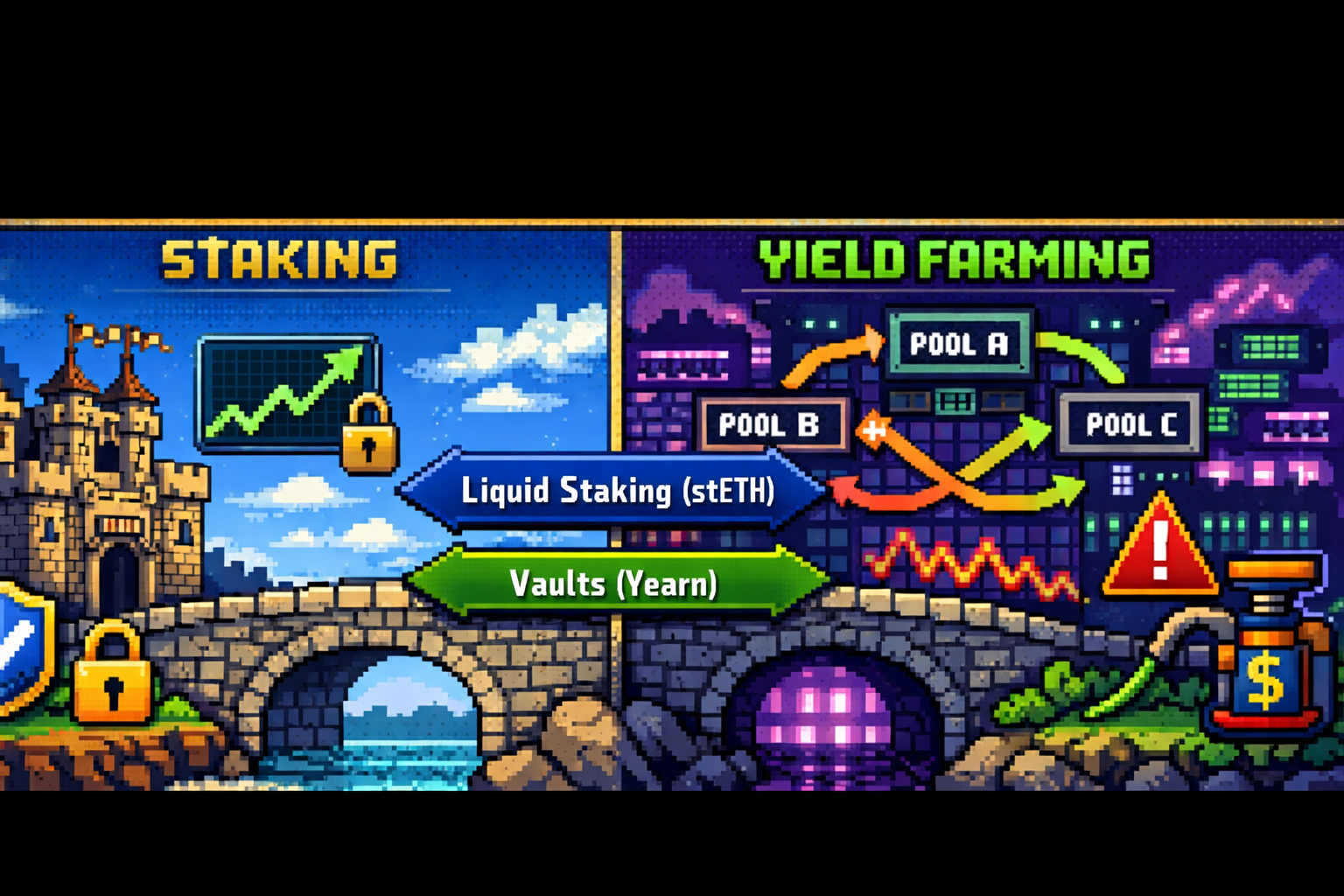
One path, staking, is straightforward: lock your tokens, support a blockchain, earn predictable rewards. The other path, yield farming, is more complex: deposit into liquidity pools, chase the highest APYs across DeFi protocols, and accept that your returns will fluctuate with market conditions.
When I first started in crypto, I only held. Then I discovered staking and watched my ETH balance slowly grow. Then I dipped a toe into yield farming and learned about impermanent loss the hard way. Both strategies have their place, but they are not the same.
In this guide, we’ll break down exactly how each strategy works, compare their returns, risks, and time commitments, and help you decide which one (or both) belongs in your portfolio.
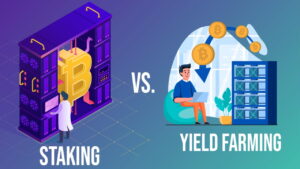
At a Glance: Staking vs Yield Farming
| Aspect | Staking | Yield Farming |
|---|---|---|
| What you do | Lock crypto to support a PoS blockchain | Deposit into DeFi liquidity pools |
| How you earn | Block rewards + transaction fees | Trading fees + incentive tokens |
| Typical APY (2026) | 3-15% (depending on asset) | 5-50%+ (highly variable) |
| Risk level | Low to moderate | Moderate to high |
| Primary risk | Price volatility, slashing | Impermanent loss, smart contract hacks |
| Lock-up period | Often required (days to weeks) | Usually none (but withdrawal may have fees) |
| Skill required | Beginner-friendly | Intermediate to advanced |
| Best for | Long-term holders | Active DeFi participants |
The Bottom Line
Staking is like earning interest in a savings account – predictable, lower risk, set-and-forget. Yield farming is like active trading – higher potential returns, but you need to know what you’re doing and monitor your positions.
What is Staking? The Foundation of Passive Income

The Simple Definition
Staking is the process of locking up your cryptocurrency to help secure a Proof-of-Stake (PoS) blockchain network. In return for your contribution, you earn rewards (usually paid in the same cryptocurrency you staked).
How Staking Works
| Step | What Happens |
|---|---|
| 1. You lock your tokens | You deposit crypto into a staking contract or delegate to a validator |
| 2. The network uses your stake | Your tokens help validate transactions and produce new blocks |
| 3. You earn rewards | The network distributes newly minted tokens and transaction fees |
| 4. You unstake (when ready) | After a lock-up period (unbonding), you withdraw your original tokens + rewards |
The Proof-of-Stake Mechanism
Proof-of-Stake is the consensus mechanism that makes staking possible. Instead of miners using energy-intensive computers (Proof-of-Work), validators are chosen to create new blocks based on how many tokens they have staked. The more you stake, the higher your chance of being selected and earning rewards.
Where Can You Stake?
| Method | Description | Best For |
|---|---|---|
| Solo staking | Run your own validator node | Technically skilled, large holdings (e.g., 32 ETH) |
| Staking pool | Combine funds with others | Smaller holders who want better odds |
| Exchange staking | Stake via Coinbase, Binance, Kraken | Beginners who want simplicity |
| Liquid staking | Receive a tradable token (stETH) representing your stake | DeFi users who want liquidity |
2026 Staking Landscape
Staking yields have compressed across major chains as participation has grown:
- Ethereum: ~2.87-3% APY (up to 6% with MEV extraction)
- Solana: ~6.77% APY
- Polkadot: ~12% APY (28-day unbonding)
- Cosmos: 21%+ APR (21-day unbonding)
- Cardano: 3-5% APY (no lock-up)
Example: Staking Ethereum
Let’s say you stake 10 ETH when ETH is $3,000 ($30,000 total). At 3% APY, you’ll earn 0.3 ETH in rewards over one year. If ETH’s price stays the same, that’s $900 in passive income. If ETH appreciates, your rewards appreciate too. If ETH drops 30%, you’ve earned rewards but lost value on your principal (always consider net returns, not just headline APY).
Key Staking Terminology
| Term | Definition |
|---|---|
| APY (Annual Percentage Yield) | Yearly return including compounding |
| Unbonding period | Time you must wait after unstaking before funds are available |
| Slashing | Penalty for validator misbehavior – you lose a portion of staked funds |
| Validator | Node operator who processes transactions |
| Delegator | You – someone who delegates tokens to a validator |
What is Yield Farming? The DeFi Power Move

The Simple Definition
Yield farming (also called liquidity mining) is the practice of depositing crypto into DeFi protocols (lending markets), liquidity pools, or vaults to earn returns. Unlike staking, which supports a single blockchain, yield farming involves actively moving funds between protocols to chase the highest yields.
The Origin Story
Yield farming exploded during the “DeFi Summer” of 2020 when Compound began distributing its governance token to users who lent or borrowed on the protocol. Some pools advertised four-digit yields (but those opportunities were extremely risky), and the payouts often arrived in volatile protocol tokens whose prices could swing dramatically.
How Yield Farming Works
1. Liquidity Provision (The Foundation)
You deposit a pair of tokens into a liquidity pool on a DEX like Uniswap or PancakeSwap. In return, you receive LP (Liquidity Provider) tokens representing your share of the pool. Every time someone swaps tokens using that pool, you earn a portion of the trading fees.
2. Yield Farming (The Layering)
You take those LP tokens and stake them in a “farm” to earn additional incentive tokens (often the protocol’s governance token). This adds a second income layer on top of the trading fees.
3. Advanced Strategies (The Loop)
Experienced farmers might borrow assets from one protocol, deposit them into another, stake the LP tokens into a farm, and then use the rewards to repeat the process. This is complex, gas-intensive, and carries significant risk.
Real-World Example: Yield Farming on Uniswap
| Step | Action | Reward |
|---|---|---|
| 1. Provide liquidity | Deposit ETH + USDC into Uniswap pool | Receive LP tokens |
| 2. Earn trading fees | Each swap in the pool generates 0.3% fee | Fee share proportional to your pool share |
| 3. (Optional) Farm rewards | Stake LP tokens in Uniswap’s incentive program | Earn UNI governance tokens |
Popular DeFi Protocols for Yield Farming (2026)
| Protocol | Type | Typical Yield Range | TVL (2026) |
|---|---|---|---|
| Aave | Lending/borrowing | Up to ~15% | $21B+ |
| Curve Finance | Stablecoin DEX | 10-40% | $9.7B+ |
| Uniswap | DEX | Varies by pool | $7B+ |
| PancakeSwap | DEX (BNB Chain) | Up to 59% | $4.9B+ |
| Compound | Lending/borrowing | 0.21-3% | $16B+ |
Key Yield Farming Terminology
| Term | Definition |
|---|---|
| Liquidity Pool | Smart contract holding reserves of tokens for trading |
| LP Token | Token representing your share of a liquidity pool |
| Impermanent Loss | Temporary loss when deposited token prices diverge |
| APY vs APR | APY includes compounding; APR is simple annual rate |
| TVL (Total Value Locked) | Total assets deposited in a protocol |
| Rug Pull | Scam where developers drain liquidity and disappear |
Side-by-Side Comparison: Key Differences
| Dimension | Staking | Yield Farming |
|---|---|---|
| Primary purpose | Secure blockchain network | Provide DeFi liquidity |
| Where it happens | PoS blockchains (Ethereum, Solana, Cardano) | DeFi protocols (Uniswap, Aave, Curve) |
| What you earn | Block rewards + transaction fees | Trading fees + incentive tokens |
| Reward consistency | Predictable APY | Highly variable, depends on pool activity |
| Impermanent loss risk | None | Significant – price divergence reduces returns |
| Smart contract risk | Low (core blockchain contracts) | Higher (complex DeFi protocols) |
| Lock-up period | Often required (unbonding) | Usually none, but withdrawal may have fees |
| Slashing risk | Yes – validator misbehavior penalized | No |
| Minimum investment | Varies (0.01 ETH on pools, 32 ETH solo) | Any amount (but gas fees matter) |
| Time commitment | Set and forget | Active monitoring recommended |
| Tax treatment | Income when received | Income + capital gains on swaps |
| Best for | Long-term holders | Active DeFi participants |
The Key Insight
The fundamental difference is this: staking rewards you for network security (a public good). Yield farming rewards you for providing liquidity (a market service). One is foundational; the other is strategic.
Real-World Returns: What Can You Actually Earn?
Staking Yields (March 2026)
| Asset | Approximate APR | Notes |
|---|---|---|
| Cosmos (ATOM) | 21%+ | Highest among major PoS chains |
| Polkadot (DOT) | ~12% | 28-day unbonding period |
| Solana (SOL) | ~6.77% | 2-4 day unbonding |
| Ethereum (ETH) | 2.87-3% (up to 6% with MEV) | Most liquid, most secure |
| Cardano (ADA) | 3-5% | No lock-up, instant unstaking |
| Average major PoS | ~6.8% | Across all assets |
Yield Farming Returns (Highly Variable)
| Strategy | Typical Range | Notes |
|---|---|---|
| Stablecoin lending | 2-6% | Lowest risk, most stable |
| Major DEX liquidity | 5-20% | Depends on trading volume |
| Incentivized farms | 20-50% | Often includes volatile governance tokens |
| Promotional/promo rates | 50-200%+ | Usually unsustainable, high risk |
The “Net Return” Reality
Analysts emphasize that headline APY means nothing if the underlying token dumps 50%. Net returns (rewards minus price depreciation) separate profitable participants from bag holders.
Example Comparison: $10,000 Invested for One Year
| Strategy | Gross APY | Token Price Change | Net Return |
|---|---|---|---|
| Staking ETH | 3% | ETH up 20% | ~23% ($2,300) |
| Staking ETH | 3% | ETH down 20% | ~-17% (-$1,700) |
| Yield farming (stablecoins) | 8% | Stablecoin flat | 8% ($800) |
| Yield farming (volatile pair) | 40% | Incentive token down 50% | ~-30% (-$3,000) |
The lesson: chasing the highest APY without understanding the underlying assets is a recipe for losses.
The Risks You Need to Understand
⚠️ CRITICAL SECTION. DO NOT SKIP
Staking Risks
1. Price Volatility (The Biggest Risk)
Your staked asset’s price can drop while your rewards accrue. A 20% price drop can wipe out a year’s worth of 3% rewards.
2. Lock-Up and Unbonding Periods
Many networks require you to lock tokens for a set period. During this time, you cannot sell. Even if the market crashes.
| Network | Unbonding Period |
|---|---|
| Polkadot | 28 days |
| Cosmos | 21 days |
| Ethereum | 1-5 days |
| Solana | 2-4 days |
3. Slashing
If your chosen validator misbehaves (downtime, double-signing), you can lose a portion of your staked funds, not just miss rewards.
4. Inflation Dilution
Some networks fund rewards primarily through token inflation. If everyone stakes, your percentage ownership of the network may decrease over time, even if your token count increases.
Yield Farming Risks
1. Impermanent Loss (The Most Misunderstood Risk)
When you provide liquidity to a pool with two volatile assets, you risk impermanent loss (the difference between the value of your LP position and simply holding the assets). This loss becomes permanent only when you withdraw.
Simple example: You deposit 1 ETH ($3,000) and 3,000 USDC into an ETH/USDC pool. If ETH doubles to $6,000, the pool rebalances. You end up with less ETH and more USDC than you started with (potentially worse than just holding ETH). The fees you earn need to exceed this loss to be profitable.
2. Smart Contract Vulnerabilities
DeFi protocols are complex software. Bugs can be exploited, leading to total loss of funds. Even audited protocols have been hacked.
3. Rug Pulls and Scams
Anyone can create a token and liquidity pool. Scammers can drain liquidity and disappear, leaving you with worthless tokens.
4. Protocol Dependency and Cascading Failures
Your strategy may depend on multiple protocols. If one fails, your entire position could unravel.
5. High Gas Costs
On Ethereum mainnet, gas fees can spike to $50-100+ during congestion, making small transactions uneconomical.
Risk Comparison Table
| Risk Type | Staking | Yield Farming |
|---|---|---|
| Price volatility | ✓ | ✓ |
| Lock-up illiquidity | ✓ (unbonding) | × (usually none) |
| Slashing | ✓ | × |
| Impermanent loss | × | ✓ |
| Smart contract exploit | Low | High |
| Rug pull | × | ✓ |
| Gas costs | Low | High (on Ethereum) |
The Golden Rule
Never invest more than you can afford to lose. Start small. Understand the protocol before depositing funds. For yield farming, treat it as active DeFi participation, not passive income. Because it requires active monitoring.
Which Strategy Is Right for You?
Decision Framework
| If you are… | Recommended Strategy | Why |
|---|---|---|
| A beginner with long-term holdings | Staking | Simpler, lower risk, set-and-forget |
| Comfortable with wallets and DeFi | Both – stake base, farm on top | Diversify yield sources |
| Chasing maximum returns | Yield farming | Higher potential, but requires active management |
| Risk-averse, want stable returns | Stablecoin lending (yield farming subcategory) | Lower volatility, predictable |
| Holding ETH long-term | Liquid staking (Lido, Rocket Pool) | Earn yield + maintain DeFi access |
| Short-term, need liquidity | Neither – keep funds accessible | Lock-ups could trap funds |
| Want to learn DeFi gradually | Start with staking, graduate to farming | Build understanding before taking more risk |
The Portfolio Approach
Most experienced crypto investors use both strategies:
- Base allocation: Stake long-term holdings for foundational yield (70-80% of capital)
- Satellite allocation: Yield farm with smaller, risk capital (20-30%)
The “Set and Forget” vs “Active” Spectrum
| Strategy | Time Commitment | Monitoring Needed |
|---|---|---|
| Exchange staking | Low (minutes/month) | Check rewards occasionally |
| Delegate staking | Low | Check validator health |
| Liquid staking | Low | Monitor de-peg risk |
| Stablecoin lending | Low-Medium | Check rates periodically |
| DEX liquidity provision | Medium | Monitor impermanent loss |
| Active yield farming | High | Daily/weekly rebalancing |
| Vault strategies | Low (automated) | Trust the strategy |
The Honest Truth
There’s no “better” strategy – only what fits your goals, risk tolerance, and time commitment. Staking is the foundation of passive income; yield farming is the amplifier. Most long-term investors should stake their core holdings and treat yield farming as an active DeFi hobby, not a passive income stream.
How to Get Started with Staking
The Beginner’s Path
| Step | Action | Time |
|---|---|---|
| 1. Acquire PoS asset | Buy ETH, SOL, ADA, or DOT on exchange | 10 min |
| 2. Choose staking method | Exchange, wallet, or pool | 5 min research |
| 3. Stake your tokens | Follow platform instructions | 5-10 min |
| 4. Monitor rewards | Check dashboard periodically | 5 min/week |
| 5. Unstake when ready | Initiate unbonding (wait period applies) | 5 min |
Recommended Staking Methods by Experience
| Experience | Recommended Method | Why |
|---|---|---|
| Absolute beginner | Exchange staking (Coinbase, Binance, Kraken) | Simplest, no technical knowledge |
| Comfortable with wallets | Delegate staking via wallet (MetaMask, Phantom) | More control, higher returns |
| Advanced, large holdings | Solo validator or liquid staking | Maximum returns, DeFi access |
📚 Read Alos: What is Cryptocurrency Staking? Complete Guide
How to Get Started with Yield Farming
The Beginner’s Path
| Step | Action | Warning |
|---|---|---|
| 1. Set up a DeFi wallet | MetaMask, Rabby, or Trust Wallet | Only download from official sources |
| 2. Fund your wallet | Transfer ETH or stablecoins from exchange | Keep ETH for gas fees |
| 3. Choose a protocol | Start with major, audited protocols (Aave, Uniswap) | Avoid unknown/new protocols |
| 4. Start with stablecoins | USDC/USDT pools minimize impermanent loss risk | Lower returns, safer learning |
| 5. Deposit small amount | Test with $50-100 first | Learn mechanics before committing |
| 6. Monitor your position | Check daily for impermanent loss and rates | Yield farming is not “set and forget” |
Yield Farming Safety Checklist
- Use only well-known protocols (Aave, Uniswap, Curve, Compound)
- Check protocol audits (CertiK, Trail of Bits, etc.)
- Start with stablecoin-only pools to avoid impermanent loss
- Never invest more than you can afford to lose
- Keep records for tax purposes
- Revoke unused approvals at Revoke.cash
📚 Read Also: What is DeFi? A Beginner’s Guide | Aave Explained: Lending and Borrowing in DeFi
Advanced Strategies: Liquid Staking and Vaults
Liquid Staking: The Best of Both Worlds
Liquid staking protocols like Lido, Rocket Pool, and Jito let you stake your tokens and receive a tradable derivative (stETH, rETH, JitoSOL) in return. These tokens can be used in DeFi while still earning staking rewards.
The Strategy
- Stake ETH on Lido → receive stETH
- Deposit stETH into Aave as collateral → borrow USDC
- Deposit borrowed USDC into Curve pool → earn additional yield
You’re now earning staking rewards + lending yield + liquidity fees. All on the same underlying ETH.
Vault Strategies (Automated Yield Farming)
Vaults like Yearn Finance automate the complex work of yield farming. You deposit funds, and the vault automatically allocates them across the highest-yielding strategies, compounds rewards, and rebalances positions.
| Strategy | Complexity | Risk | Best For |
|---|---|---|---|
| Manual yield farming | High | High | Experienced DeFi users |
| Vault strategies | Low (automated) | Medium | Users who want higher yields without active management |
📚 Read Also: Liquid Staking Explained: Lido, Rocket Pool, and More
Our Verdict: Do Both
Summary Assessment
There’s no need to choose. The most effective approach for most crypto investors is to do both, strategically.
The Recommended Portfolio
| Allocation | Strategy | Purpose |
|---|---|---|
| 70-80% | Staking (core holdings) | Foundational yield, low maintenance |
| 20-30% | Yield farming (risk capital) | Higher returns, active participation |
The Bottom Line
Staking is your foundation. Set it and forget it, let your long-term holdings work for you. Yield farming is your amplifier. Use it with capital you’re willing to actively manage and risk losing. Neither is inherently “better.” They serve different purposes in a well-rounded crypto portfolio.
Final Thought
Whether you stake, yield farm, or both, the most important rule is the same: understand what you’re doing before you commit capital. Start small. Learn the mechanics. Respect the risks. And never invest more than you can afford to lose.
Disclaimer: This guide is for educational purposes only and does not constitute financial advice. Both staking and yield farming involve significant risks, including potential loss of principal. Always do your own research and never invest more than you can afford to lose.
This guide was last updated for the 2026 edition. Staking yields and yield farming opportunities change frequently. Always verify current rates on official protocol websites.
Frequently Asked Questions
Which is more profitable, staking or yield farming?
Yield farming has higher potential returns (some pools advertise 20-50% APY or more) but these come with significantly higher risk. Staking offers lower but more stable returns (3-15% depending on asset) with less complexity and risk. Neither is "better"; it depends on your risk tolerance and time commitment.
Is yield farming riskier than staking?
Yes. Yield farming exposes you to impermanent loss, smart contract vulnerabilities, rug pulls, and higher gas costs. Staking risks are primarily price volatility, lock-up periods, and slashing (penalties for validator misbehavior).
Can you lose money staking crypto?
Yes. Even if you earn staking rewards, the token's price could drop, resulting in a net loss. You can also lose funds through slashing if your chosen validator misbehaves. Lock-up periods can trap funds during market crashes, preventing you from selling.
What is impermanent loss in yield farming?
Impermanent loss occurs when the price ratio of your deposited tokens changes. You end up with less value than if you'd simply held the tokens. The loss becomes "permanent" only when you withdraw.
How much can you earn staking Ethereum?
As of 2026, Ethereum staking yields roughly 2.87-3% APY, though some estimates stretch to 6% depending on MEV extraction and validator efficiency. Over 33 million ETH is currently staked, worth roughly $100 billion.
How do I start yield farming?
Set up a DeFi wallet (MetaMask), fund it with ETH or stablecoins, choose a reputable protocol (Aave, Uniswap, Curve), and start with small amounts. Always test with $50-100 first to understand the mechanics.
Do you have to pay taxes on staking and yield farming?
In most jurisdictions, yes. Staking rewards are generally taxable as income when received. Yield farming creates multiple taxable events: receiving rewards (income), swapping tokens (capital gains), and providing/withdrawing liquidity. Consult a tax professional familiar with crypto.
What is liquid staking?
Liquid staking protocols (Lido, Rocket Pool) give you a tradable token (stETH, rETH) representing your staked assets. You can use these tokens in DeFi while still earning staking rewards, maintaining liquidity that traditional staking locks up.
Which is better for beginners, staking or yield farming?
Staking is better for beginners. It's simpler, has lower risk, and requires less active monitoring. Yield farming requires understanding impermanent loss, smart contracts, and gas optimization and carries real risk of total loss.
What are vault strategies in DeFi?
Vaults like Yearn Finance automate yield farming. You deposit funds, and the vault automatically allocates them across the highest-yielding strategies, compounds rewards, and rebalances positions, making DeFi accessible to less technical users.
Can I stake Bitcoin?
Bitcoin uses Proof-of-Work and cannot be staked directly. However, new protocols like Babylon enable Bitcoin holders to stake BTC to help secure other PoS chains (a different paradigm from traditional staking).
What's the minimum amount for staking vs yield farming?
Staking minimums vary: solo staking requires 32 ETH; staking pools accept any amount. Yield farming has no minimum, but gas fees can make small transactions uneconomical, especially on Ethereum mainnet.
What is the difference between APY and APR?
APY (Annual Percentage Yield) includes compounding - reinvesting rewards to earn additional returns. APR (Annual Percentage Rate) is the simple annual rate without compounding. APY is typically higher than APR for the same base rate.
Is staking safe on exchanges like Coinbase?
Exchange staking is convenient but introduces counterparty risk (the exchange could fail or freeze withdrawals). For larger amounts, consider non-custodial staking where you control your private keys.
About the Author