
If you’ve been following crypto for a while, you’ve heard the term “Ethereum 2.0.” It promised a future of sharding, proof‑of‑stake, and unlimited scalability. But here’s the truth: Ethereum 2.0, as a single, monolithic upgrade, never really existed. The term has been largely retired, replaced by something more accurate – a continuous, multi‑phase roadmap of coordinated hard forks designed to evolve Ethereum incrementally without ever “replacing” it.
Since The Merge in September 2022, Ethereum has completed five major upgrades, fundamentally reshaping everything from energy consumption to transaction costs to staking economics. Over 36 million ETH (roughly 30% of circulating supply, worth nearly $120 billion) now secures the network. Transaction fees have dropped to $0.0027, daily active addresses have approached 2 million, and institutional adoption has surged, with BlackRock launching the first yield‑generating Ethereum ETF in March 2026.
In this comprehensive guide, we’ll unpack the complete Ethereum roadmap: from the upgrades already implemented (The Merge, Shanghai, Dencun, Pectra, Fusaka), to the upcoming forks in 2026 (Glamsterdam, Hegota), to the long‑term vision for scalability, decentralization, and quantum resistance. You’ll understand not just what’s changing, but why – and what it means for the future of Web3.

The End of “Ethereum 2.0”: A New Way of Thinking
Why the Term Was Retired
Originally, “Ethereum 2.0” referred to a multi‑phase plan to transition Ethereum from proof‑of‑work to proof‑of‑stake and introduce sharding. But as development progressed, the community realized that Ethereum wasn’t being “replaced” by a new network, it was evolving through a series of upgrades. The term “Ethereum 2.0” created confusion, leading some to believe there were two Ethereums. In 2022, the Ethereum Foundation officially deprecated the term, encouraging users to refer to specific upgrades instead.
The New Paradigm: Continuous Evolution
Today, Ethereum evolves through coordinated changes called hard forks, typically occurring twice per year as research and testing are ready. This approach has several advantages:
- Smaller, more manageable upgrades reduce risk.
- Predictable cadence gives developers and users clarity.
- The network never experiences a single, disruptive “big bang” event.
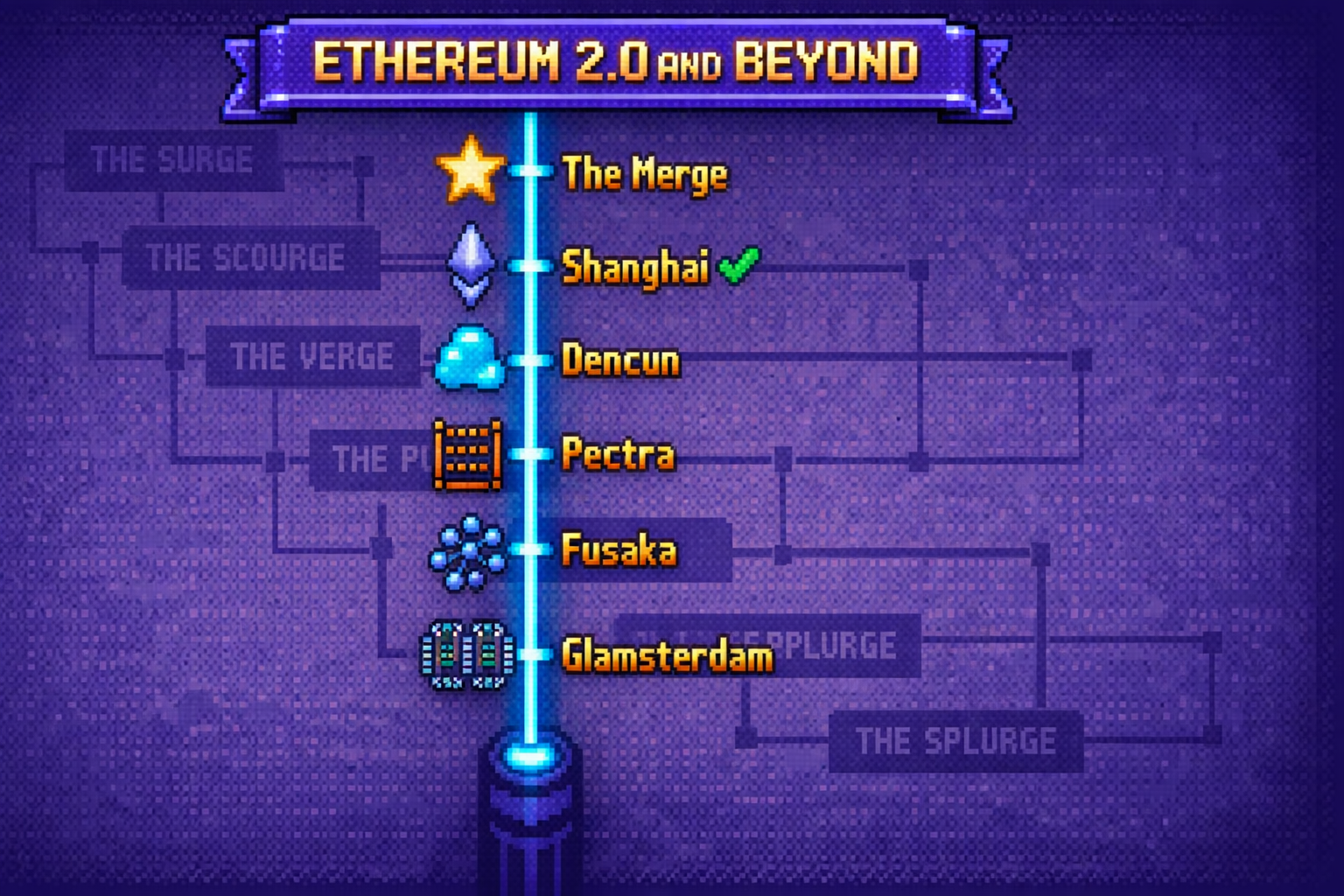
Since The Merge, Ethereum has already executed five such upgrades, each building on the last.
Timeline Graphic: The Merge (Sep 2022) → Shanghai (Apr 2023) → Dencun (Mar 2024) → Pectra (May 2025) → Fusaka (Dec 2025) → Glamsterdam (Mid‑2026) → Hegota (Late 2026)
The Six Phases of the Ethereum Roadmap
In July 2022, Ethereum co‑founder Vitalik Buterin described the network’s roadmap as six interconnected phases, each addressing a different aspect of Ethereum’s evolution.
| Phase | Status | Focus |
|---|---|---|
| The Merge | ✓ Completed | Transition from PoW to PoS; 99.95% energy reduction |
| The Surge | ✓ Ongoing | Scaling Ethereum via rollups; target 100,000+ TPS |
| The Scourge | ✓ Ongoing | Reducing MEV centralization and censorship risks |
| The Verge | ✓ Ongoing | Verkle Trees and stateless clients |
| The Purge | ✓ Ongoing | Pruning old data; simplifying the protocol |
| The Splurge | ✓ Ongoing | Smaller improvements: account abstraction, EVM upgrades |
The Surge: Layer‑2‑Focused Scaling
The Surge focuses on making rollups the primary scaling engine for Ethereum, with a target throughput of over 100,000 transactions per second via Layer 2 networks while maintaining decentralization of the base layer. Key technologies include EIP‑4844 (blob transactions), peerDAS (data availability sampling), and upcoming blob capacity expansions.
The Scourge: Fighting MEV Centralization
The Scourge addresses the growing influence of intermediaries in block production. MEV (Maximal Extractable Value) has created a competitive market dominated by sophisticated searchers and builders, threatening Ethereum’s decentralization. Upgrades like ePBS (enshrined Proposer‑Builder Separation) and inclusion lists are designed to mitigate these risks.
The Verge and The Purge: Lightweight Nodes
The Verge introduces Verkle Trees to dramatically reduce node storage requirements, enabling stateless clients that can verify the blockchain without storing its entire state. The Purge focuses on pruning old data and simplifying the protocol, making Ethereum easier to maintain over the long term.
The Splurge: “Everything Else”
The Splurge encompasses a collection of smaller but critical improvements: account abstraction (making wallets easier to use), EVM optimizations, and long‑term upgrades that don’t fit neatly into other categories.
Completed Upgrades: The Foundation
The Merge (September 2022)
What It Was: The Merge was Ethereum’s most significant upgrade to date, transitioning the network from energy‑intensive proof‑of‑work mining to proof‑of‑stake validation. It occurred on September 15, 2022, and is widely considered one of the most complex software upgrades in history, executed on a live, $200 billion network without interruption.
| Change | Before | After |
|---|---|---|
| Consensus mechanism | Proof‑of‑Work (mining) | Proof‑of‑Stake (staking) |
| Energy consumption | ~112 TWh/year | ~0.01 TWh/year |
| Reduction | – | 99.95% |
| Validator requirement | ASIC mining hardware | 32 ETH (anyone) |
What It Did NOT Do: The Merge did not directly lower transaction fees or increase transaction speed. It changed how the network is secured, not how much capacity it has. It also did not enable staking withdrawals That came later with Shanghai.
Lasting Impact: The Merge made Ethereum the most energy‑efficient major blockchain relative to its economic activity. It also transformed ETH into a yield‑bearing asset: stakers now earn ~3‑4% APY for securing the network, attracting institutional capital and fundamentally changing ETH’s investment thesis.
Shanghai/Shapella (April 2023)
What It Was: Shapella (Shanghai + Capella) enabled validator withdrawals for the first time. Early validators had locked ETH for years without any withdrawal option, creating a significant liquidity barrier to staking participation.
| Feature | Impact |
|---|---|
| Partial withdrawals | Validators could withdraw staking rewards above 32 ETH |
| Full exits | Validators could exit entirely, reclaiming their full stake |
| Staking queue management | Exit queues prevented mass exodus disruptions |
The Post‑Shapella Staking Boom: Within months of Shapella, staking participation surged. The ability to withdraw (counterintuitively) attracted more stakers, not fewer, as liquidity risk was eliminated. Staking rates climbed from under 15% to over 30% in the following years.
Legacy: Shapella completed Ethereum’s transition to a mature proof‑of‑stake ecosystem. Validators now had a complete lifecycle: stake, earn rewards, withdraw. This predictability was essential for institutional adoption.
Dencun (March 2024)
What It Was: Dencun (Deneb + Cancun) introduced proto‑danksharding (EIP‑4844), a major scaling upgrade for Layer 2 networks. It added temporary “blob” storage to Ethereum blocks, creating cheaper space for rollup data that no longer competes with regular transactions for block space.
| Traditional calldata | New blob storage |
|---|---|
| Stored permanently | Stored temporarily (~18 days) |
| Expensive | Cheap (90%+ reduction) |
| Competes with L1 transactions | Dedicated space for L2s |
The Impact on Layer 2 Fees: Before Dencun, rollup fees averaged $0.10‑0.50. After Dencun, fees dropped to $0.01‑0.05, a 90% reduction. This made DeFi accessible to millions of new users and enabled use cases previously impossible, such as micropayments and high‑frequency trading on L2s.
The Rollup‑Centric Roadmap in Action: Dencun was the first major implementation of Ethereum’s rollup‑centric scaling strategy. Rather than scaling the base layer itself, Ethereum would provide cheap data availability for rollups to settle on, effectively outsourcing execution while inheriting security.
Pectra (May 2025)
The Most Significant Upgrade Since The Merge: Pectra (Prague + Electra), activated in May 2025, was arguably the most significant Ethereum upgrade since The Merge. With 11 Ethereum Improvement Proposals (EIPs), it advanced the protocol’s scalability, staking, and account management capabilities simultaneously.
Key Changes
1. Account Abstraction (EIP‑7702) – This was Pectra’s headline feature. It allows externally owned accounts (EOAs) (the standard wallet type) to temporarily act like smart contract wallets. For users, this means.
- Apps can cover transaction fees (gasless transactions)
- Batch multiple transactions together
- Enable social recovery (no single point of failure)
- Use custom authentication methods
This dramatically reduces friction for onboarding new users and has been described as “key for onboarding the next wave of users to the Ethereum ecosystem.”
2. Expanded Validator Balance Limits (EIP‑7251) – Pectra raised a validator’s maximum effective balance from the rigid 32 ETH limit to 2,048 ETH (a 64x increase). For solo stakers, the minimum remains 32 ETH. But large stakers can now consolidate their stake across fewer validators, reducing operational overhead by up to 60%. This was a direct response to institutional demands and has been described as an “architectural pivot that fundamentally alters Ethereum’s consensus economics.”
3. Increased Blob Throughput – Pectra also expanded blob capacity, making Layer 2 solutions faster and cheaper, further strengthening Ethereum’s rollup‑centric roadmap.
The Impact on Withdrawals (EIP‑7002): Pectra accelerated withdrawals dramatically. Full validator exits are now processed via execution layer triggerable exits instead of the traditional oracle‑based method, reducing withdrawal times from roughly 13 hours to approximately 13 minutes.
Validator Economics Transformed: After Pectra, staking rewards now auto‑compound. They’re automatically added to the validator’s balance, increasing the effective stake over time. This results in slightly higher effective rewards for long‑term stakers.
Fusaka (December 2025)
The December 2025 Upgrade: Fusaka (Fukui + Osaka), activated in December 2025, introduced peerDAS, a critical step toward full data sharding. PeerDAS (Peer Data Availability Sampling) allows nodes to verify data availability without downloading entire blobs, dramatically improving L2 efficiency.
How peerDAS Works: Instead of requiring every node to store every blob, peerDAS uses a sampling mechanism where nodes randomly check pieces of data. This distributes the storage burden across the network while maintaining strong security guarantees.
The Path to Sharding: PeerDAS is considered a key milestone on the road to full danksharding, which will enable Ethereum to support hundreds of rollups with near‑infinite data capacity. Combined with Pectra’s blob expansion, L2 fees have dropped to historic lows (as low as $0.0027 per transaction).
2026 Upgrades: Glamsterdam and Hegota
Glamsterdam (Mid‑2026): Parallel Processing and ePBS
Overview: Glamsterdam, expected in the first half of 2026, represents a fundamental shift in Ethereum’s Layer 1 architecture. While previous upgrades focused on rollup scaling, Glamsterdam targets the base layer itself, introducing parallel transaction execution and enshrining Proposer‑Builder Separation (ePBS) directly into the consensus layer.
Key Feature #1: Parallel Transaction Execution (EIP‑7928)
For years, Ethereum executed transactions sequentially, one after another, like a single‑lane highway. This was simple and secure but wasted modern hardware’s parallel processing capabilities. Validators running 16‑core machines were using only one core for execution.
EIP‑7928, also known as Block‑Level Access Lists (BALs), changes this. Each block will include a map of which transactions access which accounts and storage slots. When two transactions are proven to be independent (for example, a Uniswap swap and an NFT mint accessing entirely different state) they can be executed simultaneously on multiple CPU cores.
This is Ethereum transforming from a single‑lane road into a multi‑lane highway. Combined with planned gas limit increases (from 60 million to 100 million initially, eventually 200 million after ePBS), raw throughput capacity will grow by 3.3x or more. Critically, smart contract developers do not need to modify a single line of code.
Key Feature #2: Enshrined Proposer‑Builder Separation (ePBS, EIP‑7732)
Currently, validators use an off‑chain system called MEV‑Boost to outsource block building to specialized “builders.” While functional, this system relies on trusted “relays” – centralized middlemen that introduce censorship risks and single points of failure.
ePBS eliminates the relay entirely. The handoff between proposers and builders becomes a native protocol operation, embedded directly into Ethereum’s consensus layer. Builders become first‑class participants. The relay layer (and all its centralization baggage) becomes unnecessary.
ePBS also enables something equally important: it buys time for validators to verify zero‑knowledge proofs. Ethereum Foundation researcher Justin Drake estimates that after ePBS, about 10% of validators may transition from re‑executing transactions to verifying ZK proofs, unlocking further gas limit increases.
Additional Glamsterdam Features
| EIP | Purpose |
|---|---|
| EIP‑7805 (FOCIL) | Validator committees can forcibly include specific transactions, directly combating censorship at the protocol level |
| EIP‑8007 (Gas Repricing) | Rebalances EVM gas costs to eliminate bottlenecks that have historically constrained scaling |
Hegota (Late 2026): Verkle Trees and Stateless Clients
Overview: Hegota, expected in the second half of 2026, introduces Verkle Trees, a new data structure that replaces Ethereum’s current Merkle Patricia trees. This is the centerpiece of The Verge phase and enables stateless clients, which can verify the blockchain without storing its entire state.
How Verkle Trees Work
| Merkle Patricia Tree (Current) | Verkle Tree (New) |
|---|---|
| Large proof sizes (kilobytes) | Tiny proofs (100‑200 bytes) |
| Full state storage required | Stateless verification possible |
| Node syncing takes days | Node syncing drops from days to minutes |
Why This Matters: Verkle trees dramatically reduce the amount of data a node must store and verify. With stateless clients, anyone can run a node on a modest computer or even a smartphone. This strengthens network decentralization by lowering the barrier to entry for validators and node operators.
Stateless clients have been described as a prerequisite for Ethereum’s long‑term decentralization. Hegota brings them within reach.
Additional Hegota Features
| Feature | Purpose |
|---|---|
| State/history expiry | Inactive data is archived, preventing unbounded state growth |
| Fork‑Choice Enforced Inclusion Lists (FOCIL) | Validator committees can forcibly include transactions, directly combating censorship. This forms part of the “Holy Trinity of Censorship Resistance” alongside ePBS |
| Native account abstraction (EIP‑8141) | Further wallet usability improvements, potentially replacing seed phrases with smart accounts |
The “Holy Trinity of Censorship Resistance”
Developers have described ePBS (from Glamsterdam), FOCIL, and other inclusion mechanisms as the “Holy Trinity of Censorship Resistance” (each closing a different gap in the transaction pipeline to ensure validators cannot selectively exclude transactions).
Ethereum in 2026: The State of the Network
Staking: 36 Million ETH and Counting
A Historic Milestone: In early 2026, Ethereum’s staking ratio surpassed 30% for the first time. Over 36 million ETH (worth approximately $120 billion at prevailing market prices) is now actively staked across the network, representing nearly one‑third of circulating supply.
The Institutional Shift: Institutional participation in staking surged from 31% in 2024 to 44% in 2025, driven by regulatory clarity from the SEC and IRS, and by staking‑as‑a‑service providers like Figment and Kiln building enterprise‑grade infrastructure.
The Pectra Effect: The Pectra upgrade’s validator limit expansion (from 32 to 2,048 ETH) enabled institutional stakers to consolidate their stake across fewer validators, reducing operational costs by up to 60%. By January 2026, 1.2 million new ETH had been staked, with inflows consistently surpassing outflows for six consecutive months.
Centralization Concerns: While high staking participation enhances network security, concentration remains a concern. Lido alone controls 24.2% of staked ETH with 8.72 million ETH staked, a level of dominance that critics argue represents a systemic risk to Ethereum’s decentralization. The top five liquid staking providers control nearly 18 million ETH (48% of the staked market).
Record Activity, Falling Fees
The Activity Paradox: Ethereum in 2026 is busier than ever (but fees have never been lower). Daily active addresses approached 2 million in February 2026, exceeding peaks seen during the 2021 bull market. Smart contract calls topped 40 million per day, and token transfers also set records.
Fee Compression: Transaction fees have fallen to historic lows, ranging from $0.0027 to $0.20 (levels not seen since May 2017). Swaps on the base layer now cost around $0.04, a dramatic reduction from the $50+ spikes of previous cycles.
Why Fees Are Down:
- Dencun’s blob storage dramatically reduced L2 costs, shifting activity off mainnet
- Fusaka’s peerDAS and blob expansions continued this trend
- Lower ETH price reduces dollar‑denominated gas costs
- Pectra’s efficiency improvements
The Disconnect Between Usage and Value: Despite record activity, Ethereum’s protocol revenue lags competitors. Over the past 30 days, Ethereum generated roughly $10.3 million in transaction fees, placing it third behind Tron ($25 million) and Solana ($20 million). On a revenue basis, Ethereum ranked fifth, behind Tron, Polygon, Base, and Solana.
Ethereum hosts approximately $162 billion in stablecoin supply (roughly 52% of the global market) yet this activity has not translated into proportional value capture for ETH itself.
Institutional Adoption: BlackRock ETHB and Beyond
The Landmark Launch: On March 12, 2026, BlackRock, the world’s largest asset manager, launched the iShares Staked Ethereum Trust ETF (ETHB) on Nasdaq, a historic milestone for Ethereum staking. The fund not only holds spot ETH but stakes 70‑95% of its holdings through Coinbase Prime, delegating to professional validators like Figment.
How ETHB Works:
| Component | Detail |
|---|---|
| Structure | ETF trades on Nasdaq |
| Staking | 70‑95% of ETH staked |
| Yield | Approximately 82% of staking rewards distributed to holders monthly |
| Fees | 18% of gross staking rewards retained by BlackRock + 0.25% annual sponsor fee (0.12% for first $2.5B) |
Why ETHB Matters: Before ETHB, Ethereum spot ETFs held ETH idlem (generating no yield). ETHB transforms ETH from a passive “store of value” into an active “interest‑bearing asset,” addressing the core opportunity cost that had kept some institutions on the sidelines. BlackRock’s existing Ethereum spot ETF (ETHA) holds approximately $12 billion in assets.
The Broader Institutional Picture: Total assets under management across all U.S. spot Ethereum ETFs now stand at $12.33 billion – representing 4.79% of Ethereum’s total market capitalization. However, Ethereum ETF penetration lags Bitcoin’s, and recent weeks have seen net outflows as the ETH/BTC ratio hits multi‑year lows near 0.03.
Grayscale’s Precedent: Grayscale became the first U.S. issuer to distribute staking rewards directly to shareholders in cash, paying over $9 million in January 2026.
The Strategic Pivot: Why Vitalik Is Rethinking Rollups
The Statement That Shook Ethereum
In February 2026, Ethereum co‑founder Vitalik Buterin declared that the original “rollup‑centric roadmap” (which had positioned Layer 2 networks as Ethereum’s primary scaling engine) “no longer makes sense.” The statement ignited immediate debate across the crypto ecosystem.
What Changed?
According to Buterin, two major developments reshaped Ethereum’s scaling landscape:
1. Slower‑Than‑Expected L2 Decentralization – Progress toward fully decentralized and interoperable L2s has been “far slower and more difficult than originally expected.” Some L2s have deliberately chosen not to advance beyond early decentralization stages due to regulatory or commercial considerations.
2. Ethereum’s L1 Is Scaling Faster Than Expected – With transaction fees currently low and major gas limit increases expected in 2026, reliance on L2s for basic scalability has diminished. Buterin stressed that L2s were meant to provide “large quantities of block space backed by the full faith and credit of Ethereum”, but high‑throughput chains connected through simple multisig bridges do not truly “scale Ethereum” in a meaningful way.
A New Framework: From “Branded Extensions” to a Spectrum of Networks
Rather than treating L2s as official extensions with special social status, Buterin proposed a new framework: view L2s as part of a “full spectrum” of networks with varying degrees of trust, security, and integration with Ethereum. Under this model, users would choose networks based on their needs, while L2 teams would be expected to clearly communicate what guarantees (or trade‑offs) their systems provide.
How L2s Must Evolve
To remain relevant, Buterin urged L2s to move beyond simple scaling and develop distinct value propositions:
- Privacy‑focused or application‑specific virtual machines
- Extreme throughput or ultra‑low latency designs
- Non‑financial or specialized use cases
- Built‑in oracles or dispute‑resolution mechanisms
Native Rollup Precompiles
Buterin also advocated for Ethereum to introduce a native rollup precompile, allowing trustless verification of ZK‑EVM proofs. Such a change could improve interoperability and composability while upgrading automatically alongside Ethereum’s core protocol.
Ecosystem Reactions
Buterin’s remarks sparked immediate debate across the ecosystem. Some L2 teams defended their progress; others acknowledged the challenges. The debate continues to shape Ethereum’s scaling discourse in 2026.
The Long‑Term Roadmap: 2027–2030 and Beyond
Hyper‑Scaling: 2‑Second Finality and Gigagas
Vitalik’s 2026‑2029 Vision: Buterin has outlined an ambitious scaling vision for the remainder of the decade. The goal is to move from the current ~60‑100 million gas per block toward 5× increases initially, and eventually up to 1000×.
| Technology | Purpose |
|---|---|
| New temporary/periodic state storage formats | Reduce node storage requirements |
| ZK‑EVM verification | Trustless proof verification |
| ePBS (enshrined Proposer‑Builder Separation) | MEV mitigation |
| BALs (Block Access Lists) | Parallel transaction execution |
| Blob‑based scaling | Expanded L2 data capacity |
2027: Wider adoption of ZK technology and higher gas limits are expected. The Hegota upgrade (2026) introduces native account abstraction (EIP‑8141), potentially replacing seed phrases with smart accounts.
2029: By 2029, Ethereum aims to achieve:
- Faster block slots (2‑4 seconds)
- Finality in 6‑16 seconds (down from ~15 minutes)
- Throughput reaching gigagas levels (billions of gas per second)
Quantum Resistance: Preparing for the Next Computing Era
The Quantum Threat: Ethereum Foundation researcher Justin Drake is leading a dedicated post‑quantum team working on cryptographic countermeasures against potential quantum computer attacks. Four key vulnerabilities have been identified:
| Vulnerability | Component | Mitigation |
|---|---|---|
| BLS signatures | Consensus layer | Hash‑based signature systems |
| KZG commitments | Data availability | STARK‑based proofs |
| ECDSA signatures | Wallets (EOAs) | Hash‑based signatures |
| ZK proof systems (Groth16/KZG) | Zero‑knowledge proofs | STARK‑based proofs |
Timeline: Early steps begin 2026‑2027, with full quantum resistance targeted by 2029. The “Lean Ethereum” long‑term plan aims to deploy post‑quantum cryptography algorithms between 2028 and 2032.
AI in Ethereum Development
The AI Acceleration: Buterin has noted that AI is already influencing Ethereum development. A developer recently prototyped much of the roadmap to 2030 within weeks using AI tools. Buterin proposes that half of AI productivity gains should be reinvested into testing and formal verification, improving both the speed and reliability of releases.
Our Verdict: Where Is Ethereum Headed?
Summary Assessment
Ethereum in 2026 is at a fascinating inflection point. The technical foundations are stronger than ever (over $120 billion in staked ETH), record network activity, fees at historic lows, and a clear upgrade roadmap through the end of the decade. Yet the network faces genuine challenges: ETH’s price has lagged despite usage growth, ETF outflows have persisted, and Vitalik’s reassessment of the rollup‑centric roadmap signals that the scaling strategy itself is being rethought.
The Winners by Category
| Category | Outlook |
|---|---|
| Technical development | Strong – clear upgrade cadence, active research |
| Network security | Strong – 30% staking participation, institutional validators |
| User experience | Improving – account abstraction, lower fees |
| Institutional adoption | Growing but uneven – ETHB launched, but ETF outflows continue |
| ETH value capture | Challenged – activity doesn’t translate to price |
| Decentralization | At risk – Lido dominance (24%), L2 centralization |
The Bottom Line
Ethereum is no longer a single “2.0” project with a fixed endpoint. It’s a continuously evolving ecosystem, with upgrades every six months, new research pushing boundaries, and fierce debates about its direction. This uncertainty is not weakness (it’s the price of being a living, decentralized platform). For long‑term believers, the roadmap remains compelling. But the days of assuming “upgrades = price appreciation” are over. Ethereum’s value proposition now depends on building applications people actually use, not just on promising future features.
Final Thought
From The Merge to Glamsterdam to quantum resistance, Ethereum’s evolution is far from over. The “2.0” label is gone, but the ambition remains: a global, decentralized computer that anyone can use, accessible to billions. The next few years will determine whether that vision becomes reality, or whether the complexities of governance, centralization, and value capture prove too great. Watch the upgrades, but watch the applications more closely.
Disclaimer: This guide is for educational purposes only and does not constitute financial advice. Cryptocurrency investments, including ETH, involve significant risk. Upgrade timelines are estimates and subject to change.
This guide was last updated for the 2026 edition. Ethereum upgrades, EIPs, and market data change frequently. Always verify current information from official sources.
Frequently Asked Questions
What are the six phases of the Ethereum roadmap?
In July 2022, Vitalik Buterin described six phases: The Merge (completed), The Surge (scaling via rollups), The Scourge (MEV mitigation), The Verge (Verkle Trees), The Purge (state pruning), and The Splurge (miscellaneous improvements). These phases progress in parallel; multiple are ongoing simultaneously.
How many upgrades has Ethereum had since The Merge?
Five major upgrades: Shanghai/Shapella (April 2023, enabled staking withdrawals), Dencun (March 2024, introduced blob storage), Pectra (May 2025, account abstraction + validator limit expansion), and Fusaka (December 2025, peerDAS). Glamsterdam and Hegota are expected in 2026.
What is the Pectra upgrade?
Pectra (May 2025) was the most significant upgrade since The Merge, featuring 11 EIPs. Key changes include account abstraction (EIP‑7702, enabling gasless transactions), validator balance limits expanded from 32 to 2,048 ETH (EIP‑7251), and accelerated withdrawals from 13 hours to 13 minutes (EIP‑7002).
What is ePBS in Ethereum?
ePBS (enshrined Proposer‑Builder Separation, EIP‑7732) formalizes the split between proposing and building blocks at the protocol level, eliminating reliance on centralized MEV relays. This reduces censorship risks and MEV‑driven centralization. It is a core feature of the Glamsterdam upgrade (mid‑2026).
What are Verkle trees?
Verkle trees are a new data structure replacing Ethereum’s current Merkle Patricia trees. They enable dramatically smaller proofs, allowing stateless clients (nodes that verify the blockchain without storing its entire state). This reduces storage requirements by up to 90% and is the centerpiece of the Hegota upgrade (late 2026).
How much ETH is staked on Ethereum in 2026?
Over 36 million ETH (worth approximately $120 billion) is currently staked, representing about 30% of circulating supply. Institutional participation in staking surged to 44% in 2025, up from 31% in 2024.
What is Vitalik’s new roadmap for Ethereum?
In February 2026, Buterin declared that the original rollup‑centric roadmap “no longer makes sense.” Faster L1 scaling and stalled L2 decentralization have reduced L2s’ role. He now proposes viewing L2s as part of a “full spectrum” of networks and urges L2s to develop specialized value propositions beyond simple scaling.
Is Ethereum quantum resistant?
Not yet. The Ethereum Foundation has launched a dedicated post‑quantum team led by researcher Justin Drake, targeting full quantum resistance by 2029. Four key vulnerabilities are being addressed with hash‑based and STARK‑based alternatives.
When will Ethereum reach 100,000 TPS?
Ethereum’s scaling strategy aims for 100,000+ TPS through Layer 2 rollups (The Surge phase). Base layer TPS is expected to reach 10,000+ after Glamsterdam (mid‑2026) due to parallel execution and gas limit increases. Full 100,000+ TPS via rollups is targeted by 2027‑2028.
What is the BlackRock ETHB ETF?
Launched March 12, 2026, ETHB is BlackRock’s staked Ethereum ETF trading on Nasdaq. It stakes 70‑95% of its ETH holdings through professional validators, distributing approximately 82% of staking rewards to holders monthly. It’s the first mainstream ETF to combine spot ETH exposure with on‑chain yield.
What is peerDAS?
peerDAS (Peer Data Availability Sampling), introduced in the Fusaka upgrade (December 2025), allows nodes to verify data availability without downloading entire blobs. It’s a critical step toward full danksharding and has helped reduce L2 fees to historic lows.
Why are Ethereum fees so low despite record activity?
Multiple factors: Dencun’s blob storage shifted L2 data off mainnet; Fusaka’s peerDAS improved data availability; lower ETH price reduces dollar‑denominated gas costs; and activity has shifted to rollups rather than the base layer. Base layer fees now range from $0.0027 to $0.20.
What is FOCIL?
FOCIL (Fork‑Choice Enforced Inclusion Lists) is a censorship resistance mechanism where validator committees can forcibly include specific transactions at the protocol level. It’s currently slated for the Hegota upgrade (late 2026) and forms part of the “Holy Trinity of Censorship Resistance” alongside ePBS.
Will Ethereum ever have sharding?
The original sharding concept has evolved into danksharding, a combination of blob storage (already live via Dencun), peerDAS (live via Fusaka), and future data availability sampling upgrades. Full danksharding is expected in phases through 2027‑2028, enabling hundreds of rollups with near‑infinite data capacity.
About the Author