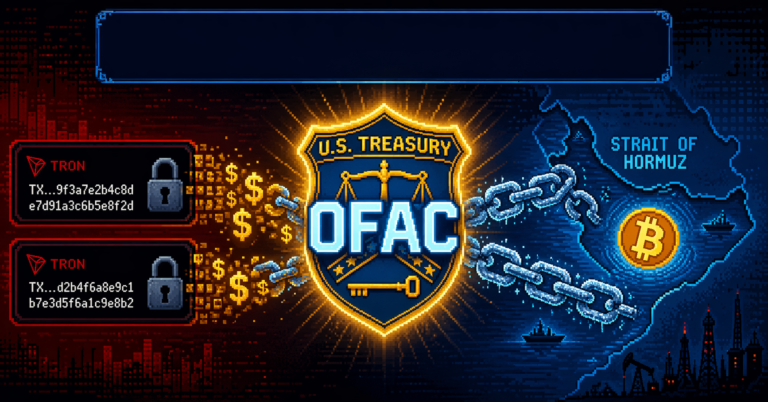
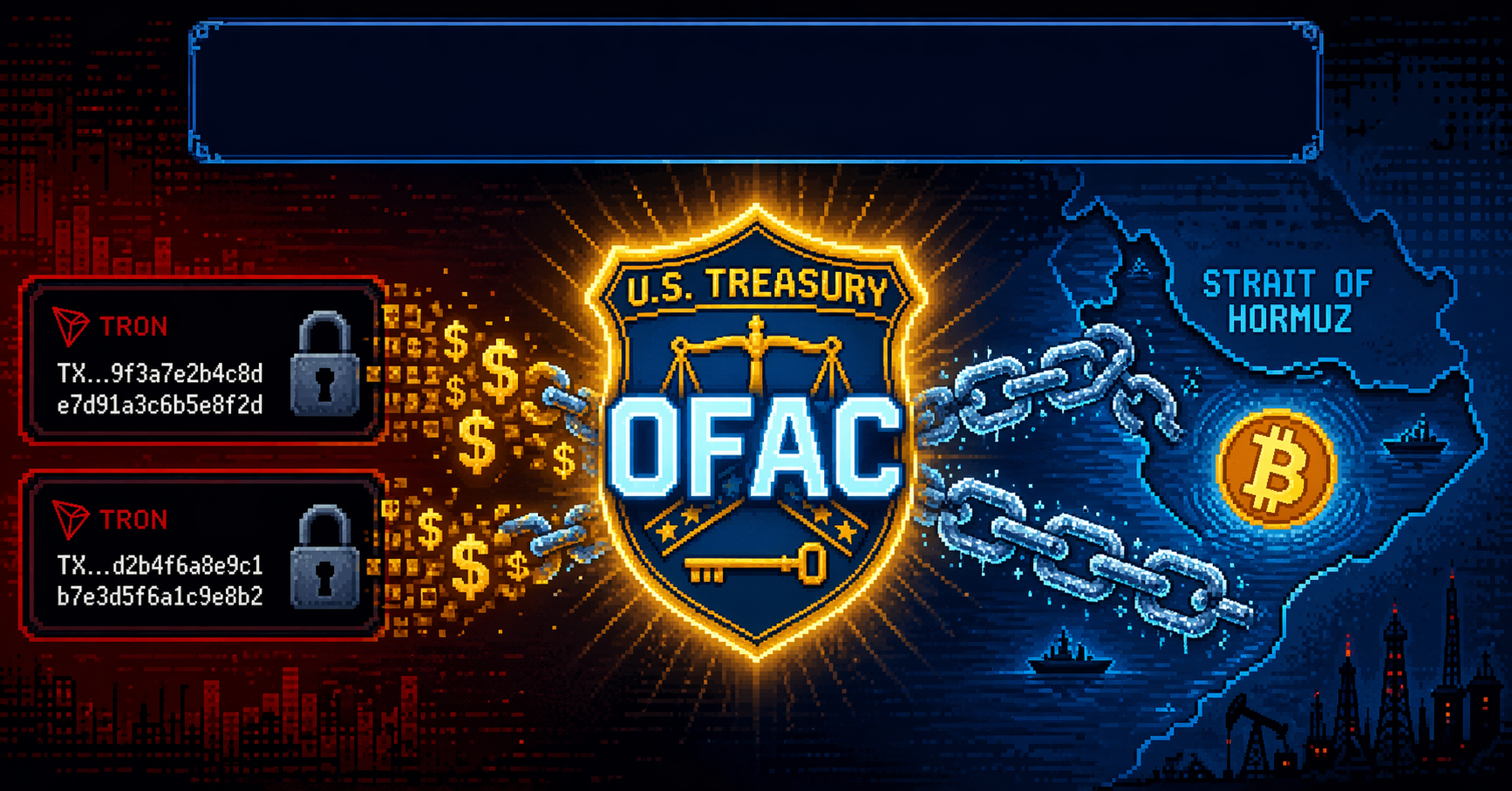
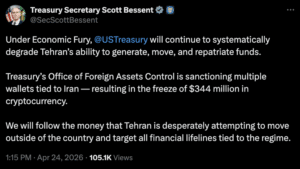
On April 24, 2026, the U.S. Treasury Department’s Office of Foreign Assets Control (OFAC) froze approximately $344 million in cryptocurrency held in two wallets on the Tron blockchain, the largest on‑chain freeze of Iranian sovereign crypto reserves on public record. Treasury Secretary Scott Bessent announced the action as part of “Economic Fury,” a broader campaign to systematically degrade Tehran’s ability to generate, move, and repatriate funds.
Just hours earlier, on April 23, stablecoin issuer Tether had frozen the same two wallets in coordination with OFAC and U.S. law enforcement, marking Tether’s single largest compliance action to date. Together, the two actions represent the most aggressive digital asset enforcement targeting a sovereign state in the history of the crypto industry.
Timeline of Events
| Date | Event |
|---|---|
| April 23, 2026 | Tether freezes two Tron wallets holding a combined $344 million in USDT on the Tron blockchain in coordination with OFAC and U.S. law enforcement – Tether’s largest single enforcement action to date. |
| April 24, 2026 | Treasury Secretary Scott Bessant announces that OFAC is “sanctioning multiple wallets tied to Iran, resulting in the freeze of $344 million in cryptocurrency” as part of a broader campaign dubbed “Economic Fury.” |
| April 24, 2026 | OFAC updates its Specially Designated Nationals (SDN) list to formally designate the two Tron addresses as property of the Central Bank of Iran, with linkages to the IRGC‑Qods Force and Hizballah. |
| April 24, 2026 (same day) | The Treasury Department simultaneously sanctions Hengli Petrochemical (Dalian) Refinery Co. (a major Chinese oil importer) and nearly 40 “shadow fleet” shipping companies. The action also blocks approximately $344 million in crypto. |
Why This Freeze Matters – Size, Coordination, and Precedent
| Metric | Value | Significance |
|---|---|---|
| Total frozen | $344.2 million | Largest on‑chain freeze of Iranian sovereign crypto reserves on public record |
| Tether single‑enforcement record | Surpassed | Previous high was $182 million in January 2026 (a five‑wallet freeze) |
| Lifetime Tether freezes | More than $4.4 billion | Over $2.1 billion of that connected to U.S. law enforcement |
The freeze demonstrates that stablecoin transparency now has teeth. The same traceability that makes USDT (and USDC) the most liquid on‑ramp to DeFi also makes them vulnerable to asset freezes when wallets are placed on the SDN list. Sanctions compliance is now a hardwired feature of the largest dollar‑denominated digital assets.
Details of the Frozen Wallets: On‑Chain Analysis
| Tron Address | Amount Frozen (approx) | Behavior Profile |
|---|---|---|
| Wallet 1 | $213 million | Zero outbound transfers; pure accumulation |
| Wallet 2 | $131 million | Received $229M; moved only $15.7M out (less than 7% outward movement) |
Additional on‑chain forensic findings:
- The freeze applied at the smart contract level, not the exchange level. Meaning Tether permanently blacklisted the addresses.
- According to Chainalysis, the two wallets were regularly active years ago but had gone nearly dormant – consistent with strategic reserve storage (accumulating funds and holding them), not daily operational use.
- The wallets collectively received approximately $370 million across nearly 1,000 transactions over more than five years, with inflows beginning in March 2021. Accumulation largely concluded by late 2023, after which both balances sat nearly undisturbed until the freeze.
- Outbound activity across both wallets totaled just $25 million over their lifetimes (less than 7% of the volume received, a profile consistent with sovereign reserve storage).
How the Freeze Happened. Technical and Legal Framework
- Tether froze the wallets on April 23 in direct coordination with OFAC and U.S. law enforcement, after authorities shared intelligence linking the addresses to unlawful conduct and sanctions evasion.
- OFAC formally sanctioned the wallets the following day, adding the two Tron addresses to its SDN list and designating them as property of the Central Bank of Iran, with links to the IRGC‑Qods Force and Hizballah.
- Treasury’s broader “Economic Fury” campaign includes simultaneous pressure on Iran’s traditional oil sector, freezing Chinese refinery assets, and targeting shadow‑fleet tankers that attempt to bypass the maritime blockade.
Key point: The freeze was applied at the smart contract level on Tron, proving that USDT on Tron can be frozen at the protocol level regardless of the underlying blockchain.
Behind the Freeze: A Multi‑Year Chain of Sanctions Escalation
- Mid‑2025: Iran’s IRGC shifted an estimated $1 billion through newly created UK exchanges Zedcex and Zedxion, mostly in USDT on Tron. Tether eventually froze 42 IRGC‑related addresses, the largest enforcement action to that date, establishing the blueprint for April 2026.
- January 30, 2026: OFAC announced sanctions against IRGC‑linked financial facilitators and designated Zedcex and Zedxion (both UK‑registered) as Specially Designated Nationals for the first time (the first time OFAC moved against Iran‑linked digital asset exchanges).
- March 2026: The UK Companies House began proceedings to strike off Zedxion Exchange after an OCCRP investigation revealed the company used a stock‑photo model to mask its relationship with sanctioned Iranian billionaire Babak Zanjani.
- April 23‑24, 2026: The freeze of the two Tron wallets as the most direct strike yet against Iran’s crypto‑based reserve architecture.
The Bigger Picture: The Strait of Hormuz and Bitcoin Tolls
- Iran has reportedly begun charging ships passing through the Strait of Hormuz in Bitcoin. According to the Financial Times, Iran is accepting bitcoin as a form of payment for transit fees on oil tankers traversing the strait (a critical global energy chokepoint through which roughly 20% of the world’s oil passes).
- According to Forbes, Iran had already banked revenue from the crypto tolls by April 23. The same day Tether executed its freeze.
- According to Chainalysis, total crypto holdings in Iran reached approximately $7.8 billion in 2025, with the IRGC itself accounting for roughly half of those holdings.
Tether’s Evolving Role as a Crypto Compliance Partner
Tether has now frozen $4.4 billion in total assets linked to illicit activity, with $2.1 billion of that tied to U.S. law enforcement. The company now works with more than 340 law enforcement agencies across 65 countries, supporting more than 2,300 cases globally (1,200 of them directly with U.S. authorities).
The April 2026 freeze surpasses Tether’s own previous high of $182 million in January 2026 (a five‑wallet freeze). The consistent escalation in scale suggests that Tether and U.S. authorities have built a reliable, repeatable mechanism for identifying and freezing Iran‑related crypto assets.
Implications for Crypto Users
- Stablecoin transparency now has teeth. The same traceability that makes USDT (and USDC) the most liquid on‑ramp to DeFi also makes them vulnerable to asset freezes when wallets are placed on the SDN list.
- Tron is not a privacy shield. Both frozen wallets were on the Tron blockchain (a network sometimes marketed as faster and cheaper than Ethereum). USDT on Tron can be frozen at the smart contract level, regardless of the underlying chain.
- OFAC will target holding addresses, not just exchange wallets. The frozen wallets were accumulation addresses designed for storage, not operational hubs. This marks an expansion of sanctions enforcement into long‑term reserve positions.
- Geopolitical risk is now on‑chain risk. The linkage between crypto holdings and geopolitical events is no longer theoretical. A holder of USDT in any jurisdiction could have their assets effectively frozen if their wallet address were ever designated for activities deemed a threat to U.S. national security (a possibility that institutional compliance officers will now be forced to weigh seriously).
🎟️ Coinfest Asia 2026 – 20% Discount for Our Readers
The world’s largest crypto festival returns to Bali on August 20‑21, 2026!
Join 15,000+ attendees, 400+ speakers, and 6,000+ companies from 90+ countries. Topics include blockchain innovation, Web3 adoption, tokenized assets, institutional digital asset compliance, and crypto‑focused regulatory frameworks.
👉 Use promo code A20ARTAKG at checkout for 20% off all ticket types.
About the Author
Cryptomaniac has been covering crypto‑regulatory intersection since 2020, with a focus on sanctions enforcement, blockchain forensics, and stablecoin compliance. They have tracked the evolution of Tether’s freeze mechanisms and OFAC’s digital asset designations through multiple enforcement cycles.
Disclaimer: This article is for informational purposes only and does not constitute legal or financial advice. Sanctions compliance is complex; consult a qualified professional for specific guidance.
This article was last updated April 25, 2026. Developments in sanctions and crypto enforcement occur rapidly. Always consult official OFAC announcements and legal counsel for current guidance.
About the Author